01
Define the service boundary before drawing the sample route
Start with a service-scope register rather than a generic list of chemistry, microbiology, and instrument rooms. For each offered or planned service, record the matrix, test family, sample quantity range, expected condition, reporting claim, responsible technical role, required environment, external provider, and whether the work is inside, outside, or pending the laboratory's recognized scope. ISO describes ISO/IEC 17025 as a framework for competence, impartiality, and consistent operation; NIST also ties accredited claims to specific activities and locations. The layout should make those service boundaries visible in work allocation and records without implying that a building arrangement itself grants accreditation.
Convert the register into two or three realistic daily arrival scenarios: a normal batch, a peak courier window, and an exception-heavy day. Trace each package from the public hand-over point to receipt, inspection, acceptance decision, identification, controlled storage, subdivision, preparation, analysis, result review, retention, transfer, return, or disposal. Add work that stops before analysis because the request, matrix, quantity, condition, seal, or method is unsuitable. This reveals the actual interfaces that need space, authority, and information support, rather than assuming every delivered item immediately becomes an analyst's sample.
02
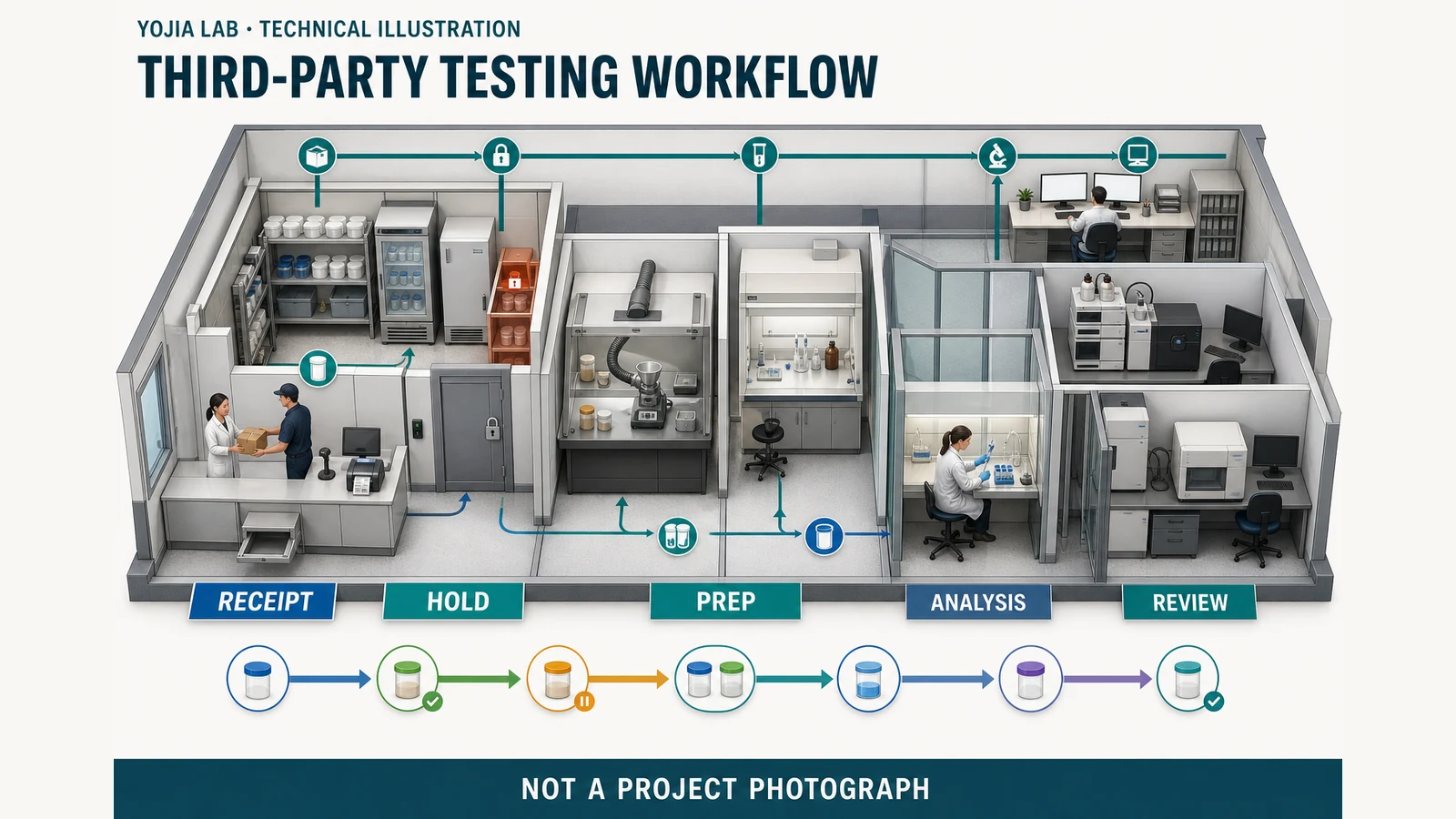
Make receipt an operational control point, not a reception desk
The sample-receipt zone needs an exterior hand-over edge and a controlled laboratory edge. Between them, provide room for package counting, document review, condition inspection, label generation, temporary temperature protection, safe opening where permitted, and communication with the client or technical reviewer. The FDA laboratory manual illustrates a rigorous model: receipt is recorded by an authorized custodial role, package identity and condition are checked against records, and broken seals, leakage, thawing, or conflicting numbers are documented for resolution. A commercial laboratory should develop its own approved procedure, but the spatial lesson is that unverified packages should not drift directly onto preparation benches.
Give exceptions physical states. Separate unopened arrivals, accepted samples awaiting dispatch, urgent cold items, administrative holds, condition-related quarantine, returns, and materials awaiting a hazard decision by labels, locations, permissions, and time limits appropriate to the operation. Do not size quarantine as one token cabinet. Use arrival frequency, peak batch size, typical client-response time, temperature classes, package dimensions, and the credible duration of a LIMS or communication outage. The route should also allow a rejected or misdirected package to leave without crossing clean preparation or retained-sample areas.
03
Separate preparation streams by interference and state change
Department names are too coarse for workflow zoning. Build a method-family matrix that asks what each operation releases, what can contaminate it, how the sample changes, and which cleaning or waste route follows. Dust-generating size reduction, wet digestion, volatile-solvent extraction, microbiological opening, trace-level aliquoting, sensory preparation, and dry precision weighing can create incompatible adjacency even if several activities belong to the same customer project. Conversely, two methods may share a room when their hazards, contamination controls, environmental needs, scheduling, cleaning, and evidence requirements have been deliberately reconciled.
Use thresholds and controlled hand-offs rather than decorative arrows. Define where an original item becomes a split, where a subsample becomes a prepared extract, which container and ID follow each portion, who may release it to the next room, and what happens to the reserve. The WHO sample-management training material treats collection, transport, storage, integrity, and final disposal as one managed path. For a multi-client laboratory, that path should include in-process holding locations, rework or repeat-test decisions, interlaboratory transfer, and waste status so that benches do not become informal storage for ambiguous material.
04
Link physical custody, information, and controlled access
Every doorway or transfer hatch that changes custody should have a matching information event. Define the minimum record for receipt, movement, split, preparation, analyst issue, return to storage, external transfer, and disposition; then decide where scanners, label printers, workstations, and manual contingency forms are actually used. The FDA example includes documented transfers and a computer-contingency plan when its primary system is unavailable. The design implication is not to copy that system, but to prevent an attractive digital workflow from collapsing when a device, network, power supply, or label printer is unavailable at the physical hand-off point.
Confidentiality and impartiality also affect circulation. Couriers need a clear delivery route, clients or witnesses may need a controlled observation point, assessors need evidence access, and maintenance staff need service access without receiving unrestricted exposure to other clients' samples or records. Use role-based doors, screened waiting or witness areas, lockable sample storage, visible status conventions, and supervised routes that match the laboratory's policy. Avoid an isolated show corridor that interferes with work; the goal is to support legitimate observation and service while keeping sample custody, personnel safety, and client information under defined control.
05
Commission the exception paths and govern scope change
Commissioning should test the laboratory as a connected sample-control system. Run scripted trials for a normal receipt, a broken package, an urgent cold item, a disputed identifier, a split sent to two technical sections, a returned reserve, a subcontracted test, a LIMS outage, a local exhaust alarm, and a storage-temperature excursion. Check that the assigned person can identify the sample state, take the authorized action, record the hand-off, and keep unrelated work protected. Room finishes and equipment start-up remain important, but they do not demonstrate that custody and exception handling work across organizational boundaries.
Third-party service portfolios change, so establish a change gate before accepting a new matrix, method, instrument, client claim, or volume profile. Review scope language, competence, reference methods, sample hazards, interference, utilities, environmental control, storage, waste, data paths, access, maintenance, and reporting before the commercial promise is released. Keep connection capacity and adaptable work zones where evidence supports them, but do not reserve vague empty space as a substitute for analysis. Post-occupancy review should compare actual arrival peaks, holds, repeats, cross-room movements, and exception times with the design assumptions and trigger controlled correction when they diverge.