01
Sort the client jobs before counting enclosures
OSHA’s laboratory-standard fact sheet describes laboratory use as handling containers one person can manage, using multiple chemicals or procedures, and staying off a production process. The same sheet lists product quality-control testing among activities that are not covered by that standard. A contract laboratory often sells both kinds of work. The chemical fume hood line should say which job families the employer has placed under a chemical hygiene plan and which families follow another program. One hood symbol does not make that split.
Where the laboratory standard does apply, the fact sheet says the employer writes a chemical hygiene plan and names chemical fume hoods as an example of an engineering control in that plan. Responsible people are designated, and the plan is revisited. Those duties stay with the employer. If a reviewed method needs a glove box or some other device instead of a hood, the reviewers write that choice. Leave the quantity blank until the split is on the register.
02
Put the plugs outside the chamber
The National Academies’ chapter on laboratory equipment tells users to locate receptacles that feed work inside a chemical hood on the outside of the enclosure. Plugging and unplugging then happens outside the vapor space, and a person can disconnect the device from outside if something goes wrong. Cords should not be easy to trip over or yank loose. Where the hood has a bottom airfoil, the chapter says to route the cords under it so the sash can close all the way.
Stirrers and heating baths in that space can ignite flammable vapor if they spark. The same chapter asks for spark-free devices that can be switched from outside the hood. OSHA’s chemical fume hood quick facts add a power-failure action plan for extremely hazardous chemicals, and they say not to store chemicals permanently inside the hood. The register names who owns that plan. Overnight bottles are storage, not a reason to widen the enclosure.
03
Count the floor in front as part of the hood
A CDC training transcript on chemical fume hood airflow says work near the front is more likely to leak, and that large equipment inside the chamber blocks the flow. A person walking past an open hood can pull contaminants out. In a third-party laboratory the busiest movement is often a sample cart. Draw a clear strip in front of the chemical fume hood and park carts off that strip.
Treat this as a room fact, not as a velocity target. The transcript explains how walking and clutter disturb containment. It is not a performance figure for a purchased enclosure, and it does not state how wide this building’s aisle must be. Measure the path that actually arrives, including the cart, and write the width the laboratory will keep clear. If that width is missing, change the layout before the hood is ordered.
04
Ask about spare exhaust without copying another owner’s rule
NIH’s July 2010 laboratory note, written for NIH facilities, says that before a retrofit adds or replaces a fume hood the engineer checks whether the existing supply and exhaust can carry it, and that this finding is approved before design goes on. The same note says NIH’s on-site protocol is run independently of both the hood manufacturer and the control-system manufacturer. Auxiliary-air hoods are not used in NIH facilities. Those sentences belong to NIH projects.
A private testing laboratory does not inherit them by citing the note. Use the note as a question list: has anyone checked spare exhaust and makeup capacity, who will test the installed chemical fume hood, and is an auxiliary-air type acceptable in this building? Missing answers stay open. Do not copy a face-velocity figure from an NIH manual onto this drawing. This article does not publish one, because another owner’s criterion is not this room’s criterion.
05
Freeze only the rows that already have an owner
A quotation can freeze the number of chemical fume hoods the employer has already assigned to named job families, the sash type, the fixtures those methods actually list, and the side where receptacles sit outside the chamber. It can show the clear strip in front. It cannot freeze a face velocity, a certification outcome, or a claim that the enclosure has passed a named test in this room. Reference model codes in an inquiry identify the conversation. They are not evidence of a test in this building.
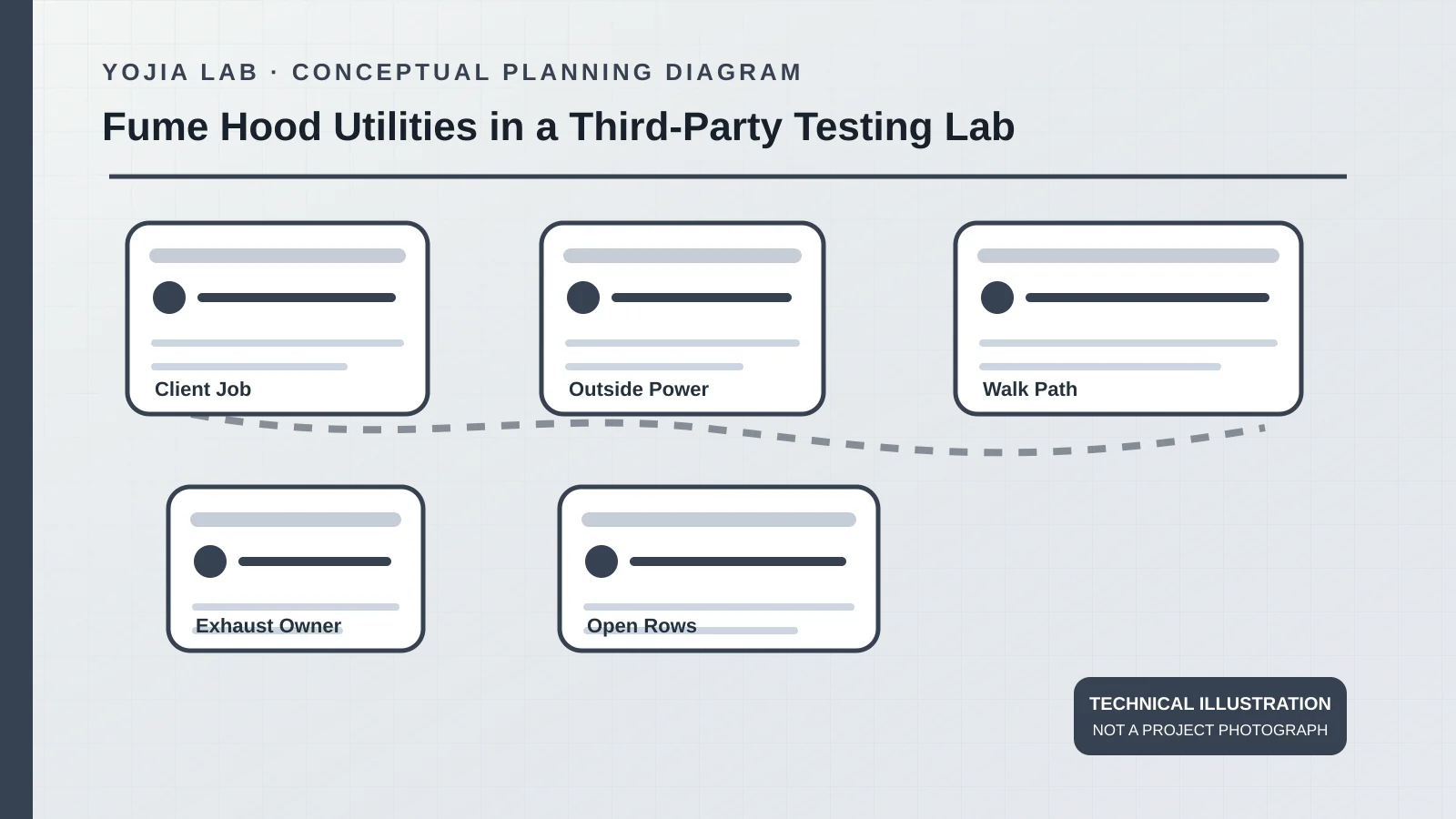
Send the register with the sketch. Each blank row still belongs to the employer, the building engineer, or the client method. When a later client brings a new digestion, add a row. Do not silently reuse yesterday’s hood. The drawing on this page is a planning diagram of those rows. It is not a photograph of an installed chemical fume hood and not a balance report.
Before pricing, place the room interface, quantities, and service points for the laboratory fume hood configuration with the workflow notes above. Airflow, performance, and compliance stay with the project's responsible reviewers.