01
The method hoods the bath and the oven
Method 3540C, Revision 3, December 1996, extracts nonvolatile and semivolatile organics from soils, sludges, and wastes. Ten grams of sample are blended with 10 g of anhydrous sodium sulfate and extracted 16–24 hours at 4–6 cycles per hour in about 300 mL of solvent. Soil and sediment use acetone/hexane (1:1) or methylene chloride/acetone (1:1). The method notes that acetone/hexane has lower disposal cost and lower toxicity. That note does not cancel the hood sentences. Other samples use methylene chloride, or toluene/methanol (10:1), all at pesticide quality or equivalent.
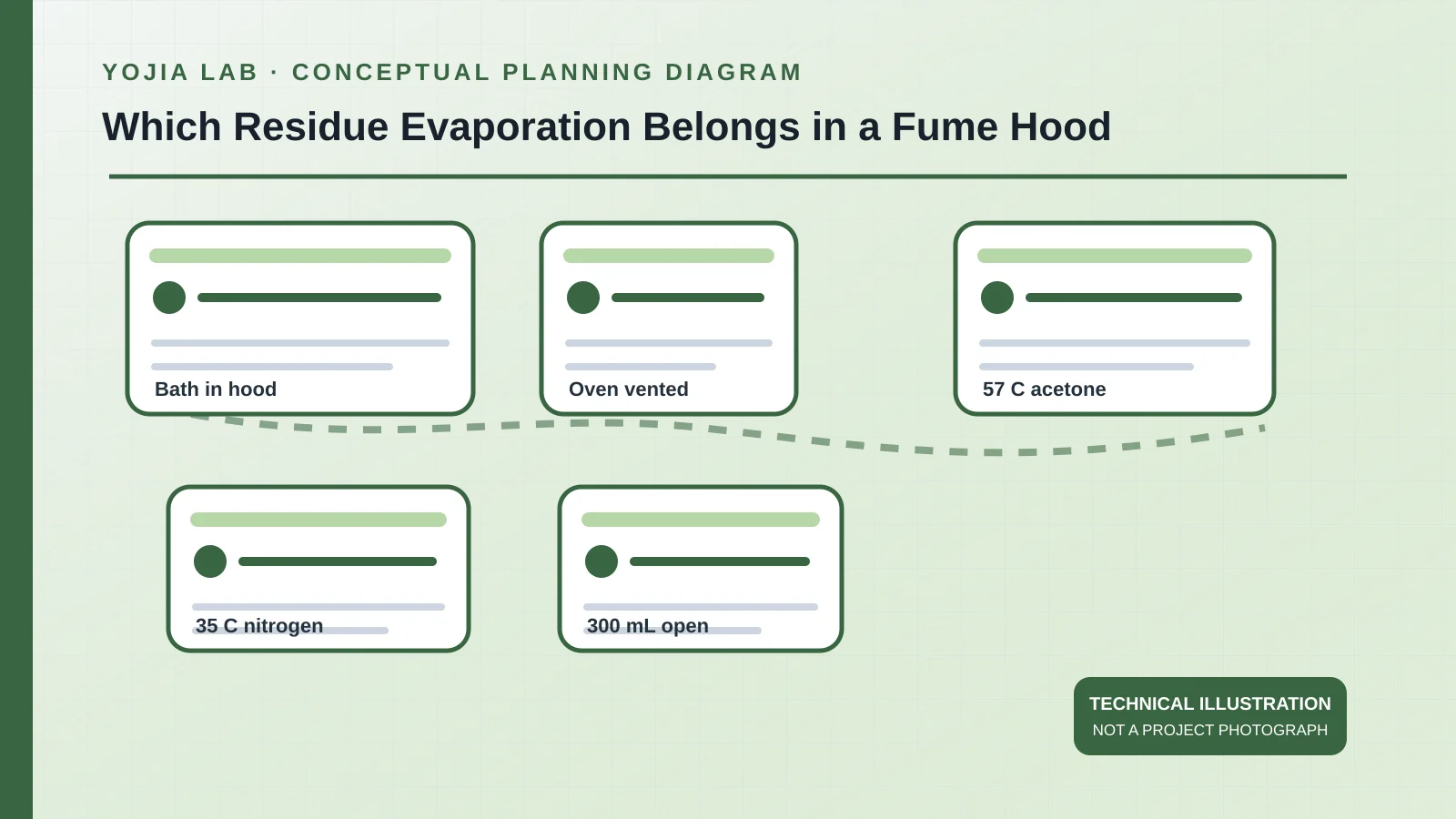
Section 4.6 describes a water bath controllable to ±5 °C and says the bath should be used in a hood. The glass is a Kuderna-Danish set: a 10 mL tube, a 500 mL flask, and a three-ball Snyder column. Section 7.9 sets the bath 15–20 °C above the solvent boiling point and takes the apparent volume to 1–2 mL in 10–20 minutes, then lets the glass cool for at least 10 minutes. A separate warning says the drying oven should be contained in a hood or be vented. A heavily contaminated 5–10 g aliquot dried overnight at 105 °C can contaminate the room. That aliquot is for dry weight. It is not extracted.
02
PAM puts evaporation in a hood and names the load
The FDA Pesticide Analytical Manual, Volume I, third edition, updated October 1999, says concentration and evaporation must be performed in an adequately ventilated hood, with the other precautions in Section 207. It also explains the solvent choice in Section 302. Acetone is less toxic than acetonitrile, boils at 57 °C rather than 82 °C, and does not form a two-phase system with water during analysis of fruit. Those are reasons for a solvent. They are not a face velocity or a sash height.
Section 302 E1 gives the volume that reaches the concentrator. The analyst weighs 100 g, adds 200 mL of acetone, and blends for 2 minutes in a blender the apparatus list calls explosion-proof. Eighty millilitres go into a separator with 100 mL of petroleum ether and 100 mL of methylene chloride. The extract is brought back to about 2 mL three times, with 100 mL and then 50 mL of petroleum ether and finally 20 mL of acetone, and it must not go to dryness. The explosion-proof note belongs to the blender, not to the hood. The hood sentence belongs to concentration and evaporation.
03
What the drawing can lock
Where 29 CFR 1910.1450 applies, paragraph (e)(3)(iii) requires the chemical hygiene plan to say that fume hoods and other protective equipment are functioning properly, and to name the checks. The opening of paragraph (e) says Appendix A is non-mandatory. The mandatory definition is a five-sided enclosure that draws air from the room and allows the hands and arms to work inside. The section publishes no face velocity. A designated area for select carcinogens, reproductive toxins, or substances of high acute toxicity may be a whole room or a laboratory hood. That choice is a plan entry, not a module length.
Once the hood holds the 3540C bath, the method's utilities are the ±5 °C control, the 15–20 °C offset above the boiling point, a rheostat-controlled heating mantle on the extractor, and the solvent-vapor recovery condenser on the Snyder column. State or local air rules may require that condenser, and EPA recommends it to cut emissions. The recommendation is not yet a furnished part. Nitrogen blowdown, in section 7.12.2, uses a warm bath at about 35 °C and clean, dry nitrogen filtered through activated carbon. Plasticized tubing between the trap and the sample is not used. The solvent stays below the water line, the extract is not taken dry, and below 1 mL semivolatile analytes may be lost. None of those figures is a hood width.
04
A nitrogen needle is not the 300 mL bath
The USDA Pesticide Data Program methods abstract describes a modified QuEChERS path. A homogenized sample meets an acetonitrile/acetic acid mixture, salts are vortexed in, and the centrifuged supernatant is concentrated under nitrogen before solid-phase extraction. Detection is by tandem mass spectrometry, in the parts-per-billion range. The abstract says the method varies by commodity. It does not mention a hood, a water bath, a 16–24 hour cycle, or a 300 mL flask.
Method 3540C lists acetonitrile only as an exchange solvent. Table 1 sends method 8310 to an acetonitrile exchange and a 1.0 mL final extract. That row is neither the PDP supernatant nor the 100 g acetone blend. Giving every nitrogen needle the Soxhlet bath, or leaving a PAM evaporation in the open because the abstract never said hood, mixes three procedures. Under 3540C the bath goes in a hood and the oven is hooded or vented. Under PAM, concentration and evaporation go into an adequately ventilated hood. Whether the 16–24 hour extractor joins them is decided under 1910.1450(e)(3)(ii). Until then it stays an open line: about 300 mL, 4–6 cycles per hour, a heating mantle, and the named solvent.
Before pricing, place the room interface, quantities, and service points for the laboratory fume hood systems with the workflow notes above. Airflow, performance, and compliance stay with the project's responsible reviewers.