01
The dryness step is perchloric acid
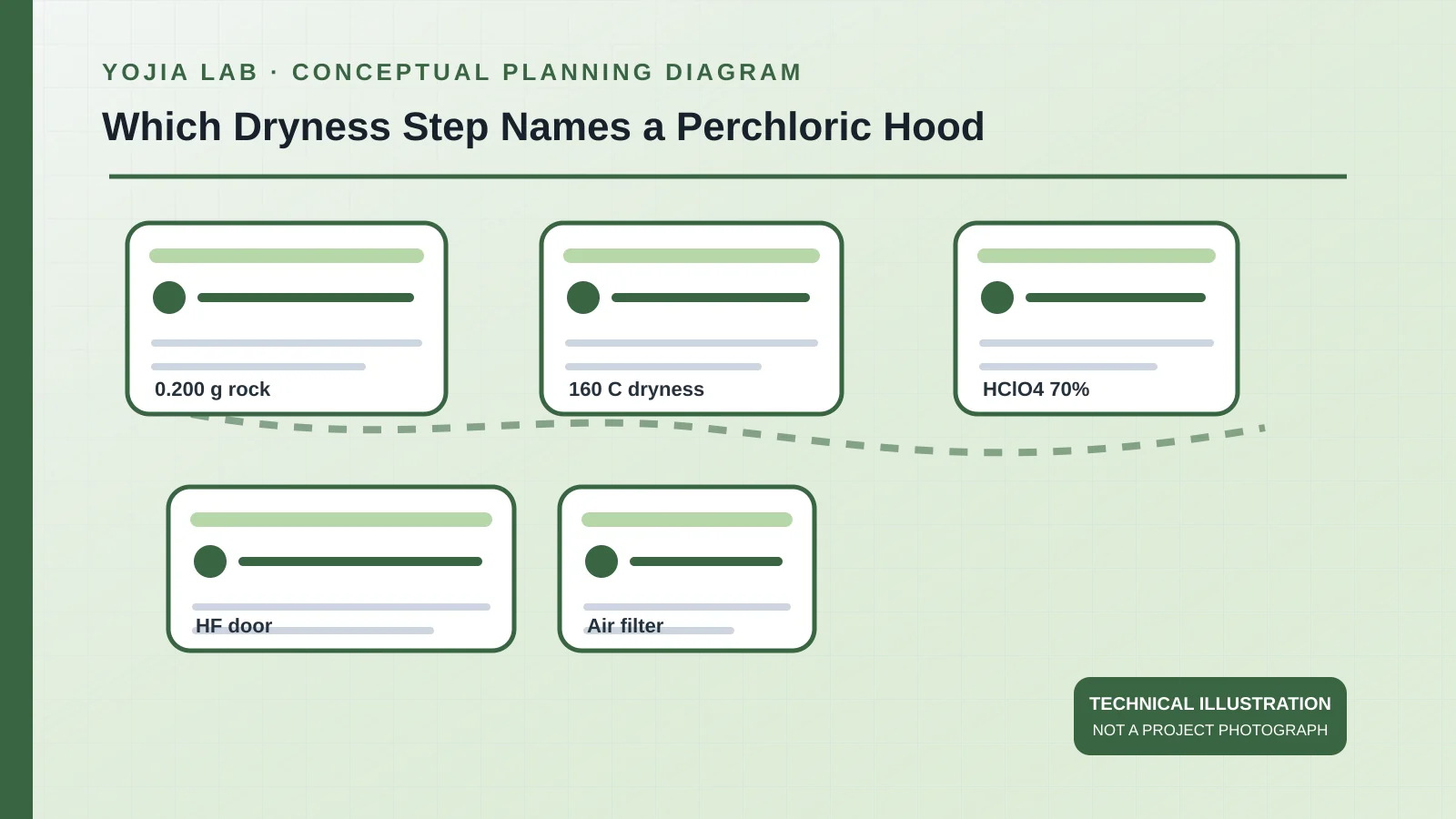
The additions are printed as separate acts. The analyst weighs 0.200 g into a Teflon vessel. Standard reference materials, duplicates, and three reagent blanks travel with the sample. Concentrated hydrochloric acid is listed at 37 percent, nitric acid at 70 percent, perchloric acid at 70 percent, and hydrofluoric acid at 48 percent. The procedure adds 3 mL of hydrochloric acid, then 2 mL of nitric acid after any reaction subsides, then 1 mL of perchloric acid and 2 mL of hydrofluoric acid. A later line adds another 1 mL of perchloric acid. None of those lines authorizes one premixed bottle.
The aluminum heating block starts at 110°C and is held to incipient dryness, then raised to 160°C for complete dryness. The extra millilitre of perchloric acid is also taken to complete dryness at 160°C. Only after cooling does the method add 1 mL of concentrated nitric acid and two drops of 30 percent hydrogen peroxide, then 19 mL of 1 percent nitric acid, and heat the capped vessels in a drying oven at 100°C for 30 minutes. That oven is not the perchloric dryness. The method also says the decomposition does not fully dissolve refractory minerals, and it names barium in barite, chromium in chromite, titanium in rutile, tin in cassiterite, aluminum in corundum, and rare-earth elements in monazite.
02
Five replicates are not a hood test
Table 3 reports aluminum in NBS-2704 river sediment with n = 5, a mean of 6.24 percent, a standard deviation of 0.10, a proposed value of 6.11, a relative standard deviation of 1.6 percent, and a recovery of 102 percent. The footnote says the proposed value comes from published reference-material compilations, and for NBS-2704 it cites Govindaraju, 1994. Recovery is the method's own label for that last column. Five replicates describe that row. They do not describe every rock that might be weighed at 0.200 g, and they say nothing about capture at a sash.
The safety precautions sit above the procedure and stay short. Personnel must wear safety glasses, a lab coat or apron, and gloves, and they must read the chemical hygiene plan and the material safety data sheets for each procedure. The 2002 wording still says material safety data sheets. It does not print a sash height, a face velocity, or a perchloric hood. Pointing to the hygiene plan is a requirement of this method. Guessing the hood the plan will name is not.
03
Must and should do not share a sentence
Open-File Report 83-131, by Skinner, Watterson, and Chemerys, applies to U.S. Geological Survey Water Resources Division laboratories. It is a 1983 handbook, not a current code for every assay shop. In that scope, perchloric and hydrofluoric acids must be used in hoods designated for them. Perchloric hoods must be dedicated to perchloric use, flushed after each use, and inspected monthly for chlorate deposits. Hydrofluoric acid must be stored in plastic and should be used in hoods with doors other than glass. Both acids must stay within reach of an eyewash. The door line is a should. The designated-hood line is a must.
Other strong acids must also be used in a hood near an eyewash. That general sentence is not the dedicated perchloric row. Under organic chemicals, containers should be opened only in a hood with an effective face velocity of at least 85 feet per minute, or in a bench hood area. The figure is a should, and the bench-hood alternative is one the perchloric paragraph does not offer. Moving 85 feet per minute onto the perchloric line would cross a heading.
04
The air-filter hood stays with the filter
NIOSH Method 7300, Issue 3, dated 15 March 2003, determines elements on air samples by inductively coupled plasma atomic emission. Its special precautions require every perchloric acid digestion under that method to be done in a perchloric acid hood. The ashing acid is four volumes of concentrated nitric acid to one volume of concentrated perchloric acid. Preparation adds 5 mL, waits 30 minutes at room temperature, heats at 120°C until about 0.5 mL remains, and then takes the sample to near dryness at 150°C, again about 0.5 mL. The stated working range is 0.005 to 2.0 mg per cubic metre of each element in a 500-litre air sample. That is a filter, not 0.200 g of rock taken to complete dryness at 160°C.
A fume hood line for this digestion can record the 0.200 g mass, the acid volumes, the 160°C complete dryness, and the hygiene-plan questions: a dedicated perchloric hood, a flush after use, a monthly chlorate inspection, a non-glass door for hydrofluoric acid, and an eyewash within reach. Method 7300 answers those questions for its air-filter digestions. Open-File Report 83-131 answers them for Water Resources Division laboratories in 1983. A commercial assay room is inside that handbook only when it is one of those laboratories. None of the three documents prints a perchloric face velocity, so that cell stays blank.
Before pricing, place the room interface, quantities, and service points for the laboratory fume hood systems with the workflow notes above. Airflow, performance, and compliance stay with the project's responsible reviewers.