01
Start unknown specimens from a cautious assumption
World Organisation for Animal Health Terrestrial Manual chapter 1.1.4 says diagnostic centres receive specimens whose infectious status is often unknown. Initial processing assumes an infectious agent or toxin is likely present until characterisation says otherwise. Risk-group numbers were not meant to equal biosafety levels. The assessment uses the procedure, the facility, and local animal health. Engineering controls include ventilation, barriers, and separation of incompatible activities. Necropsy is listed separately from receipt, culture, centrifugation, and storage.
BMBL says the manual is an assessment tool, not a regulation. For an unknown agent in a specimen, it calls a minimum biosafety level 2 assumption prudent unless information points higher. Most public and animal-health clinical laboratories, it notes, already use biosafety level 2 facilities and practices because the agent may still be unidentified. That is a starting assumption. It does not place every veterinary task on one open bench.
02
Split smear staining from necropsy
For Coxiella burnetii, BMBL recommends biosafety level 3 for inoculation, incubation, harvesting, necropsy of infected animals, and manipulation of infected tissues. Experimentally infected rodents go to animal biosafety level 3 because they may shed in urine or feces. A plaque-purified phase II Nine Mile clone 4 is exempt from select-agent rules and may be handled at biosafety level 2. Biosafety level 2 is recommended for non-propagative work, including serology and staining impression smears. The wall laboratory bench can be discussed for the smear. It is the wrong object for necropsy of an infected animal.
For Francisella tularensis, BMBL says type A and type B strains can cause disease from 10 to 50 organisms. Overall fatality is under 2 percent and can reach 24 percent for particular strains. Person-to-person transmission has not been documented. Biosafety level 3 is recommended for suspect cultures, animal necropsies, and experimental animal studies. Biosafety level 2 covers the first handling of suspect clinical materials. Citing a Canadian data sheet, BMBL says the agent can survive for months to years in carcasses, organs, and straw.
03
Read one campus necropsy rule as that campus’s rule
The University of Nebraska–Lincoln necropsy procedure, revised July 2021, covers research, diagnostic, and teaching necropsies there and says they must meet or exceed the procedure. With no zoonotic or human-pathogen exposure, necropsy may use a bench, and a biosafety cabinet is still recommended. Unknown cause or possible zoonotic exposure calls for at least biosafety level 2 practices. History is checked for named risk-group 3 agents: anthrax, Q fever, rabies virus, Chlamydophila psittaci, West Nile virus, and equine encephalomyelitis viruses. Small-animal necropsy should use a Class II cabinet when one is available.
Eating, drinking, and grooming are barred in necropsy areas, and observers wear the same clothing as the people making the cut. The sentences govern that university. A wall laboratory bench drawn elsewhere inherits neither the bench permission nor the cabinet preference. What travels is the order: history first, then the address of the cut.
04
Use the sealed joint inside the practice guideline’s scope
Canada’s practice guideline uses a filled circle for a reasonable precaution and a hollow circle for an added recommendation. Item 2.1.8, a backsplash sealed at the wall-bench junction and pointed at Canadian Biosafety Standard 3.4.4, is filled. Item 2.1.6, seam-free benchtops that withstand repeated cleaning, is filled. A room separated from public, office, and animal areas is hollow. Paper work kept off the specimen surface is hollow. A sink for handwashing on exit is filled, with sanitizer named when no sink is present.
The checklist covers practices that may handle risk-group 2 human pathogens. Facilities receiving specimens from other clinics are outside the licence exemption and are directed to a Pathogen and Toxin Licence and the Canadian Biosafety Standard. Copying item 2.1.8 does not issue that licence. If a risk-group 3 or 4 pathogen is identified or believed present, cultivation needs a licence, or the sample is transferred or destroyed. BMBL’s level 2 facility text adds benchtops impervious to water and resistant to heat, organic solvents, acids, and alkalis, with cleanable gaps and a sink near the exit.
05
Measure the wall for steps that remain in the room
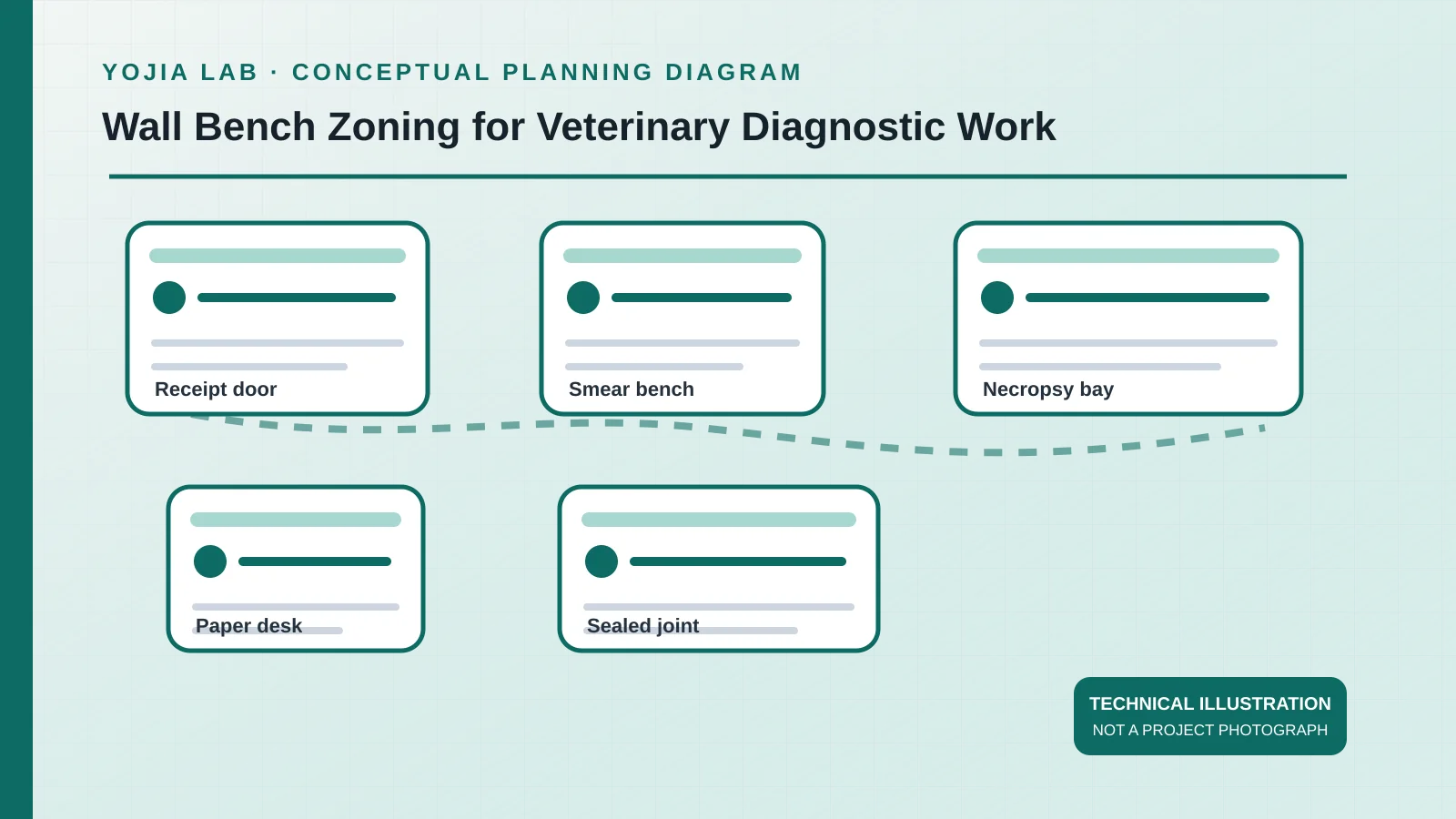
The wall laboratory bench length follows steps the current assessment leaves in the open room. Staining an impression smear, under BMBL’s biosafety level 2 note for that non-propagative Q-fever procedure, can be one. Necropsy of an animal infected with Coxiella burnetii or Francisella tularensis follows the level 3 recommendation and does not use the smear-bench length. Nebraska allows a bench necropsy only after its own assessment finds no zoonotic exposure, and it still recommends a cabinet.
A quotation can record wall length, the user side, a sealed joint when the Canadian practice guideline really applies, the sink near the exit, and the cleaning gap. Paper can be kept off the specimen surface when that hollow-circle item is adopted. The quotation cannot state a biosafety level, a licence, or resistance to an unlisted disinfectant. A step without an address stays off the wall laboratory bench.
Before pricing, place the usable wall length, modules, and service points for the wall laboratory bench run with the room notes above. Final materials and supplied scope remain the approved quotation.