01
Decide whether this is still a classroom hood
The University of Missouri System's 2024 fume hood guideline separates hoods in university buildings into teaching, research, and clinical use, then defines classroom laboratories as spaces with regularly scheduled classes where no research is taking place. Those rooms, in that text, should be supervised by instructors who know the hood's operation and its limits. Every other hood falls into research or clinical categories, which the guideline further splits into standard, perchloric acid, acid digestion, and radiological hoods. A renovation that quietly adds a research group to a teaching afternoon changes the category. Ask the department to say which description is true after the project, not which sign is on the door today.
That same guideline does not allow ductless fume hoods, requires design to ANSI Z9.5, NFPA 45, and SEFA, and tells the designer not to gang a fume hood with a ducted biological safety cabinet. Perchloric and radioactive exhaust are completely separate from other exhaust. These are Missouri's consultant rules for Missouri buildings. They are still the right kind of question elsewhere: is a recirculating enclosure being offered as a shortcut, is a cabinet being tied into the teaching hood's duct, and does anyone remember perchloric acid or radionuclides in the old hood? If the history is unknown, the demolition note stays open.
02
Survey the hood that is already in the room
University of Wisconsin–Madison's fume hood program says new and renovated hood systems are evaluated with the campus performance-testing guideline, and that a system which misses those criteria is not accepted for use. Established hoods are tested on a cycle, and a hood that fails is placed out of service. Users, including students, are told not to use a hood that has failed certification. Physical plant, in that document, provides design and construction services when a department asks for a new installation or a relocated fume hood. Remodeling is called out separately: a performance test is a condition of acceptance when a new hood is installed or when an existing hood is part of a significant renovation, and the program assigns the cost of new installations and remodeling to the department. Those funding sentences are Madison's. The planning point that travels is that relocation and replacement are projects with an acceptance test, not a furniture swap.
Before a contractor prices demolition, record width, sash type, whether the hood is on a manifold, and who last tested it. Madison also says the user shall not modify the interior, the exterior, or the components without approval from the chemical hygiene officer or another named authority, and that equipment must not block the air slots or the airfoil. A renovation drawing that fills the old chamber with a drying rack or a demonstration still has to answer that rule for the hood that remains. If the hood is non-compliant, Madison's program schedules replacement and allows a high-performance replacement when the size does not increase or when an energy case is made. Do not assume this campus uses that size limit. Ask.
03
Keep the sash out of the doorway and out of the demonstration queue
The University of Pennsylvania's environmental health office asks to be consulted on fume hood selection and placement for a new or renovated laboratory. Its placement notes follow a practical observation: a person walking past can disturb a face velocity around 100 feet per minute, and an open window or a supply diffuser can reduce that velocity or the room's negative pressure. The page says not to put a hood next to the only way out, not to put it in a main path, and not to put a workstation in front of the opening unless the work at that station is part of the hood activity. Hoods immediately beside or opposite each other can interfere. In a teaching room the queue to see a demonstration is exactly that walking path. Draw the queue. If the only place left for the replacement fume hood is beside the exit, the plan is not finished.
Pennsylvania also refuses an on/off switch for the blower, expects directional supply diffusers not to discharge toward the hood and not to sit within 10 feet of it, and wants a Factory Mutual approved, UL listed flammable-liquids cabinet under the hood when that specification applies. If a vacuum-pump cupboard is proposed under the hood, the same page asks for power, heat removal, noise, and a ventilated path. A teaching renovation that reuses the base cabinet without those lines has skipped the exhaust device's neighbors. Color alone is not enough for valve handles; the page points to a fixture standard for words as well as colors. Write the labels in the language the class actually uses.
04
Choose variable volume only as this campus defines it
Missouri's guideline makes variable-volume hoods the default for new and replacement work, and it says no hood may be used as variable volume unless the manufacturer has certified that hood for the use. Variable-volume hoods there get a sash lock and alarm at 18 inches, a flow indicator with a low-flow alarm, and an occupancy sensor on the front that can drop face velocity to 60 feet per minute when nobody is within 2 feet. The maintained velocity at the sash lock is written as 100 feet per minute unless campus environmental health approves a lower figure for a low-flow hood. Constant-volume hoods are restricted to small installations or to conversions that can later become variable volume. Copying 60 or 100 onto a purchase order for a different university would invent a setpoint.
Pennsylvania's commissioning text is a different campus number and should stay labeled as such. With the sash at 18 inches, that office looks for an average face velocity of 80 to 120 feet per minute, with no reading more than 20 percent from the average, and sets the low-flow alarm below 80. Hoods must meet the current ASHRAE 110 tracer-gas protocol at a stated rating, and a professional engineer seals the report. Both EHRS and a vendor test the hood before occupants use it, and balancing comes before the EHRS test. A renovation specification can require the campus acceptance test by name. It should not paste Missouri's sensor rule and Pennsylvania's velocity band into the same sentence as if they were one code.
05
Do not hand the room back on a delivery date
Pennsylvania says a salvaged fume hood may be reused only if the design team inspects and validates it, and any modification has to meet the manufacturer's original specification. Ductless filtering hoods need approval before installation. Madison will not accept a new or renovated system that fails its performance test, and it tells the teaching assistant to keep emphasizing that users do not alter the hood and do not block the slots. OSHA's laboratory standard, where it applies, requires the chemical hygiene plan to state that fume hoods and other protective equipment are functioning properly and to name the measures that check that performance. The plan is reviewed at least annually. A renovation is one of the moments that review has to catch, because the hood, the path to the exit, and the chemicals in the teaching experiment may all have changed.
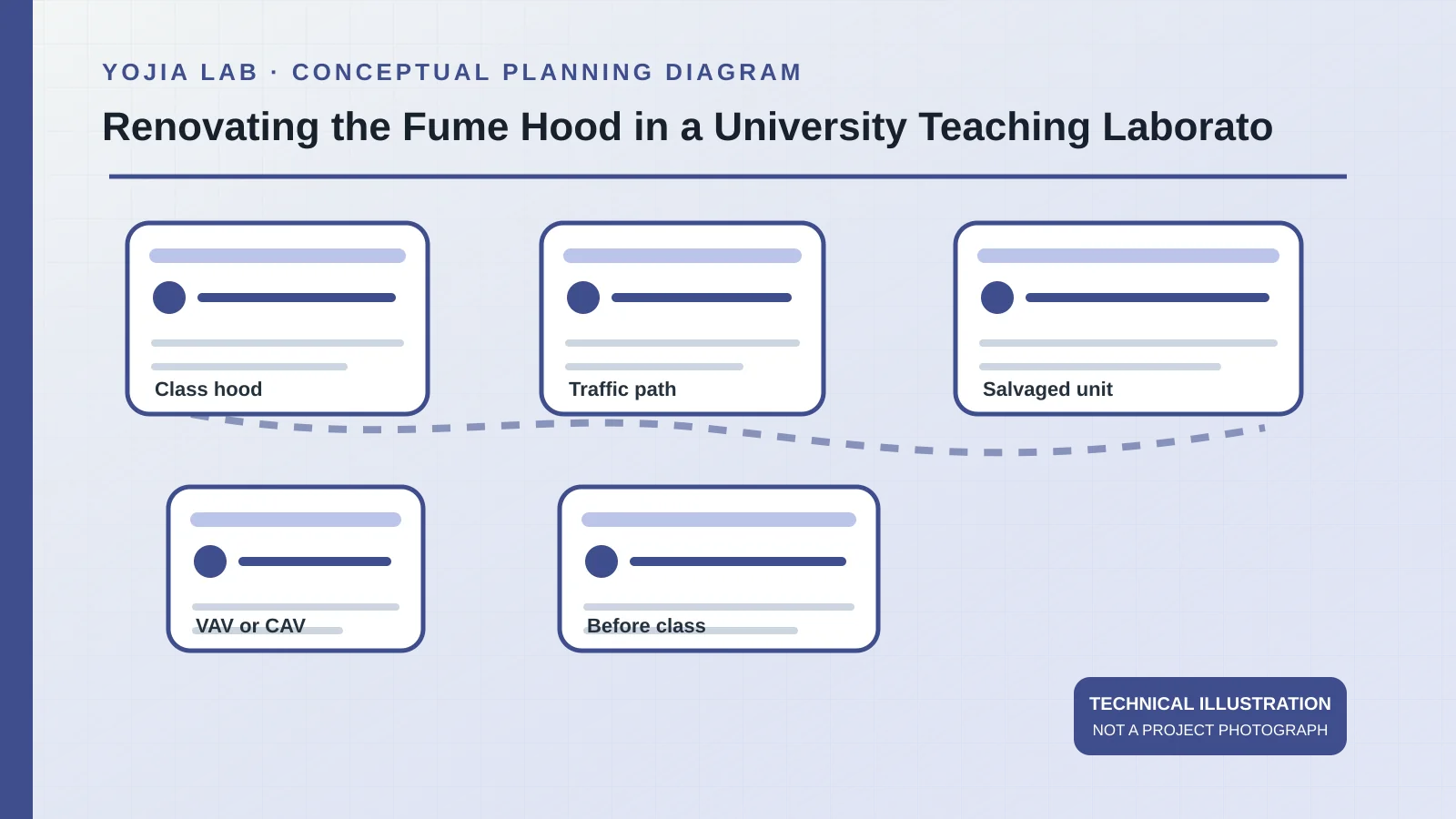
Build the handback around the timetable. Name the last class that may use the old hood, the weeks the demonstration moves to another supervised room, and the first class that is forbidden to enter until the acceptance test is on file. Include the fan, the alarm, the labels, and the under-hood cabinet in that file, not only a photograph of a new sash. If the test is late, the room stays closed to the experiment even though the benches look finished. The figure on this page is a technical illustration of that sequence. It is not a hood that has passed a test, and it does not set a price for demolition or for a replacement fume hood.
When these planning questions move into a quotation, list quantities, materials, and service points for the laboratory fume hood systems in the same package used for distributor and contractor project support. This article records what still needs confirmation; the approved quotation sets the supply.