01
The printed tolerance is still a controlled room
Amendment 1 to ISO 139:2005, dated 2011-07-01, replaces the requirements clause. The standard atmosphere shall be 20.0 °C and 65.0% relative humidity. An alternative may be used only when the parties agree, and it shall be reported. The alternatives are not equivalent: 23.0 °C and 50.0% relative humidity, or the tropical 27.0 °C and 65.0%. Tolerance is ±2.0 °C and ±4.0% relative humidity. The ISO catalog record says edition 2, published in January 2005, was confirmed in 2025 and remains current. The abstract limits the standard to conditioning for physical and mechanical properties. It is not a burn method.
The introduction in the 2005 preview explains why those tolerances look wider than ISO 139:1973. The 1973 figures were measured laboratory values and did not include instrument uncertainty. The second edition folds that uncertainty into the printed tolerance, and it says the laboratory must still be controlled, as measured temperature and humidity, to essentially the 1973 level. A wider number on the page is not a license for the room to wander. An island laboratory bench standing in an ordinary workroom does not produce 20.0 °C or 65.0% relative humidity. The room control does. The bench is the surface used after the room is already inside the tolerance that applies to the agreement the laboratory actually has.
02
Two hours between weighings is a location
The amendment’s equilibrium rule uses should, while the atmosphere uses shall. Unless another document says otherwise, equilibrium is successive weighings with no progressive mass change greater than 0.25%. In a conditioned laboratory those weighings should be 2 hours apart. An accelerated system should use 2 to 10 minutes. A furniture note that invents a one-hour soak is not this text. The balance has to stay in the conditioned laboratory between readings. Carrying the specimen to a drier office breaks the condition the second weighing checks.
Rapid conditioning, added as definition 2.8, means a system that brings specimens to equilibrium with the standard atmosphere faster than static exposure. It has its own short interval. It does not rename the atmosphere, and it does not send the cloth into a drying oven. Until the laboratory chooses a static conditioned room or an accelerated system, the number of benches is not known. One island laboratory bench can hold the successive weighings only when everyone using that surface is in the same named atmosphere. A method that first removes moisture cannot take a turn on that surface between the 2-hour readings.
03
Clothing flammability dries the cloth on purpose
16 CFR 1610 is the US rule for clothing and textiles intended for clothing, not a worldwide room code. A specimen is 50 mm by 150 mm. Preliminary cuts find the fastest direction, and marks stay out of the exposed area. Plain cloth is clamped before conditioning. Raised cloth is brushed against the lay first. Mounted specimens then lie on an open metal shelf in a forced-circulation oven for 30 ± 2 minutes at 105 °C ± 3 °C (221 °F ± 5 °F), then over anhydrous silica gel until cool and for at least 15 minutes. The burn starts within 45 seconds of leaving the desiccator. The October 2008 CPSC staff manual repeats the oven figures and says the Commission did not approve it. The governing figures are in the regulation.
The burn also has a draft rule. The chamber sits under the hood, or another suitable enclosure, with the fan off. The flame is set to 16 mm from tip to nozzle, and the fan comes on only after the test. The apparatus clause asks that hood for a draft-proof volume and a way to exhaust smoke. That volume is not the 65.0% relative-humidity laboratory, and it is not a shelf for a 2-hour wait. A 105 °C oven inside the conditioned room fights the humidity the physical tests are holding.
04
Only one of the three stations is the island bench
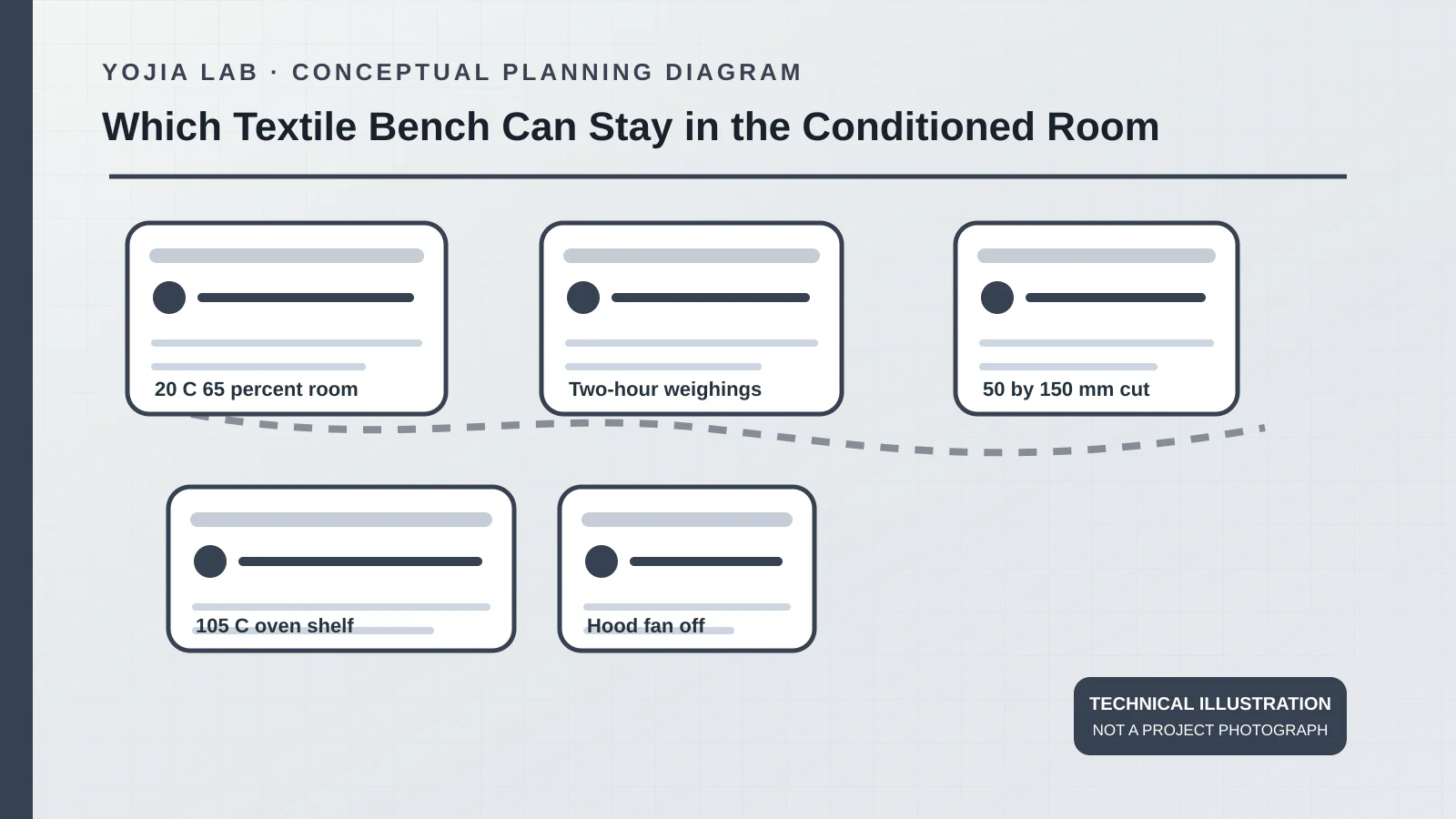
Only one of the three stations is a candidate for an island laboratory bench. Cutting is a clear table for the 50 mm by 150 mm piece, with marks off the burn area and brushing finished before the oven. The conditioned laboratory holds the balance for the 0.25% mass check and the physical tests that cite ISO 139. An island laboratory bench belongs there only if the room is already controlled. The third station is the oven shelf, the desiccator, and the hooded chamber, with the fan sequence in the regulation. None of the three is a load rating or a pass-fail result for cloth that has not been tested.
The brief for that island laboratory bench is short because the texts are short. It names the atmosphere in force, whether the parties have agreed an alternative and which one will be reported, whether equilibrium is the 2-hour laboratory check or an accelerated interval, and which work is physical rather than 16 CFR 1610. The clothing rule does not reset ISO 139. ISO 139 does not dry a specimen at 105 °C. One open bench asked to do both will be outside one of the two documents on the day the specimen is prepared. The drawing can show the bench after the rooms have been assigned, and not before.
Before pricing, place the room dimensions, user sides, and service interfaces for the island laboratory benches with the workflow notes above. The final configuration remains the approved quotation and drawings.