01
The amendment’s atmosphere is a reported choice
The public text of ISO 139:2005/Amd.1:2011 replaces Clause 3. The standard atmosphere shall have a temperature of 20.0 °C and a relative humidity of 65.0 %. The tolerance zone is ±2.0 °C and ±4.0 % relative humidity. Two other atmospheres are allowed only when the parties agree, and the one that was used has to be reported. The specific alternative is 23.0 °C and 50.0 % relative humidity. The tropical alternative is 27.0 °C and 65.0 % relative humidity. The amendment calls these alternatives not equivalent to the standard atmosphere and not equivalent to each other.
This preview does not include a minimum number of hours, a rack design, or a furniture material. The tolerance is a property of the air. Holding 20.0 °C within 2.0 °C, and 65.0 % relative humidity within 4.0 %, across the surfaces of the specimens, is a room or chamber performance. It is checked with instruments, not with a catalog description of a bench. If the project also runs the 23.0 °C / 50.0 % alternative for a different client, that air is a second setpoint. Putting both setpoints in one sentence makes them look interchangeable. The amendment says they are not.
02
The apparel oven is a different climate
Part 1610 is the US standard for clothing-textile flammability, not a general physical method. A specimen is 50 mm by 150 mm, long side in the faster-burning direction found by preliminary trials. Raised-surface cloth is brushed, and every specimen is clamped before conditioning. Mounted specimens lie horizontally on an open metal shelf in a forced-circulation oven, dry for 30±2 minutes at 105±3 °C (221±5 °F), then cool over anhydrous silica gel until cool and for at least 15 minutes. Section 1610.5 sizes the draft-proof chamber at 35.3 cm by 36.8 cm by 21.6 cm, sets the rack at 45°, and uses a 16 mm butane flame for 1 second. A stop thread is 127 mm from where the flame meets the cloth.
The October 2008 CPSC staff manual says it was not reviewed or approved by the Commission and may not represent the Commission’s views. Treat detail that goes past the regulation as staff procedure. The manual cuts five specimens, or ten if cloth remains for a second set of five, and allows an extra 3.2 to 12.7 mm on the long side against edge ignition. Specimens on the rack must not touch. Conditioning in the manual starts only after the door is shut and the oven is back at 105±3 °C; the operator then starts a 30-minute timer. The regulation’s duration is still 30±2 minutes. Dropping the ±2 minutes copies the staff sentence and loses the legal tolerance.
03
What the price package has to contain
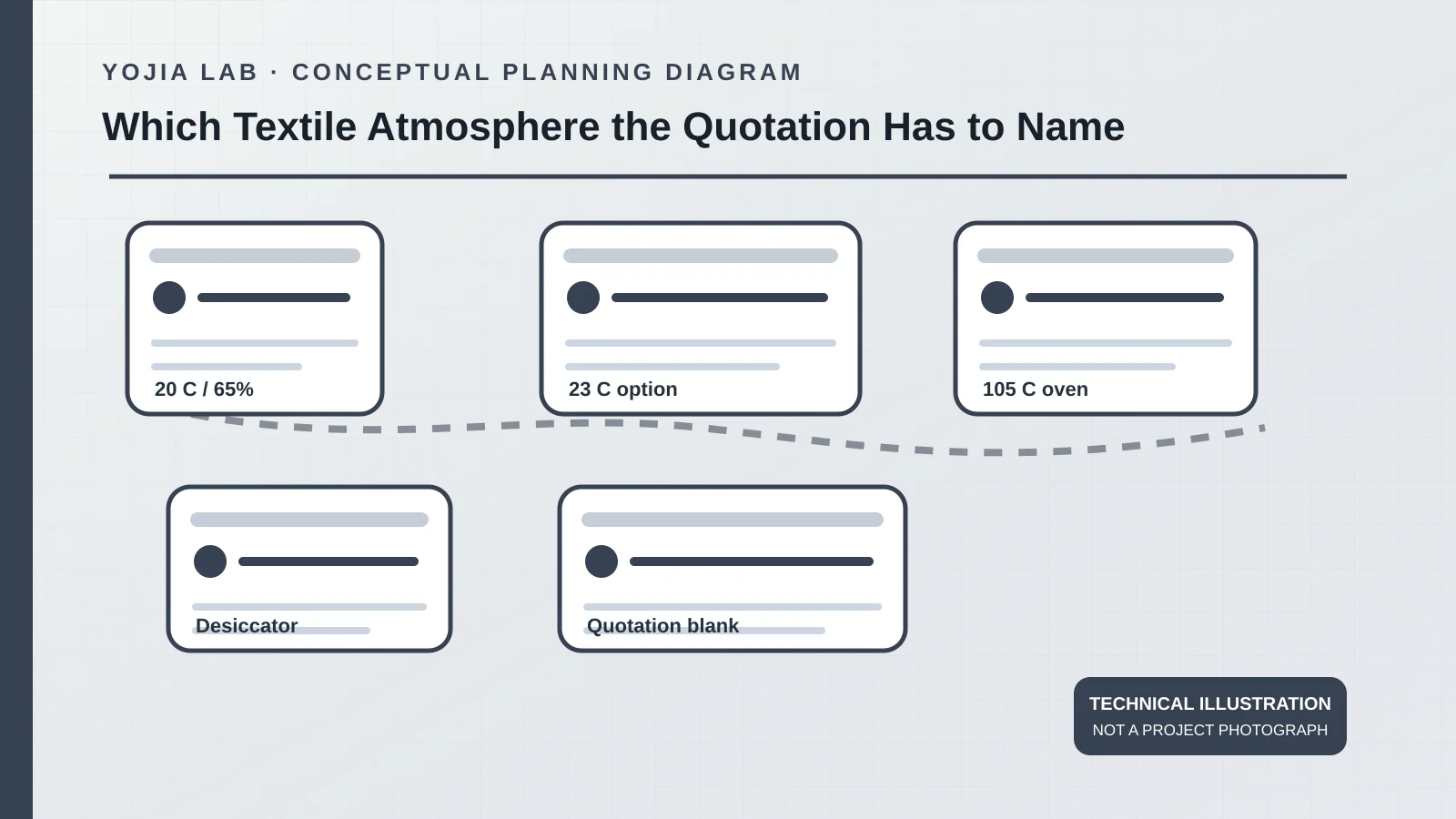
Price one row per test the laboratory will sell. The ISO 139 row records 20.0 °C, 65.0 % relative humidity, the stated tolerance, and whether anyone agreed to an alternative. The Part 1610 row records the specimen, the 105±3 °C oven, the desiccator, and the chamber. Any other method stays a blank row. Cutting, which must leave the exposed area unmarked, is not the oven and is not the conditioning air.
Count holders that fit without specimens touching, and a desiccator that keeps them horizontal and apart. Neither document gives a floor area, so an area-based table count skips the printed numbers. A stand for the 45° chamber is a Part 1610 apparatus. Oven power, smoke exhaust, and holding the chosen air are questions for the project engineer.
04
Keep the staff manual and the regulation apart
Two documents can describe one test and still disagree in the details a buyer might type into a specification. The regulation requires 30±2 minutes at 105±3 °C. The 2008 manual tells the operator to wait for recovery after the door closes and then time 30 minutes, and its table still prints 30±2 minutes. A careful package quotes the regulation as the requirement and quotes the manual as the way one staff procedure avoids starting the clock while the oven is still climbing. It does not average 30 and 32 into a third duration. The manual’s extra 3.2 to 12.7 mm of cloth is a preparation note for edge ignition.
Jurisdiction belongs in the same package. Part 1610 applies to textiles used or intended for apparel under that US rule. The ISO amendment is a conditioning atmosphere for textile tests that call it up. A cloth that needs both climates passes through them in the order the methods set, not through a room held somewhere between 20 and 105 °C.
Before pricing, check the laboratory furniture support for distributors and contractors against the room and workflow conditions already recorded above.