01
Put the dissolution apparatus inside the hood zone
USGS Bulletin 1770 describes an acid dissolution for silicate and carbonate rock: hydrofluoric acid, aqua regia, and perchloric acid, taken to dryness on a hotplate, then returned to solution for measurement. A later section separates rare-earth elements on cation-exchange resin with nitric acid, strips iron on an anion resin from hydrochloric acid, and only then sends that fraction to inductively coupled plasma atomic emission. The hotplate and the columns are not the plasma instrument. Give the hotplate a hood, and do not draw the instrument inside that outline.
Open-File Report 86-189 is more literal about the enclosure. Samples are dissolved with hydrochloric, nitric, and hydrofluoric acids in closed polycarbonate bottles and heated in a microwave oven. The report states that the entire oven was placed in a fume hood so fumes escaping around the caps would be ventilated. If the group still uses that pattern, put the oven inside the hood zone, not beside the balance and not in the spectrometer room. The report does not transfer a face velocity or a construction type onto the drawing.
02
Keep the acid columns out of the measurement room
The bulletin's rare-earth separation loads a nitric acid solution onto resin, elutes with further nitric acid, and moves iron off an anion column in hydrochloric acid before the rare-earth cut is evaporated and redissolved. Those steps use open acid handling even after the rock has been dissolved. They need a bench, bottles, and a place for eluate that is still an acid zone. Calling the whole sequence sample preparation and parking it next to the spectrometer hides the acid.
A support table under the spectrometer is a different object from the column bench. Write the table as support furniture in the measurement room, and write the column bench with the hood that serves the acid work. A cup sink at the columns is not a reason to pipe the same services into the spectrometer footprint. If the group has not chosen between the digestion room and a second hood room, show both as unresolved instead of picking a catalog module.
03
Give heavy-liquid separation its own hood
USGS Circular 827 treats bromoform, methylene iodide, and related heavy liquids as mineral-separation reagents with their own rules. Work goes under a fume hood. Saturated papers stay inside the hood while it runs, rather than in an open waste container outside, and fumes should not be recirculated into adjacent ventilation. Mineral separation is therefore not a side task on the digestion sash. It is another hood zone, or it is absent. The sketch should say which.
Do not copy any face-velocity discussion in the circular onto the drawing as a project number. The circular instructs geologic-laboratory staff. It is not a purchase specification. The zoning sheet can copy the spatial rule: contaminated wipes stay in the hood, waste does not move to a general bin, and exhaust is not assumed to be shared with the next room. If heavy liquids are no longer used, delete the zone instead of keeping a hood for an old method.
04
Pull the walking route off the sash
National Academies guidance says a person walking in front of an open chemical hood can drag contaminants out, so hoods should stay off busy aisles while work is underway. The same chapter places hoods away from doors and discourages operable windows in rooms that rely on hoods. Those are zoning constraints, not an acceptance test.
Draw the aisle people will actually use, from sample login past the hoods to the spectrometer door. If that line crosses a sash, move the hood or the line, and record which choice is still open. A hood opposite a busy door is a clash even when the module count looks neat. The chapter also says to keep stored bottles out of the hood. Acid reserves and heavy-liquid bottles need a place that is not the working chamber. If the chemical review has not named it, leave the place as a question.
05
Stop the sketch before it becomes a performance claim
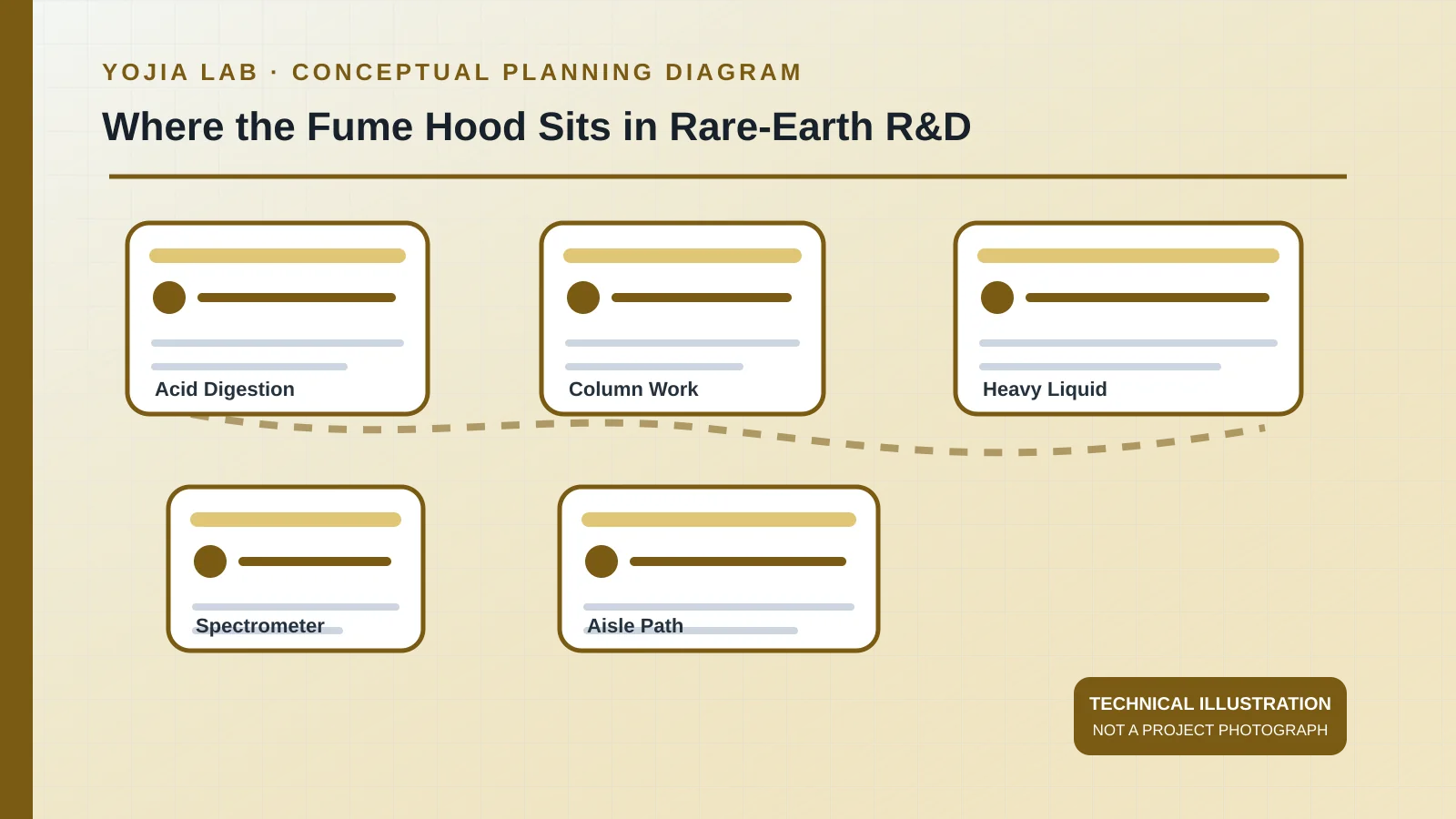
A usable zoning sheet names the hotplate or microwave, the acid columns, heavy-liquid separation if it exists, the spectrometer, and the aisle. Each place lists the acids the cited method uses and the enclosure that method already associates with them. A label such as rare-earth bench does not separate those places. The fume hood marks the operations that need it.
Commissioning, airflow, and whether perchloric acid is permitted in the building stay with the laboratory's safety reviewers. Bulletin 1770 names perchloric acid in a digestion. Naming it does not authorize a wash-down hood, a duct material, or a face velocity. The furniture plan can refuse to put that hotplate in the spectrometer room. It cannot close the safety questions the reviewers have not answered. When the sketch is sent onward, the blanks should still be visible.
Before pricing, place the room interface, quantities, and service points for the laboratory fume hood configuration with the workflow notes above. Airflow, performance, and compliance stay with the project's responsible reviewers.