01
Sort blocks by whether the method is written
Open-File Report 02-223 is a manual of validated geological methods. Its introduction says the edition keeps some procedures that barely changed, revises others because the instrument or a small step changed, and adds procedures that had just been developed and approved. It is written for laboratory scientists and also to help a user judge the data that come back. The steps are there so people can be trained and so the quality record has something to point to. A research schedule that says only rare-earth laboratory has skipped that mix.
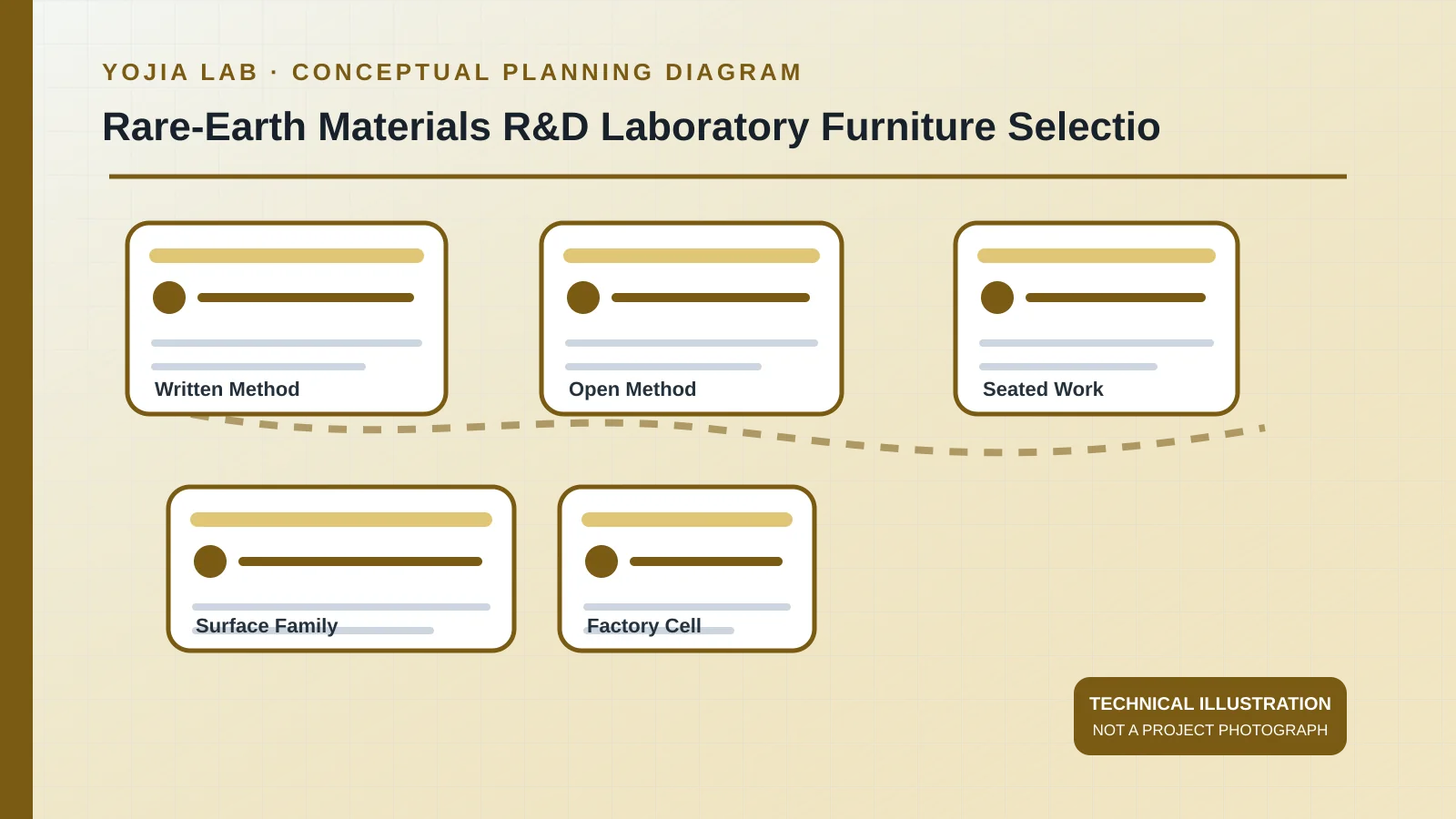
Give each furniture block one of those three labels: unchanged procedure, procedure under revision, or procedure not yet approved. The first label can carry a length, a seat height, and a list of vessels the written steps already name. The second and third labels carry a holding length and a note that the holding length may move. Asking a factory to freeze all three as one module turns an unfinished method into a purchased object.
02
Give seated instruments a real knee clearance
National Academies guidance on laboratory facilities says bench areas need knee space for a chair beside a fixed instrument or for a procedure that keeps someone seated. It also asks work areas, including computer seats, to be adjustable, with task light and enough room for equipment to cool. Columbia University requires at least one bench in each laboratory to meet accessibility rules for counter height and knee space. Those are requests to copy from the instrument manual and from the access rule that applies here. They are not a generic stool height.
Arizona State University’s laboratory guideline makes adjustable-height painted metal casework its usual starting point, and it asks for knee space at fixed instruments and at long procedures. If a spectrometer manual states a different seated height, write that height in the block and leave the construction open until someone compares it with the manual. Do not invent a load or a vibration number to fill the comparison.
03
Let the laboratory name the work-surface family
The National Academies chapter says casework should survive long use, reuse, and relocation, and that it should be easy to clean and repair. Work surfaces should resist chemicals, stay smooth, and clean easily. Arizona State University then refuses one surface for every room: chemistry rooms are pointed to epoxy, biological rooms to phenolic or epoxy, electronics rooms with chemicals to phenolic, electronics rooms without chemicals to a laminate, dry rooms to phenolic or a resistant laminate, and heavy work to concrete or hardwood. The designer still has to get campus approval before the surface is final.
A rare-earth research block does not become one of those rooms by its title. The group has to say whether that block sees corrosives, water, heat, electronics, or only paper. Write the family the group names, and write that the campus approval is still open if this project has a campus reviewer. The National Academies text also says not to add cup sinks beyond need, because an unused sink can dry out and smell. Add a cup sink only where the written procedure calls for one. Symmetry is not a procedure.
04
Measure this building before freezing a module
Columbia’s design guideline starts from the fact that its laboratory buildings differ in age, systems, column spacing, and floor-to-floor height, so the team surveys the affected rooms and tests the systems the project will load. A module that looks regular on a blank grid can stop at a column or at a ceiling that is already low. Record those measurements on the schedule before comparing offers. A supplier cannot see them from a room name.
The same guideline prefers movable, adjustable benches, with services from above where that arrangement fits, and it asks for back and side splashes along the perimeter of benches. A change from standing height to sitting height in a wet room needs a continuous surface that still resists chemicals. National Academies guidance expects some pieces, such as sinks, to stay fixed, while carts and adjustable tables take the middle of the room so the next study can move them. Mark which blocks are fixed and which are loose. A schedule that calls everything modular has not made that choice.
05
Send only the cells a drawing can answer
A factory review can answer the cells that are already decided: the length of a written-method block, the knee clearance requested for a named instrument, the surface family the laboratory wrote down, and whether a block is fixed or loose. Those answers are comparisons among offers. They are not a finding that the surface survives the group’s own reagent list, and they are not approval of a method that the manual has not yet recorded.
Keep a visible open column for compatibility, for procedures still being revised, and for any campus test the campus itself requires. Open-File Report 02-223 exists so a method can be followed and later audited. Furniture selection does not replace that record. When the schedule leaves the building, the unfinished blocks should still look unfinished.
When the plan is ready for a factory review, send the quantities, hazards, and unresolved room limits to a laboratory furniture manufacturer in China. Open items should stay open rather than being written as a confirmed specification.