01
Map research campaigns as equipment states and hand-offs
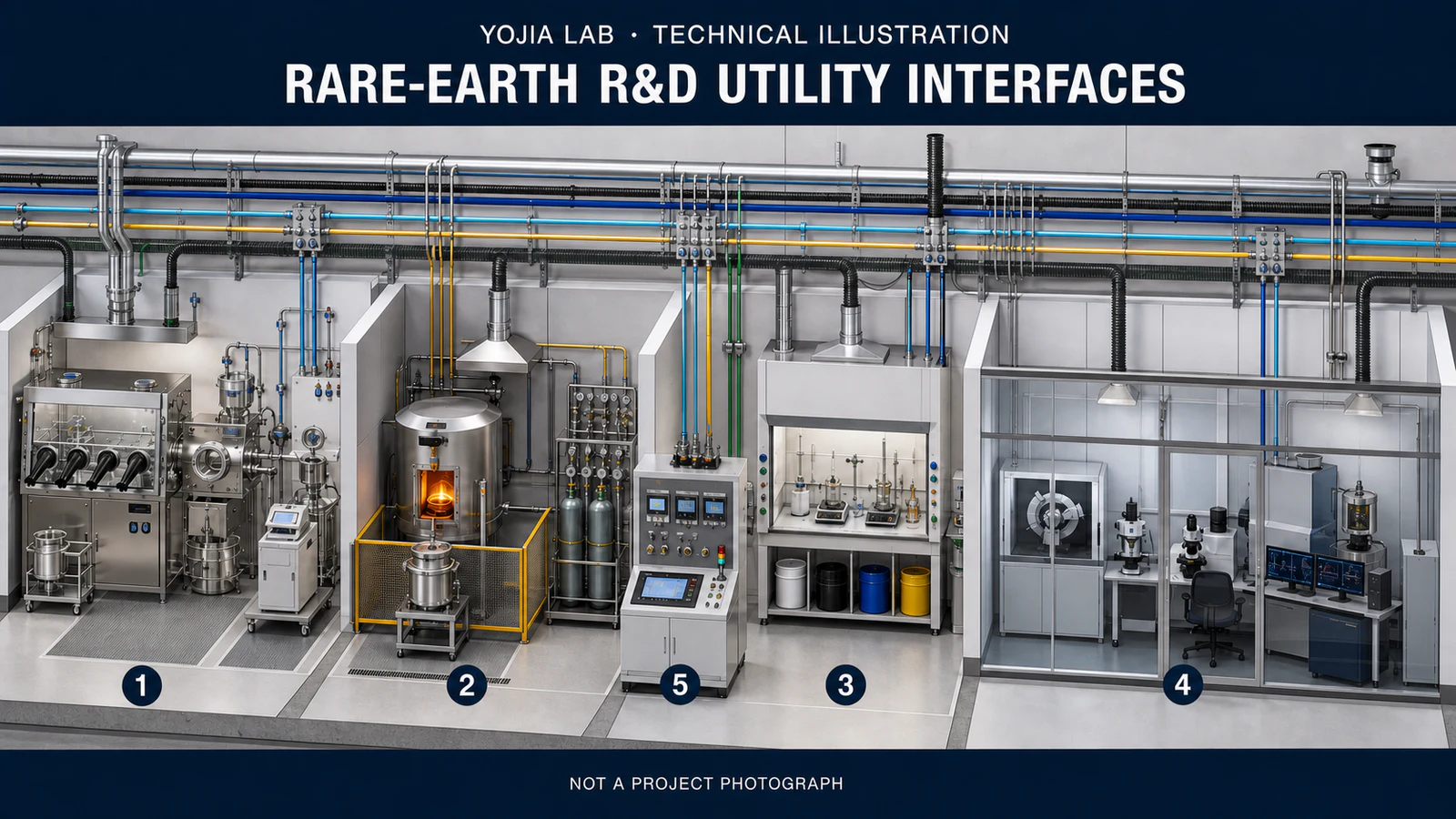
Begin with two or three credible experiment campaigns, not a catalogue of rooms. Trace each material through receipt, preparation, atmosphere change, thermal or chemical treatment, intermediate holding, characterization, data review, retention, and waste. At every step, record the physical form, quantity range, container, exposure condition, cleanliness requirement, responsible operator, equipment state, and next hand-off. Ames National Laboratory describes controlled-atmosphere capability spanning milling, sieving, compaction, magnetization, heat treatment, quenching, microscopy, and elemental analysis. That breadth shows why the brief must connect a sequence of operations rather than treat each instrument as an isolated purchase.
Add abnormal and non-research states to the same map. Purifier regeneration, furnace cool-down, filter replacement, pump maintenance, a low-gas alarm, an interrupted run, a contaminated transfer container, and a planned utility outage can occupy space or require services even when no sample is being measured. Mark which state may continue, which must pause safely, and which needs a controlled recovery authorized by a named role. This turns the workflow into a design input for separation, access, alarm routing, temporary storage, and resilience, while avoiding the false assumption that the laboratory operates only at the steady state shown in a brochure.
02
Build a model-level interface ledger before drawing service points
For every planned instrument, create one controlled interface record using the current model and selected options. Capture the footprint and service side, loaded mass and support geometry, installation and replacement path, electrical characteristics, power-quality or backup needs, heat rejection, gas identity and pressure range, vacuum, exhaust, cooling, drainage, network, grounding, noise, vibration, room limits, and maintenance clearances. Separate continuous demand from startup and short-duration demand. A family name such as glovebox, tube furnace, mill, microscope, or diffractometer is not an interface specification, and a tender allowance should never silently become a final connection value.
Record interfaces by operating state because optional modules can change the building response. MBRAUN's technical service guidance distinguishes working gas, regeneration gas, vacuum-pump and purge outlets, possible cooling-water use, analyzer maintenance, and behavior after power interruption. A different glovebox configuration or research substance can produce a different exhaust and recovery decision. Obtain vendor drawings and manuals before the utility and furniture freeze, identify assumptions that remain open, and give each open item an owner and due date. The ledger should be revision-controlled so a substituted model triggers a visible review instead of inheriting old connections.
03
Bundle utilities by failure consequence, not by convenience
Coordinate service bundles around what must happen when a supply is lost. Ordinary receptacles, dedicated instrument power, conditioned power, control power, data, inert gas, regeneration gas, vacuum, cooling, local exhaust, and general room ventilation may have different shutdown and recovery roles. Define isolation points, labels, access, monitoring, alarm recipients, and responsibility boundaries for each bundle. Stanford's laboratory design guidance emphasizes planning electrical demand before occupancy and locating selected gas or vacuum isolation so it can be reached when entry may be unsafe. The applicable project code and engineering review must determine the final arrangement rather than importing another institution's details unchanged.
Treat furnace atmosphere and off-gas as a linked system. Carbolite Gero's manufacturer literature for one hydrogen-capable laboratory furnace arrangement combines supply monitoring, purge sequencing, furnace-temperature logic, shutdown purging, and off-gas treatment. It is useful evidence that the gas skid, furnace, exhaust, controls, and emergency behavior cannot be coordinated by separate trades in isolation; it is not a universal design for every rare-earth experiment. Document the actual gas composition, inventory, pressure, process temperature, exhaust destination, monitoring basis, interlocks, safe state, and restart authorization for the selected equipment and local risk assessment.
04
Protect transitions while keeping equipment serviceable
The highest coordination risk often sits between machines. Define how powders or specimens cross from ambient preparation into a controlled atmosphere, from a glovebox to a furnace, from hot treatment to cooling, and from wet chemistry to sensitive characterization. Specify transfer containers, pass-through capacity, staging time, identity controls, cleaning, spill or damaged-container handling, and custody at each boundary. Avoid routing routine traffic through a precision room or forcing maintenance staff to open a controlled process enclosure just to reach a valve, filter, network switch, or pump. Furniture and local exhaust should support the approved hand-off, not create an attractive but unusable gap between instruments.
Reserve maintenance envelopes with the same discipline as operator space. Show door swings, antechamber loading, furnace tube removal, pump withdrawal, filter access, cylinder or manifold service, electrical panels, overhead lifts if justified, and the route for eventual replacement. Specialist workstations can separate instrument support from sample manipulation; fume hoods can serve reviewed wet-chemical operations; fixtures can make approved service connections legible and accessible. None is automatically suitable for reactive powders, hot equipment, or controlled-atmosphere processes. OSHA's laboratory guidance calls for activity-specific risk assessment and attention to scale-up, reactive materials, engineering controls, maintenance, and contingencies before work begins.
05
Commission the experiment train, then govern every change
Write acceptance tests from the interface ledger and campaign map. First verify installation facts: connection identity, direction, range, labeling, isolation, access, exhaust path, monitoring, alarm destination, and documentation. Then test approved sequences such as purge and transition, heat-up and cool-down, sample transfer, controlled shutdown, low-supply response, loss of exhaust or cooling, power interruption, restart, and maintenance release where applicable. Building-system commissioning, vendor start-up, instrument calibration, method qualification, safety authorization, and researcher training are different evidence packages; the project matrix should show who owns each and what unresolved deviation blocks use.
After handover, keep the ledger alive. A new furnace option, larger powder batch, different regeneration gas, added characterization module, or relocated pump can change heat, exhaust, electrical, gas, monitoring, maintenance, and emergency assumptions. Require a short change review before connection, then update drawings, asset data, labels, alarm contacts, spare-capacity records, and tests. Flexibility comes from accessible routes, documented capacity, capped connections that were deliberately planned, and clear approval rules—not from installing every utility everywhere. The laboratory remains useful when future experiments can change through a traceable decision path without bypassing the interfaces that keep equipment and people coordinated.