01
The standard vial already has an address
Method 8081B, Revision 2, February 2007, determines organochlorine pesticides in extracts from solid and liquid matrices. It is a starting point for a laboratory procedure, and its performance data are not accreditation limits. Stock, composite, calibration, internal, and surrogate solutions are stored at or below 6 °C, sealed with polytetrafluoroethylene, in the dark. The public PDF prints that inequality with an older glyph; the 2024 PHILIS procedure writes it as less than 6 °C. Aliquots of a lot should sit in individual small vials. Stock solutions must be replaced after one year, and other standards after six months, or sooner if quality control fails.
Those four conditions already remove the wall laboratory bench. The vial is small, sealed, dark, and cold, and an ordinary benchtop is none of those. The method also says reagents should be stored in glass so plastic containers do not leach into them. That should concerns reagent bottles, not every polymer in the room. PHILIS SOP L-A-403, Revision 2, dated 19 June 2024, is the EPA mobile-lab procedure under contract 68HERH21D0002. It stores the same standard classes below 6 °C, replaces opened stock at twelve months or the manufacturer's date if sooner, and replaces dilutions at six months.
02
Forty days is a should, and the table is guidance
Section 8.2 says extracts must be refrigerated in the dark and should be analyzed within 40 days. The must and the should are different duties. Chapter Four, Update V, Revision 5, July 2014, says SW-846 is not mandatory unless a regulation requires it, and that Table 4-1 is guidance rather than an EPA requirement. A project may shorten the time for a reactive analyte or a complex matrix, or lengthen it when evidence shows the analyte is unharmed. Many semivolatile classes are extracted within 7 to 14 days. Forty days is recommended for solvent extracts of most of those classes.
The organochlorine block of the table cools samples to 0 to 6 °C and prints both a 7-day and a 14-day extraction window, each followed by analysis within 40 days. Column order is easy to misread, so the chapter's warning matters: match the window to the matrix and the data objective. PHILIS makes one choice for its mobile labs. Aqueous samples are extracted within 7 days and solids within 14, unless a documented quality-assurance plan overrides those numbers. Samples are held from 0 °C to 6 °C. Amber glass is an alternative to the words in the dark, not a reason to leave the extract warm.
03
Food standards use another clock
SANTE/11312/2021 v2026, implemented on 1 January 2026, governs pesticide residues in food and feed. It is not SW-846. Section F1 stores neat reference standards cold, preferably in a freezer, with light and moisture excluded. The supplier's expiry may be replaced by a date up to 10 years from receipt only if the standard is checked on time and purity still passes. Ten years is not automatic. Section F4 keeps stock solutions cold, dark, and in containers that block solvent loss and water. After warming they must be remixed and checked for complete dissolution. Current data, the document says, show that most pesticide stocks kept properly in toluene, acetone, acetonitrile, methanol, or ethyl acetate are stable for several years.
Section F6 adds a bench failure: septum caps lose solvent and can contaminate the solution, so a pierced septum should be replaced if the solution will be kept. Section C11 says extract stability should be checked during validation, and that a refrigerator or freezer minimises degradation. Losses at room temperature can occur, with vials in an autosampler rack given as the example. That example is what the wall laboratory bench is for, and what it is not for. It can equilibrate, remix, and check a vial. It is a poor overnight address, and the rack is a documented loss point rather than a cabinet.
04
What the wall bench is actually for
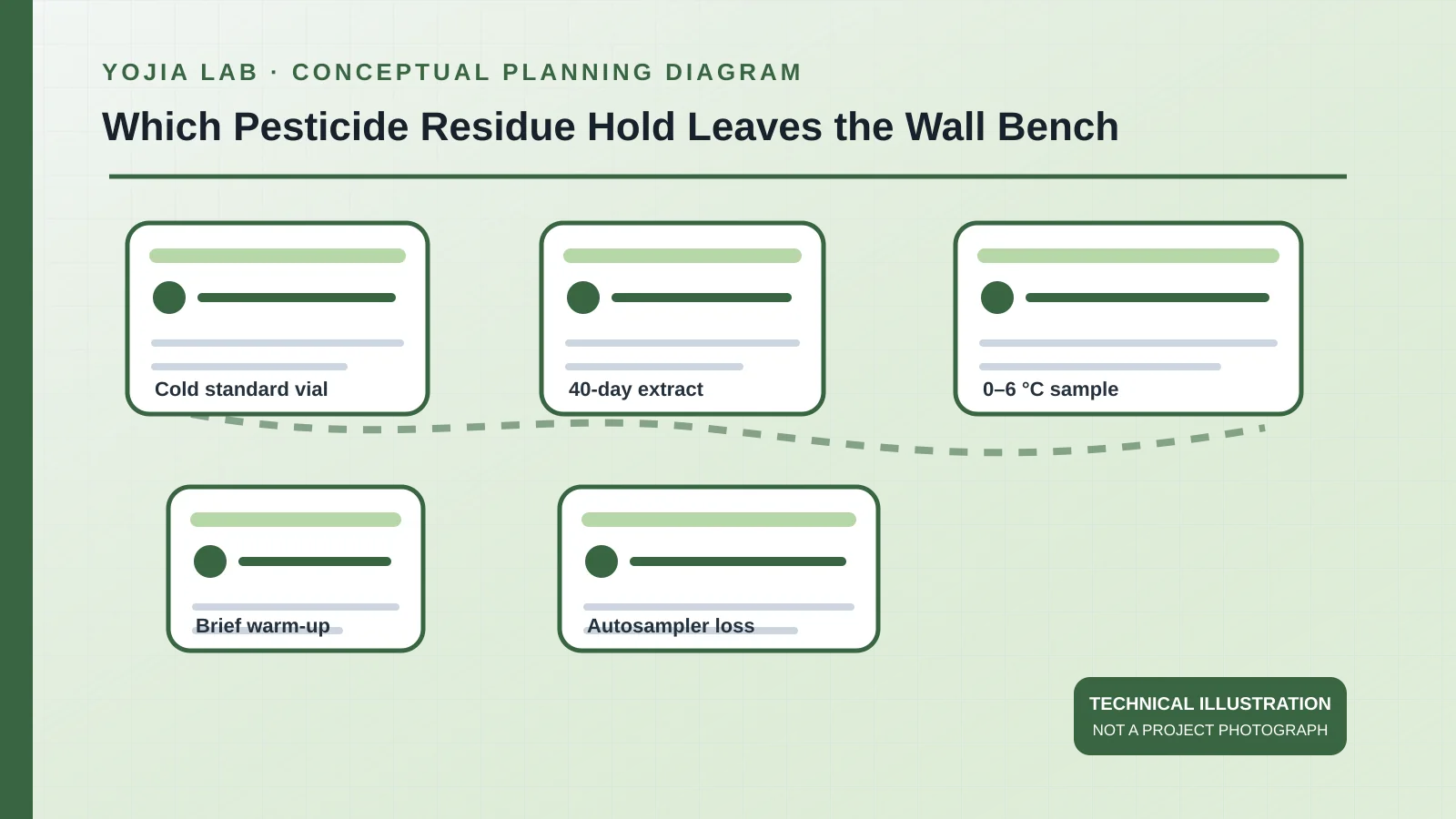
Use the wall laboratory bench for the short warm-up SANTE requires before a cold stock is remixed. Put the 8081B vial, held at or below 6 °C, and the neat SANTE standard, preferably frozen, in a dark controlled refrigerator or freezer. Park the refrigerated extract there too, with the 40-day should written beside the extraction date. Keep the unextracted sample on the 0 to 6 °C side and record whether the project uses 7 days, 14 days, or a quality-plan override. None of those holds lives on the benchtop. The bench needs depth for a small vial and a path back to the cold unit.
Two limits belong on the drawing. Chapter Four's times are guidance unless a regulation makes a method mandatory, so the note has to name the document that governs the sample. SANTE's 10-year replacement and its several-years statement both depend on storage and a purity check. They do not delete a manufacturer's date. A wall laboratory bench drawn as general storage fails the first time a standard precipitates or an extract sits in the light. The modest schedule is one cold dark address for standards, one refrigerated address for extracts, one short warm-up, and an owner for the clock.
Before pricing, place the usable wall length, modules, and service points for the wall laboratory benches with the room notes above. Final materials and supplied scope remain the approved quotation.