01
The sample hold is not a shelf
SANTE/11312/2021 v2026, which supersedes version 2 and was implemented on 1 January 2026, is an analytical quality-control document for pesticide residues in food and feed. It is not a furniture standard. Clause B6 says laboratory samples that are not analysed immediately should be stored to minimise decay. Fresh products should be refrigerated, but typically no longer than five days. Dried products may stay at room temperature, yet if the hold is expected to pass two weeks they should be sub-sampled and frozen. Those three sentences already split the furniture: a refrigerator with a short clock, a room-temperature shelf only for dried goods on a short clock, and a freezer when the dried hold runs long.
The clock is a recommendation with the word typically, not a guarantee that every commodity survives five days. Clause C1 adds that very labile or volatile residues should be started, and the steps that can lose analyte finished, as soon as possible, preferably on the day of receipt. A selection brief that asks only for one sample bench ignores that day-of-receipt case. The bench can receive and portion. The cold appliance is what B6 actually names.
02
Standards take a different cold room
Clause F1 of the same SANTE document is about the neat reference standard, not the apple or the grain. Standards of known purity need a unique code and a record of supplier, batch, receipt date, and place of storage. They should be kept at low temperature, preferably in a freezer, with light and moisture excluded. Under those conditions the laboratory may replace a supplier expiry, often based on easier storage, with a date that allows up to 10 years from receipt, provided the standard is checked by that date and purity is still acceptable. The 10 years is a conditional laboratory decision. It is not a life built into a freezer.
Clause F2 then moves the standard out of that freezer for a short, dry interval. Moisture must be excluded while it equilibrates to room temperature before a stock solution is made, and the concentration is corrected for purity. The weighing spot is therefore not inside the freezer and not in a wash area. USDA PDP-ADMIN, revision 12, effective 1 July 2024, adds the separation without a floor area. Section 5.1 requires enough space to keep samples, reference materials, and other work from being mixed up. Section 5.2.1 limits storage access to authorized people. The brief still has to name the standard freezer and the sample refrigerator as different cabinets.
03
Milling and the instrument rack are not storage
Clause C3 says processing should be shown not to change the residues, pointing to Directive 2002/63/EC. Where room-temperature homogenising degrades residues, SANTE recommends working frozen and/or with dry ice. For dithiocarbamates or fumigants, if no alternative exists, the portion should be whole units or segments. Low-moisture goods such as cereals, spices, and dried herbs should preferably be reduced below 1 mm, without extensive heating, because heat can lose some pesticides. A mill bench that must accept dry ice is not the bench where a standard is warming up dry.
Clause C11 closes the other end. Analyte stability in extracts is evaluated during validation. Storage in a refrigerator or freezer minimises degradation, and losses at room temperature can occur, for example in vials sitting in an instrument autosampler rack. The instrument bench is where a vial waits for its injection. It is not the overnight store. Asking a manufacturer for one continuous top from the mill to the instrument erases both the cold-mill note and the autosampler warning.
04
The rule has to be named before the price
40 CFR 160.47 is a different legal object: a FIFRA good-laboratory-practice rule for a testing facility. As necessary to prevent contamination or mixups, there shall be separate areas for receipt and storage of the test, control, and reference substances, for mixing them with a carrier such as feed, and for storing those mixtures. Storage of the substances and mixtures shall be separate from areas housing the test systems, and adequate to preserve identity, strength, purity, and stability. That shall does not automatically govern a food-monitoring laboratory working to SANTE or to USDA PDP. A room that is a FIFRA study facility and a room that only prepares market samples are not the same brief.
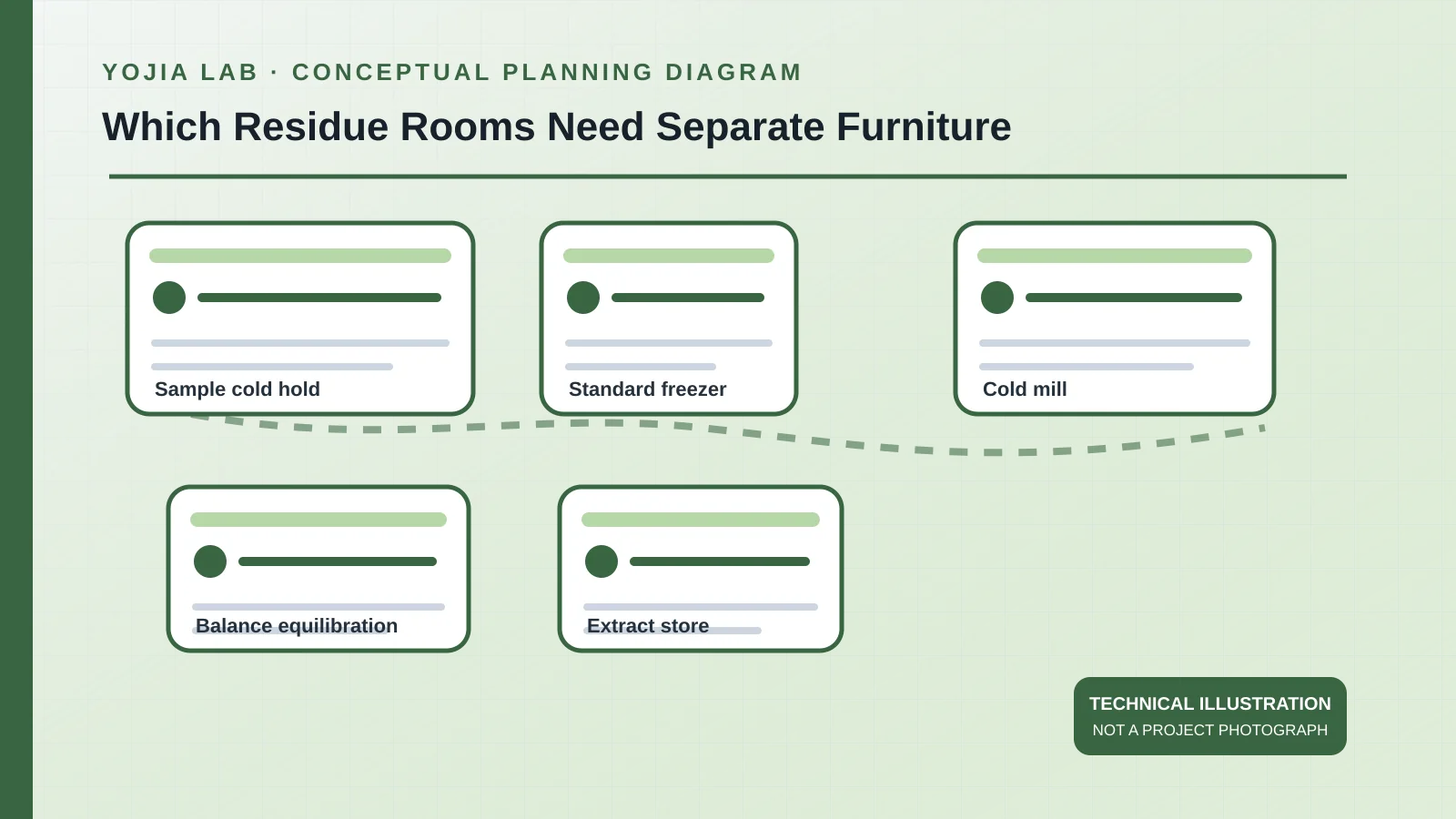
What a manufacturer can answer is the count and the duty of each cabinet and bench once those rules are named: sample refrigerator, dried-goods shelf, sample freezer, standard freezer with light and moisture excluded, a dry equilibration spot, a mill that may see dry ice, and a cold extract store apart from the autosampler. What the manufacturer cannot answer from a furniture list is residue stability, the 10-year standard date, or whether a named cleaner and solvent suit a named material. Those remain with the laboratory's validation and the chemical review. The selection is finished when each duty has its own furniture line, not when one finish has been chosen for the whole laboratory.
When the plan is ready for a factory review, send the quantities, hazards, and unresolved room limits to a China laboratory furniture manufacturer. Open items should stay open rather than being written as a confirmed specification.