01
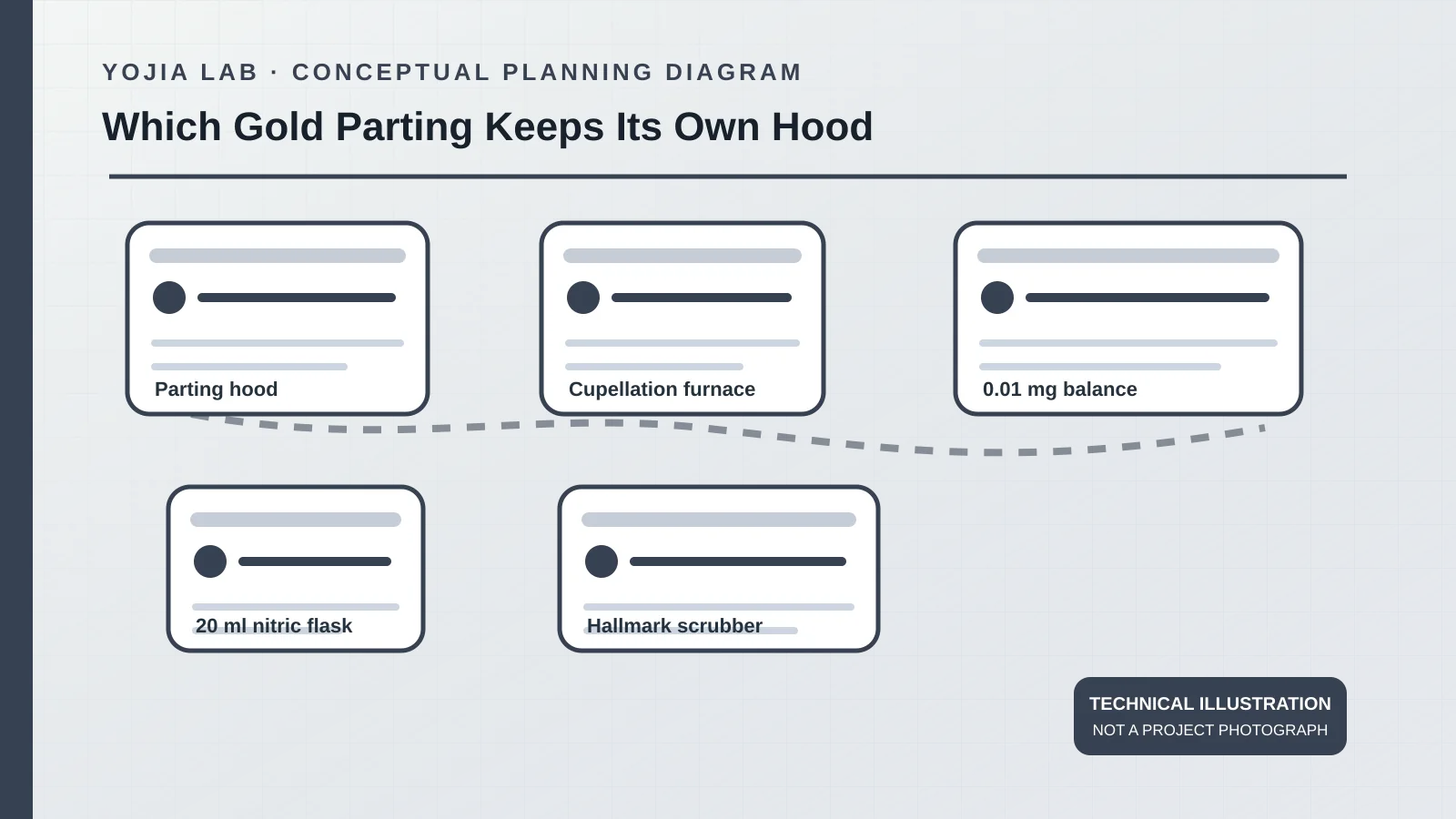
The hood caution belongs to the parting
Parting means digesting silver and other metals away from gold with nitric acid in a chloride-free environment. The caution just before those steps says a fume hood should be kept clean and used exclusively for nitric parting. The verb is should. No face velocity, sash height, or duct material is given. Two acids are named, each with halides printed as approximatively under 2 mg/l and checked by a silver nitrate test: about 33 percent by mass, then about 49 percent by mass.
In a flask, the cornet goes into 20 ml of the 33 percent acid and is boiled for 15 minutes or until nitrous fumes stop, whichever is longer. The acid is decanted and the step repeats with 20 ml of the 49 percent acid. The cornet is rinsed, dried, and annealed at 500 °C to 900 °C for at least 5 minutes before it is weighed. A basket of perforated thimbles can replace the flasks for similar samples: the 33 percent bath starts at 60 °C to 90 °C, boils gently for about 15 minutes or until the fumes stop, and a 49 percent bath follows. The hood caution covers both arrangements. It does not cover the anneal.
02
The furnace is a different machine
Cupellation has its own furnace: a relatively homogeneous 1050 °C to 1150 °C and an oxidizing atmosphere. A standard muffle furnace is stated to be not satisfactory for this purpose. Magnesia cupels, single or in a block, absorb the lead and the base metals. Charges sit on cupels preheated into that range, or on cupels that were heated and then cooled to room temperature before charging. Heating continues until the bead looks mirror-like, typically 20 to 40 minutes. Buttons cool before they are lifted.
The general method uses at least two portions of about 250 mg, weighed to 0.01 mg, in 4 g to 6 g of assay lead. Silver is brought to 2.3 to 3 times the fine gold. Above 900 parts per thousand precious metals, 25 mg to 50 mg of copper should be added. Mass may move between 125 mg and 500 mg if other masses scale and the cupel can take the oxides. The bead is flattened, annealed at 500 °C to 900 °C, rolled to 0.12–0.15 mm, annealed again, and rolled into a cornet, underside out. High base metals add 2 g to 4 g of lead at the start and may cut the sample to 125 mg. None of this places the furnace in the parting hood.
03
The acid limits do not set a sash speed
The NIOSH Pocket Guide nitric-acid entry, CAS 7697-37-2, reviewed 30 October 2019, prints a recommended time-weighted average of 2 ppm (5 mg/m³) and a short-term 4 ppm (10 mg/m³). The OSHA figure on that page is also 2 ppm (5 mg/m³). The immediately dangerous concentration is 25 ppm, and 1 ppm equals 2.58 mg/m³. Boiling point is 181 °F, defined by the guide’s introduction as the value at 1 atmosphere. Vapor pressure is 48 mmHg with no temperature on the line, so the introduction reads it at 68 °F. Specific gravity is separate: 1.50 at 77 °F. The entry includes fuming nitric acid and says fuming acid contains dissolved nitrogen dioxide. Those lines are not a measurement of the 33 percent or 49 percent parting acids.
The liquid is called noncombustible, yet it can increase the flammability of combustible materials. Respirator choices stop at 25 ppm. There is no face velocity, and 2 ppm is not a hood construction test. The balance is separate: at least 0.01 mg, with 0.001 mg preferred above 995 parts per thousand. Duplicates shall differ by less than 0.16 parts per thousand at or above 995, by less than 0.5 below that without platinum, palladium and nickel, and by less than 1.0 when any of those is present. A tighter “ideally” band, typical of reference materials and dependent on composition, is under 0.3 and under 0.5 in those two cases. The method does not put that balance in the parting hood.
04
A hallmarking scrubber is another procedure
The Central Pollution Control Board’s October 2020 guidelines follow a National Green Tribunal order of 18 November 2019. They cover centres recognized under IS 15820:2009 and testing by IS 1418:2009. They print 923 recognized facilities: 312 south, 203 west, 181 east, 133 central and 94 north, a facility count rather than an emissions survey. Their description is a muffle at 1100 °C for 25 minutes, lead-oxide fume, and parting acids of specific gravity 1.2 and 1.3 g/cm³. Both emission streams should pass a suction hood, a duct and a scrubber, with the stack set by the state board’s consent. Nitric acid is about 0.5 litres per assaying; spent acid is about 1.0 litre a day, about pH 2.0, in a 20 to 25 litre container.
Those figures describe the guideline’s IS 1418 centres. They are not ISO 11426’s 20 ml followed by another 20 ml, and ISO says a standard muffle is not satisfactory for its furnace. Moving either sentence onto the other method changes the work. The guidelines also say lead dust should not build up on laboratory surfaces, and that a worker with at least six months on site should have a yearly blood-lead test. Cleaning is not a face velocity. Before a fume hood is priced, lock four lines: the parting hood only as the ISO caution states it, the furnace from the method in use, the acid volume from that same method, and a note that no face velocity came from the pocket guide.
Before pricing, place the room interface, quantities, and service points for the laboratory fume hood systems with the workflow notes above. Airflow, performance, and compliance stay with the project's responsible reviewers.