01
Price demolition only after a clearance gate
NIH describes decommissioning as vacating, surveying, and decontaminating a space so that hazardous chemicals, radioisotopes, pathogens, and hazardous building materials are addressed before a renovation proceeds. The page says the process begins with the users, who know what was handled. A furniture count is not that record. Ask for a room history before a contractor is invited to price removal of benches or services.
NIH's laboratory-move guide, written for its own campus, tells groups to remove radioactive material, waste, and potentially contaminated items before a complete renovation, and to clear the work area before a partial one. Movers are not to pack contaminated items. An area health physicist is contacted before the room is emptied and again after it is vacant. Those steps are NIH procedures. Use them to ask which office on this project issues a clearance, and do not treat an NIH form number as a document this factory supplies.
02
Put the user brief ahead of the furniture quantities
The World Health Organization's laboratory design monograph says a renovation starts from a risk assessment and a needs assessment: which activities, which biological agents, which utilities, and what already exists in the building. The user requirement brief records that purpose. Furniture quantities come after it. A distributor can help gather the brief. The brief is still the owner's technical statement, not a catalog page.
WHO also notes that scientific users may be unfamiliar with construction, so a project manager coordinates designers, builders, and subcontractors through procurement, construction, commissioning, and handover. That role is not the same as a furniture supplier. On the scope sheet, name who writes the brief, who coordinates the trades, and who is only supplying items against an accepted list. Mixing those names is how a bench order absorbs a clearance duty it cannot perform.
- Activities, agents, and specimens
- Utilities the risk review says are required
- What the existing room already has
- Who writes, who coordinates, who supplies
03
Say what the builder holds, and what must be proven first
WHO's construction section says the builder typically takes possession of the site, becomes responsible for security, and is responsible for the safety of workers and visitors while construction is underway. Possession ends at handover. If a medical research floor stays partly occupied, the scope sheet should say which rooms remain in use and who controls access. A price that assumes an empty building is a different project.
The same monograph says that on an existing building some utility checks cannot be finished until construction, including electrical supply, water, drainage, and sewerage. NIH's chemical-move page, for institute relocations on its campus, asks for a final walk-through so that chemicals are gone, tells groups not to carry chemical waste to the new location, and asks that cold rooms at the destination work before cold-stored chemicals move. The notice windows on that page are NIH move guidance. They are not a lead time for laboratory furniture. Record the equivalent local questions: who removes waste, and which services are live.
04
Keep handover apart from authorization
WHO describes commissioning as the check that finished work matches the user requirement specification and the design documents. Acceptance and handover follow. Accreditation or certification, where a country requires it, is discussed separately: a standard is chosen, and an authorized body assesses the laboratory. Some countries authorize activity instead of issuing a certificate. Builder handover does not complete that assessment.
NIH's policy manual on radioactive materials says that deactivations, moves, and complete or partial renovations receive a radiation clearance from its own radiation-safety staff, and that a major renovation or demolition may need a fuller radiological decommissioning. The manual says that path can involve the Nuclear Regulatory Commission and may take nine months or more at NIH. Quote that duration only as NIH's description of its own major radiological work. It is not a renovation schedule, and it does not apply to a room that never used radionuclides. Ask the radiation office whether this room is in that class.
05
Leave equipment models open until the gate is real
WHO notes that a laboratory project can run long enough, from planning to handover, for equipment models to be replaced. The monograph treats that as a reason to track changes with the makers and the designers, not as a promise of any particular duration. On a contractor package, list instruments as provisional until the clearance gate and the user brief are accepted. A model that changes can change the service stub. Do not freeze a cutout against a catalog photograph.
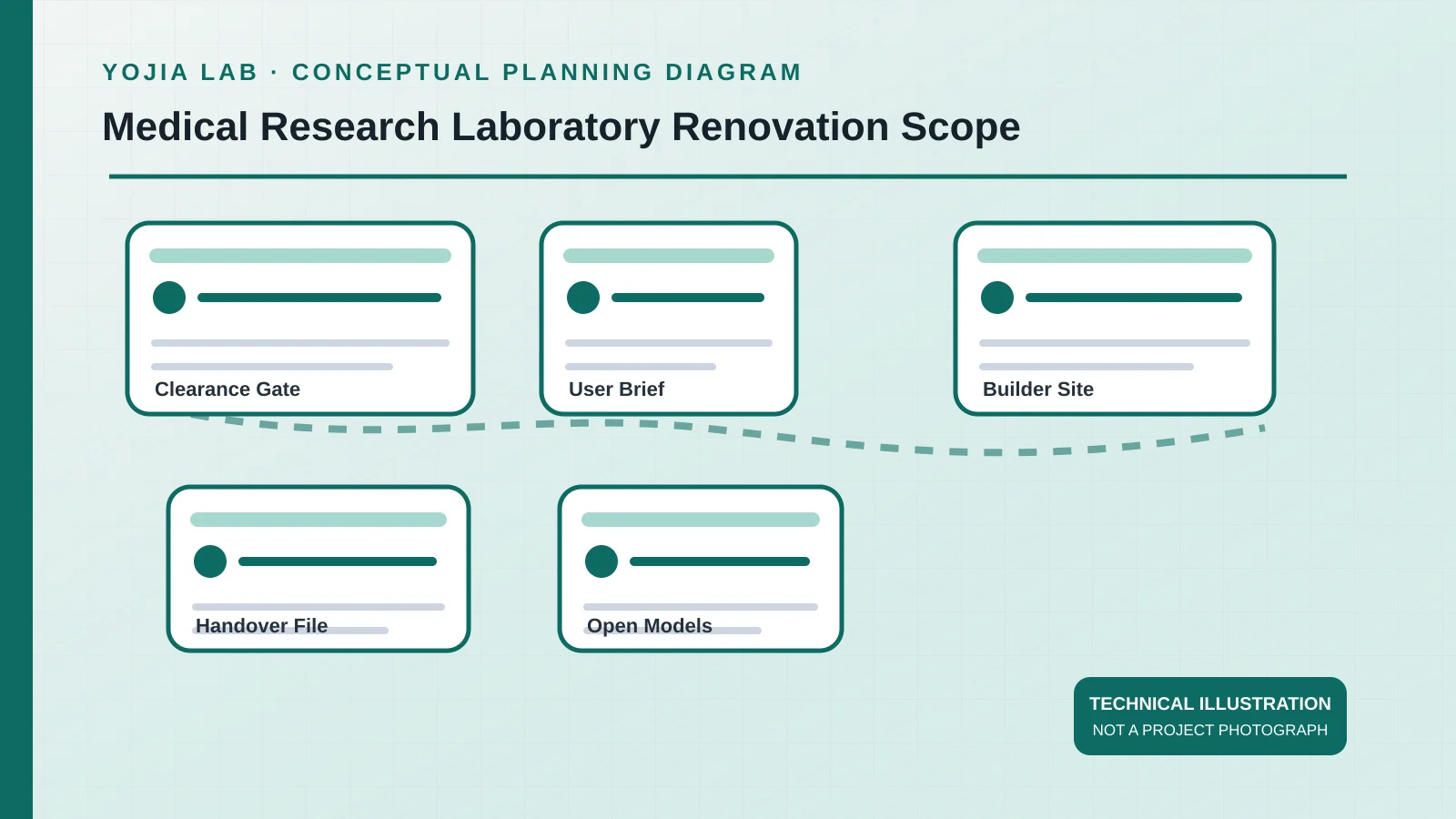
Exclusions belong on the same sheet. Decontamination, radiation survey, waste removal, and any authorization by a competent authority stay with the offices that own them. Mobile tables and storage can be discussed after the room is cleared and the brief is stable. They do not clear a laboratory. The figure shows five planning zones. It is a technical illustration, not a built renovation and not a clearance sticker.
Before pricing, check the laboratory furniture support for distributors and contractors against the room and workflow conditions already recorded above.