01
Keep only the working quantity in the room
The UK Health and Safety Executive says an employer must justify any flammable liquid kept in a workroom or laboratory. Keep only the minimum for frequent tasks, or the amount for half a day or one shift. Containers stay closed when idle, in a fire-resisting cabinet or bin that holds a spill equal to 110 percent of the largest vessel normally stored there, away from the immediate task and clear of escape.
The same page offers recommended maxima, not absolute caps: no more than 50 litres for extremely or highly flammable liquids and for liquids whose flashpoint sits below the room’s highest ambient temperature, and no more than 250 litres for other flammable liquids with a flashpoint up to 60 degrees Celsius. Exceeding them needs a written risk assessment covering how people leave. Do not paste 50 litres onto a drawing governed by another country’s rule.
02
Name the cabinet duty without claiming a fire test
OSHA’s flammable-liquids standard limits a storage cabinet to not more than 60 gallons of Category 1, 2, or 3 flammable liquids and not more than 120 gallons of Category 4. The cabinet must hold its internal temperature to not more than 325 degrees Fahrenheit in a 10-minute fire test, with joints tight and the door closed, and it must carry conspicuous lettering: “Flammable - Keep Fire Away.” A line that only says “flammable cabinet” has not recorded that test or that wording.
The same standard says flammable liquids must not be stored so that they limit exits, stairs, or other routes people use to leave. On the wall laboratory bench elevation, show the door swing against that route. A different paragraph sets quantities that may sit outside a cabinet in industrial plants where flammable liquids are only incidental to the business. Ask whether this quality-control room is that case before printing an outside-cabinet gallon figure. This article does not choose the paragraph for the building.
03
Do not mix hazard families in one bay
The Canadian Centre for Occupational Health and Safety says incompatible materials do not share a safety cabinet unless the cabinet is built with the fire barrier the applicable fire code requires. A flammable acid or a reactive flammable chemical is not stored with flammable solvents it will react with, even though both can burn. Acids and caustics are not stored together. Open-topped cans are not allowed in the cabinet. Cardboard packaging comes off before a bottle goes in, because paper inside the cabinet adds fuel.
The same note says glass needs extra protection because it melts above the temperature the cabinet fire test is meant to limit, and that gas cylinders are not automatic contents of a liquid cabinet. The UK page keeps energetic substances, oxidizers, and corrosives out of the flammable cabinet even when those materials are themselves flammable liquids. Draw a second bay, or name another room. Another shelf inside the first cabinet does not separate the families.
04
Give retained samples their own address
EPA’s SW-846 holding-time page says a recommended holding time depends on the constituent, the matrix, and the sample type. Those figures are guidance unless a regulation or a method says otherwise. If this method calls for refrigeration or freezing, a room-temperature cupboard under the wall laboratory bench is the wrong address. If the internal procedure has no cold step, do not add a refrigerator to imitate that page.
OSHA’s hazard communication standard requires workplace containers of hazardous chemicals to carry a product identifier and hazard information that employees can use with the rest of the written program. A portable container filled by one person, kept under that person’s control, and used only during that shift, is the immediate-use case the standard exempts from labeling. Overnight retains and reagents shared across a shift change are not that case. Mark a label position on the elevation for every container that will still be there when the next person arrives.
05
Price the bays that have a named duty
A priced elevation can show the wall length, which bays are ordinary cupboards, which bay is proposed as a flammable cabinet, where the required wording would go, and how the door meets the exit. It can show a separate cold address when a named method requires one. It should not print a litre or gallon limit the site has not adopted, and it should not state that a cabinet has passed a 10-minute fire test unless a report for that construction is already in the file.
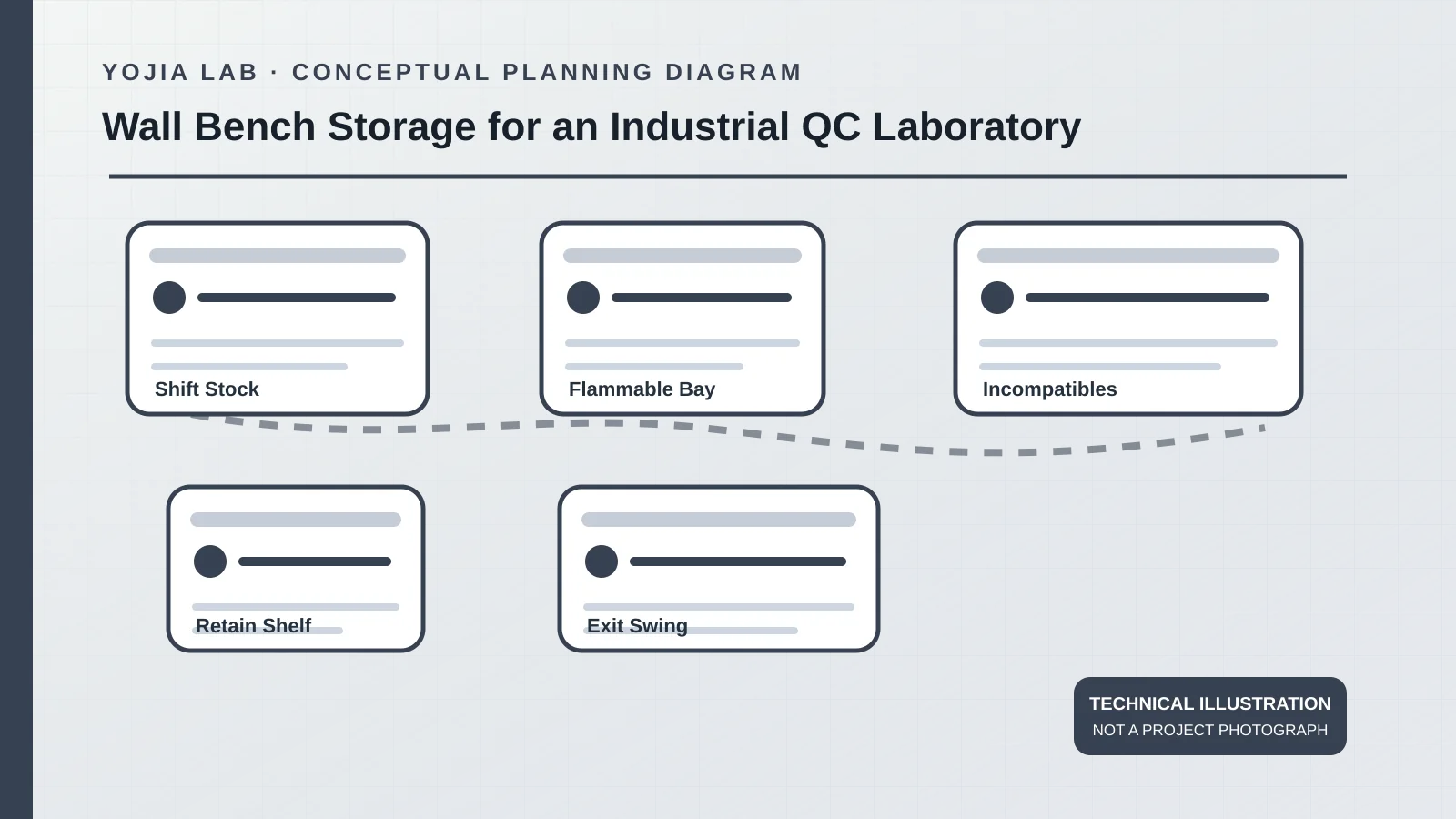
Reference model codes identify the inquiry. They do not certify a cabinet, a shelf load, or a chemical compatibility. The illustration on this page shows the questions along a wall laboratory bench. It is not a photograph of an industrial quality-control room and not a fire-test record.
Before pricing, place the usable wall length, modules, and service points for the wall laboratory bench run with the room notes above. Final materials and supplied scope remain the approved quotation.