01
Ask which machines actually need two sides
An island laboratory bench is a two-sided or walk-around worktop. A gauge loaded from the front and serviced against a column should not start there. NIH's April 2010 note describes a repeating module, typically 3,350 millimeters wide and about 10,056 millimeters long, with a 1,525-millimeter aisle between bench or equipment zones. Its biomedical thumb rule is two people per module and support space around half the laboratory area. An inspection room does not inherit that headcount. It can still name who stands where before the worktop is drawn.
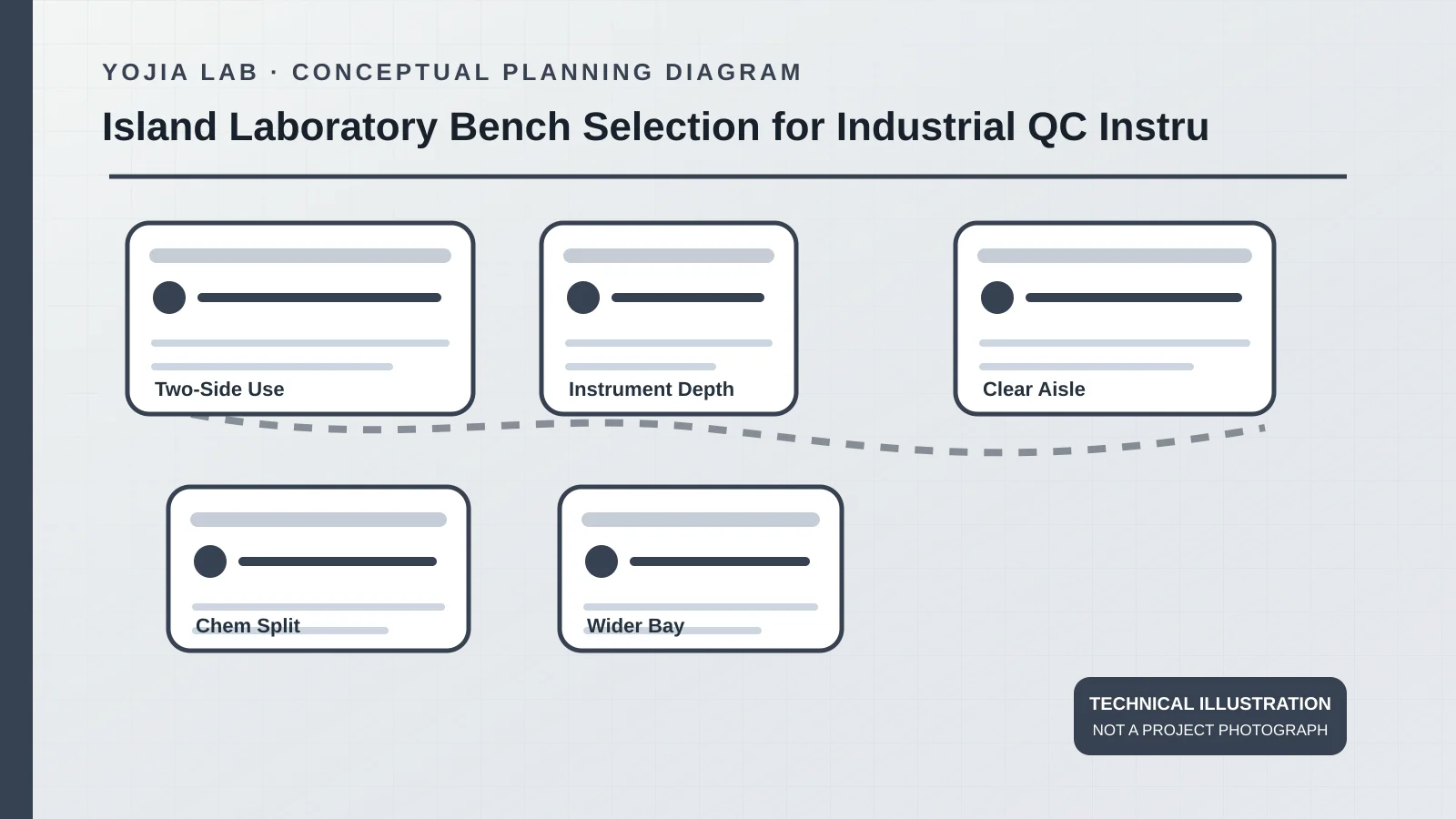
The 2013 bulletin refuses a single module for some machines. Optical tables, imaging gear, electronics, and robotics often need access all around: one 11-foot bay is too narrow, and two bays side by side are too large. A factory measuring volume or a vibration-sensitive balance has the same shape problem even though the bulletin never names it. Mark each line walk-around or front-load only. An island laboratory bench belongs only on the walk-around lines.
02
Put instrument depth and the leftover aisle on one line
The 2013 bulletin defends a 5-foot aisle with a turning radius it cites, back-to-back work, a clearance in front of a biological safety cabinet, and a width that discourages equipment in the path. The cabinet figure is biomedical. A hardness tester does not inherit it. What transfers is subtraction. Thirty-inch benches are not an open spectrometer door, nor the 40-inch freezer or 48-inch enclosure listed as reasons to widen the bay.
Draw the current depth, the open door, and the operator, then write the aisle that remains. Do not paste 5 feet or 5 feet 6 inches onto a purchase line because a bulletin used them. If the leftover path is smaller than the access this project's reviewer requires, the island laboratory bench is too deep, the bay is too narrow, or the machine belongs elsewhere. A path that exists only when the cart is moved has not been selected.
03
Keep the walking surface and the chemistry off the instrument
OSHA’s walking-surface rule, 29 CFR 1910.22, publishes no island width. The employer must keep passageways clean, orderly, and sanitary, keep floors clean and as dry as feasible, and, for wet processes, maintain drainage and dry standing places such as platforms or mats. The surface must carry its maximum intended load, access must be provided, and hazards must be corrected or guarded before reuse. An island laboratory bench choice that omits the load and the wet step has only picked a shape.
If the room handles hazardous chemicals, 29 CFR 1910.1450 applies as well. The chemical hygiene plan must require protective equipment to work and must state the measures. For particularly hazardous substances it must consider containment where appropriate, such as a hood or a glove box. Appendices add no duties by themselves. A solvent wipe or acid spot test does not automatically share the spectrometer island. Put that step on its own line and leave performance numbers blank until the plan names them.
04
Move deep, hot, or shaky machines out of the standard bay
The 2013 bulletin does not fix an awkward machine by lengthening the bench in the same 11-foot slot. It points to specialty rooms with a wider module, often 12 to 15 feet, or a column-free area whose utilities sit on a regular ceiling and perimeter grid. Noise, heat, vibration, radio-frequency sensitivity, and security are further reasons to leave the standard laboratory. A compressor or furnace beside a microbalance ignores that split even when nobody on the project works at NIH.
There are three addresses. Front-loaded gauges can stay single-sided. Walk-around instruments that fit the aisle arithmetic can use an island laboratory bench. Deep, hot, or vibration-sensitive machines go to the wider bay, on that bay's service grid. A writing ledge is an extra line only when a task needs it. Half the laboratory area, from the 2010 biomedical note, is not a furniture quantity.
05
Hold the model until the blanks are filled
Someone who has not seen a brochure should be able to read the sheet. Each row shows sides of use, open depth, leftover aisle, intended floor and bench load, wet or dry, and whether a chemical step shares the footprint. Empty cells stay empty. Copying 3,350 or 1,525 millimeters from the 2010 note without a survey invents a module this factory may not have. Copying a biosafety clearance onto a coating gauge invents a rule that does not name the gauge.
The sheet should also say what is not ordered. Hood velocity, cabinet certification, and any claim that the bench protects a test result sit outside this choice. OSHA assigns walking-surface and hygiene duties to the employer. NIH's dimensions belong to its research buildings. The island laboratory bench decision is only whether this instrument, in this bay, still has the access and separation the project wrote down.
Selection here is a room configuration, not a generic catalog. Put the dimensions, materials, and interfaces to confirm for the island laboratory bench layout next to what a laboratory furniture manufacturer in China can answer from drawings and a written brief.