01
Receipt is a form, not a crusher
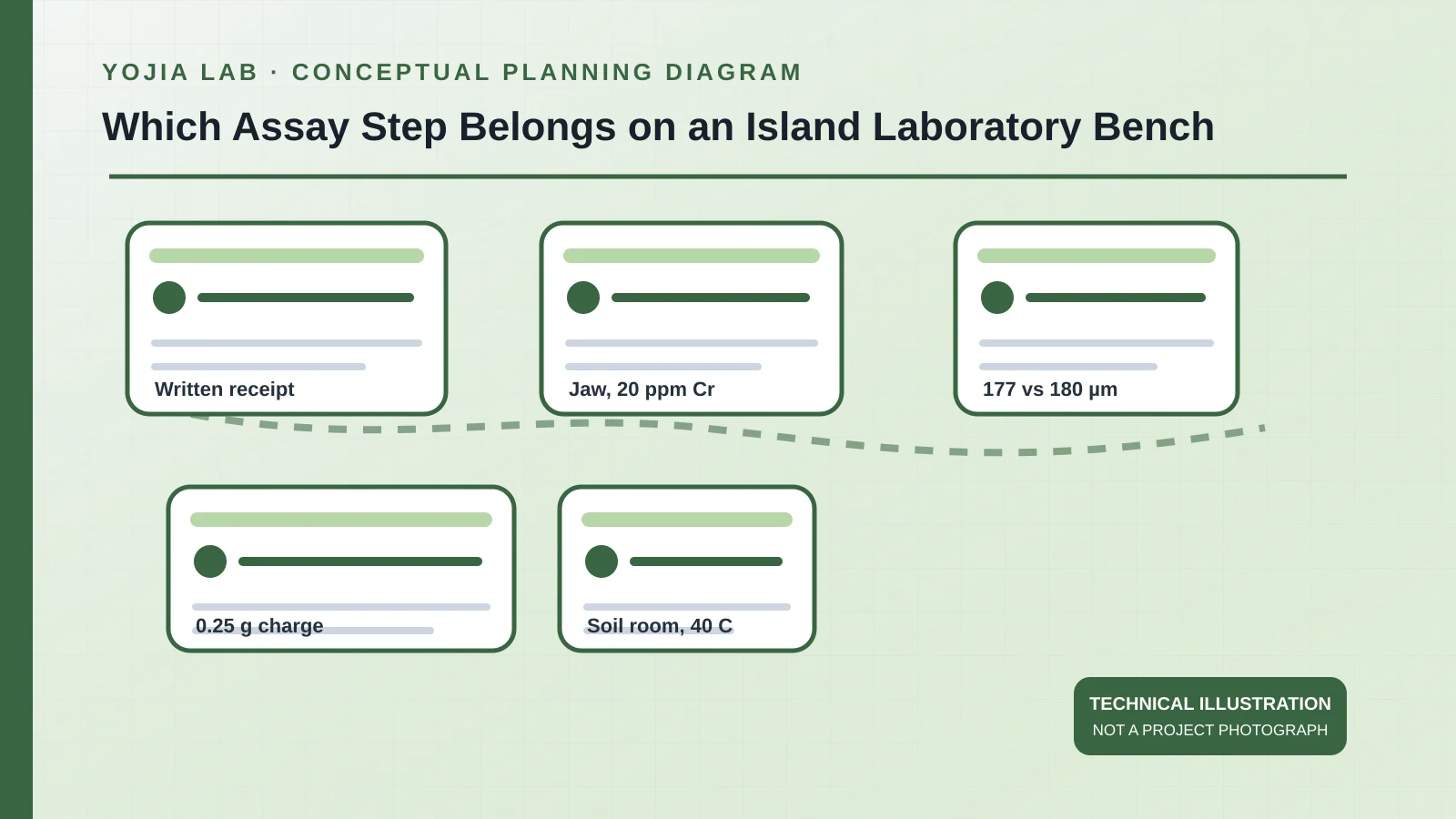
Issue 18 of the Ontario Geoscience Laboratories schedule, effective 1 April 2026, says samples will not be processed until adequate written instructions are received. The client’s name and address have to be marked on the shipment, each piece has to be numbered, and a copy of the Sample Submission Form has to come with them. Poor labels increase turnaround and draw a sorting charge. Where pulverizing is required, the brochure calls 300 g the optimal submission. That figure is a mass the laboratory asks to receive. It is not the length of an island laboratory bench, and checking the form is not the same motion as crushing the bag.
The same schedule equips the laboratory for samples up to 3 kg and charges for anything heavier. A 3 kg rock and a 300 g pulverizing submission are different objects before a layout is sketched. The client must disclose hazardous materials. The laboratory may refuse an undeclared hazard and return it at the client’s expense. Those sentences govern receiving. They do not describe a jaw, a mill, or a balance, and they set no distance between those machines.
02
The jaw and the mills do not add the same metal
For rock, the brochure uses a jaw crusher with steel plates, a riffle to split the crushed material, and then a grinding medium. During jaw crushing, up to 20 ppm chromium and 1 ppm molybdenum may be added, depending on the sample’s SiO2 content. Clients who need analyses sensitive to chromium are advised to submit pulps. That is a contamination statement about steel jaws at this laboratory. It is not a clearance the brochure measured between the crusher and a balance, and it should not be copied onto a laboratory that does not use those plates.
The mills are named separately. SAM-SPA uses high-chrome steel and may add minor chromium and iron: minimum 150 g, 80 mesh printed as 177 µm. SAM-SPG, for detailed whole-rock geochemistry, uses a 99.8 percent aluminum-oxide planetary ball mill and may add minor aluminum: 150 g, and 170 mesh printed as 90 µm. SAM-AGM, the agate mill, is described as significantly reducing chromium, iron, and aluminum compared with those two, again at 150 g and 170 mesh (90 µm). SAM-CTK disaggregates with a mortar and pestle and keeps the minus 200 mesh fraction, printed as less than 75 µm, from a 100 g minimum. An island laboratory bench cannot be all four of those preparations.
03
The 0.25 g charge is already a pulp
U.S. Geological Survey Open-File Report 96-525 (1996) says on its cover that the report is preliminary and has not been reviewed for conformity with Survey editorial standards. In the rock-pulverizing steps, a grind is acceptable when 100 percent passes an 80-mesh screen, written as less than 180 µm, and at least 80 percent passes a 100-mesh screen, written as less than 150 µm. Cleanup uses about 1 oz of quartz sand, then compressed air that must not be aimed at the face, with a fan or exhaust hood to vent the dust. The brochure’s 177 µm and this manual’s 180 µm are two printings of an 80-mesh screen, not one tolerance and not a furniture module.
The manual’s hydride-generation atomic-absorption procedure for arsenic, antimony, and selenium in rock, soil, and sediment starts by weighing 0.25 g of sample already finer than 80 mesh into a 30 mL Teflon vessel, adding 9 mL of nitric acid and 0.25 mL of 10 percent hydrochloric acid, and standing for 3 hours. That digestion’s safety note calls for a chemical exhaust hood. In the preparation steps that check the Request for Analysis form before sieving, wet or damp samples dry at 60°C until thoroughly dry, and Sample Control is called if field numbers do not match the bags. The 0.25 g weighing can sit on an island laboratory bench. The jaw, the counter that is blown clean, and the hood cannot. The 60°C figure is an oven setpoint in this manual, not a bench depth.
04
Soil pretreatment stays in its own room
The public preview of ISO 11464:2006 is a soil-quality standard for pretreatment before physico-chemical analysis of stable, non-volatile parameters. It names drying, crushing, sieving, dividing, and milling. It does not apply if pretreatment would change the result, or when volatile compounds are measured. Clause 5.1 recommends that this pretreatment always use a room reserved for it, remote from analytical measurements, and it warns against dust from the room or between samples processed close together. Clause 4 says the apparatus must not add or remove the substances under investigation, giving heavy metals as the example. That sentence belongs to soil pretreatment under this standard. It does not measure the Ontario jaw, and it does not withdraw the brochure’s note that the jaw may add up to 20 ppm chromium.
Oven drying in the preview uses a layer not thicker than 5 cm and a temperature that does not exceed 40°C. The same 40°C cap is printed with air drying and with the forced-ventilation oven. The principle prefers that cap to room-temperature air drying because faster drying limits microbial change. The apparatus list gives the plate sieve a 2 mm aperture, an analytical balance readable and accurate to 0.1 g, and a second balance readable and accurate to 1 g. None of those is a length of island laboratory bench. A soil tray at 40°C is not the 60°C drying step in Open-File Report 96-525, and neither oven is the 0.25 g balance.
Before pricing, place the room dimensions, user sides, and service interfaces for the island laboratory benches with the workflow notes above. The final configuration remains the approved quotation and drawings.