01
Accessioning is a place and a signature
UKIAFT's 2018 laboratory guidelines recommend, where possible, a separate accessioning area. Specimens are received there, accession numbers are assigned, and aliquots are removed or stored in a refrigerator or freezer. Shipping containers are opened only in a secure area, by the person designated to record receipt. Unauthorized people do not enter unless escorted. The physical layout must make undetected entry impossible, and an escorted visitor signs the time, date, and purpose. Until login, specimens must stay under appropriate environmental and security conditions.
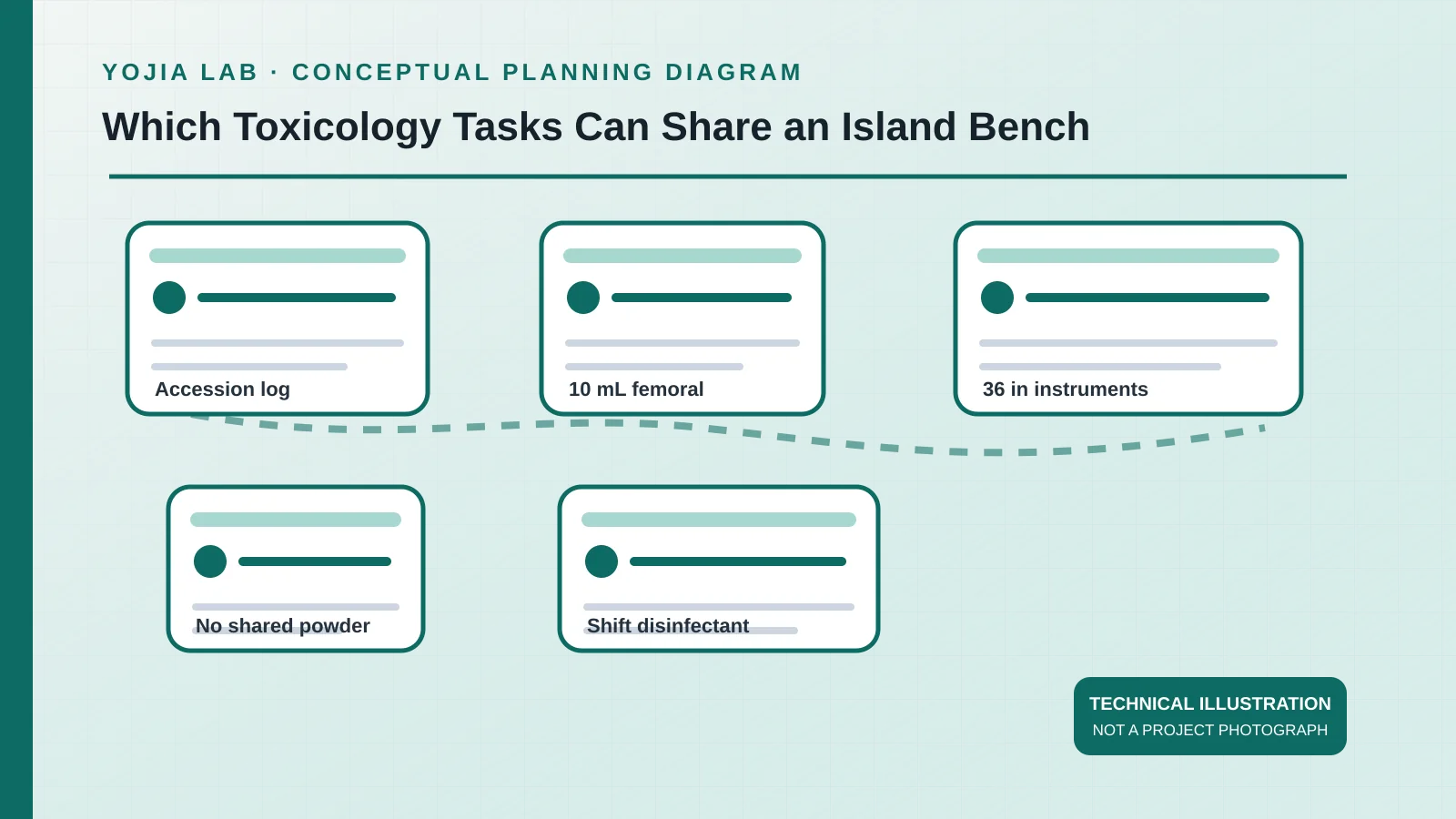
A specimen transfer, or a portion removed for analysis, must enter the permanent record: date, test, accession numbers, who took the aliquot, and who received it. Two people passing a tube across an island laboratory bench without those fields have missed that record. The volumes beside the rule are collection amounts, not bench lengths: 10 mL femoral blood, site specified and isolated; 25 mL of cavity or heart blood only if femoral blood is limited or unavailable and the laboratory agreed to that starred sample; a human-performance minimum of 5 mL of blood and 20 mL of urine, with smaller volumes still accepted and a narrower screen. A reasonably complete screen should still be possible on no more than 5 mL. Sodium fluoride, and at least 1.5 percent where possible for unstable drugs, is a vial condition.
02
The analyst line is not the instrument line
NISTIR 7941 (2013) says there is no universal forensic laboratory plan, and Appendix B says its figures may not bear on a given facility. The toxicology main-laboratory line is a 15-linear-foot or 90-square-foot U-shaped bench per analyst, at user preference, with a secure in-process cabinet and a separate 6-linear-foot bench for a hood as needed and a sink. Instrumentation is a 36-inch-deep bench per instrument, with rear access, an adjacent layout bench, and gas cylinders in a corridor closet outside that room. Refrigerated evidence is an additional room or a secured, monitored refrigerator in the main laboratory or a separate room.
Those lines are not one island. A 36-inch instrument bench needs rear access; folding it onto the analyst island removes that access and puts pump heat and gas plumbing beside sealed specimens. UKIAFT puts the refrigerator or freezer in the accessioning area, so the cold hold is a monitored cabinet, not a stripe on the top. Reagent preparation may share the main laboratory or occupy its own room, and it still has a 4-linear-foot chemical layout bench. The 15-linear-foot and 90-square-foot figures are alternatives in a consideration table, not a code minimum and not a furnished length.
03
Blood on the top creates a cleaning duty
Where a U.S. employer has occupational exposure, 29 CFR 1910.1030(d)(1) requires universal precautions. If body fluids are difficult or impossible to tell apart, all of them are treated as potentially infectious. Paragraph (d)(2)(xiii) requires a container that prevents leakage during collection, handling, processing, storage, transport, or shipping. Paragraph (d)(2)(x) prohibits food and drink in refrigerators, freezers, shelves, cabinets, or on countertops or benchtops where blood or other potentially infectious material is present. Paragraph (d)(4)(ii)(A) requires an appropriate disinfectant after procedures, as soon as feasible after overt contamination or a spill, and at the end of the shift if the surface may have become contaminated since the last cleaning.
That standard names no island depth and no resin. NISTIR 7941's general work-surface considerations, which the handbook says may not apply to every facility, mention stainless steel where biologically contaminated evidence is placed on the work surface, epoxy resin where a hood is installed, and chemical-resistant plastic laminate in other laboratory spaces. Those lines are not a disinfectant test of a named bench. The accessioning surface holds closed containers and a written cleaning schedule. It is not the extraction bench, and it is not a place for food, even when the only cold box is in the same room. If plastic wrap, foil, or imperviously backed paper is used, paragraph (d)(4)(ii)(B) removes it when overtly contaminated or at the end of the shift. A covering does not replace the separate accessioning area UKIAFT recommends where possible.
04
Powder exhibits do not join the blood tube
UKIAFT recommends segregating biological specimens from other exhibits, especially drug material, bulk or otherwise, because that material may contaminate biological fluid or hair. Samples must be in individual labelled containers, examined on receipt and later for contamination, and stored appropriately. Disposable tools that touch a biological sample are sterilized or replaced, and surfaces are cleaned. Carry-over in a qualitative or quantitative system should be assessed with a blank, with and without internal standard, after the highest calibrator or a high-concentration control. Blanks inside a batch and between specimens are called good practice when the matrix may hold a high drug concentration. Liver is the example given.
An island laboratory bench that takes both a powder exhibit and a blood tube is the arrangement UKIAFT says to avoid. A wipe is not the blank the guideline describes. If another room is unavailable, the drawing should say so and name the glassware, instrument, and blank sequence that remain. Fifteen feet, 36 inches, and 5 mL are a consideration, a service depth, and a specimen volume. They are not one quotation length, and none is a measured bench from a furnished room.
Before pricing, place the room dimensions, user sides, and service interfaces for the island laboratory bench layout with the workflow notes above. The final configuration remains the approved quotation and drawings.