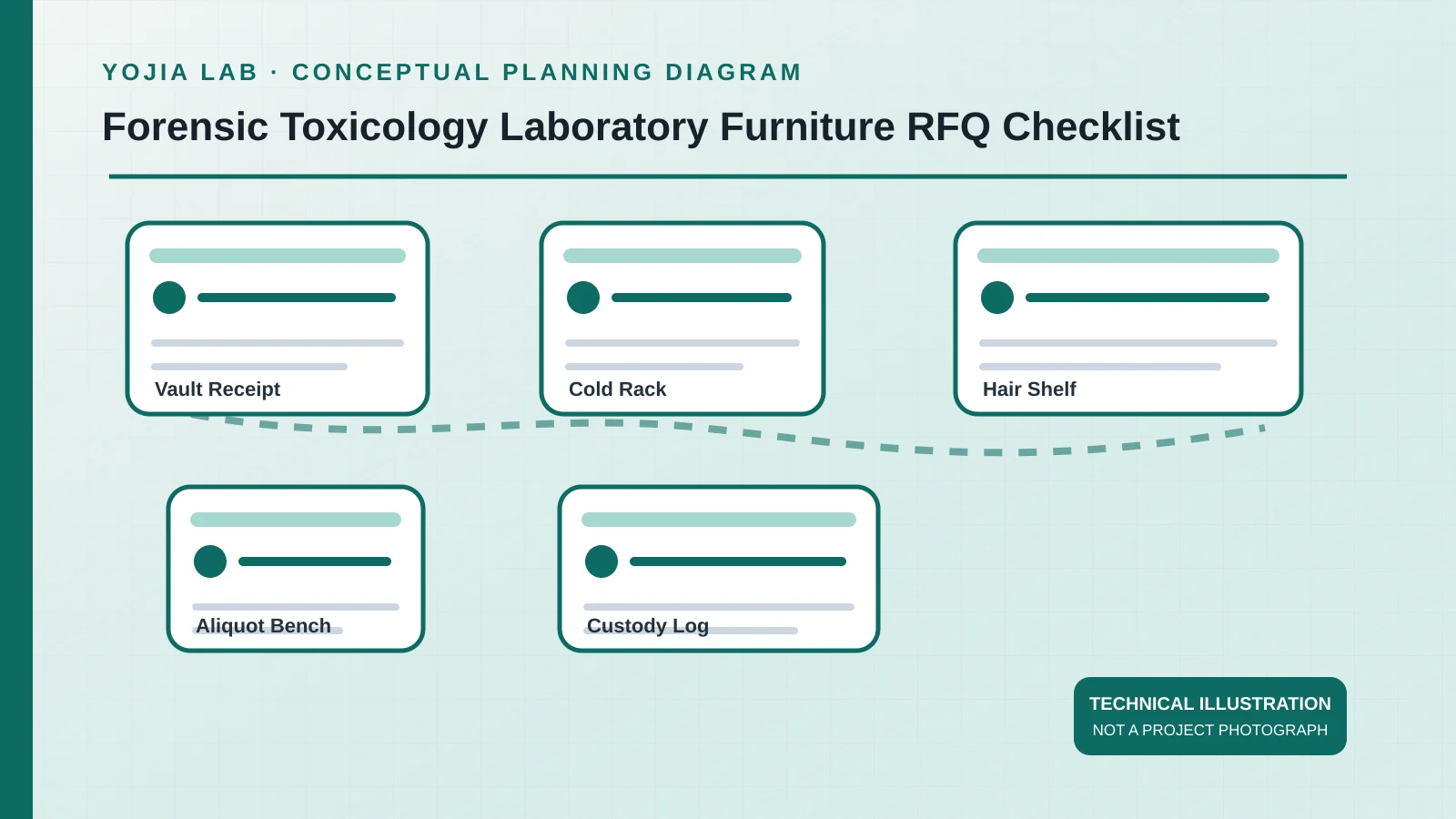
01
Name the sub-discipline before any length
ASB 156 covers postmortem work, human-performance cases, court-ordered testing, non-regulated occupational testing, suspected poisoning, and child-welfare cases. It does not cover breath alcohol. Not every specimen is collected in every case. Human-performance blood in that document is two 10 ml tubes with 1 to 2 percent sodium fluoride and 0.2 percent potassium oxalate, held at or below 8 °C. Court-ordered urine is 45 ml, also at or below 8 °C. Postmortem peripheral blood is 20 ml when it can be obtained. Hair, about 100 mg with the root end marked, stays at room temperature. One cupboard labeled “samples” erases those differences.
NIST IR 7941 describes toxicology as the examination of biological specimens for alcohol, drugs, and other toxic compounds. As a consideration, not a quota, it offers a 15-linear-foot or 90-square-foot U-shaped bench per analyst, a cabinet for in-process evidence, and about 6 linear feet of miscellaneous bench. The appendix says these lines may have no bearing on a given facility. Copy a figure only after the laboratory circles it or strikes it. Printing 15 feet for every person, without a headcount, is not yet a quantity.
02
Split cold racks from the room-temperature shelf
The temperature split in ASB 156 is the storage plan. Blood, urine, oral fluid, vitreous humor, tissue, and gastric contents in the tables reviewed here are held at or below 8 °C. Hair and nails stay at room temperature. Gel-separator tubes are not used. Tubes with additives are inverted at least eight times. Specimens go into glass or plastic unless the laboratory has a different instruction for a named drug, and glass that will be frozen needs a guard against breakage. None of that is a cabinet model. It is why a cold rack and a dry shelf are separate lines, with the laboratory’s own upper temperature written beside the cold line.
NIST adds secured refrigerated or frozen storage beyond the analyst’s in-process cabinet, with a walk-in only if quantity justifies it, plus temperature monitoring. That is a second decision, not an automatic walk-in. A few tubes a day may mean a locked refrigerator. Tissue and long holds may mean a room. Ask which, and ask who is alarmed when the temperature leaves the range. ASB 156 also says the laboratory should explain a rejection. Receipt needs a place for a rejected package that is not the accepted cold rack.
03
Keep the vault and the in-process cabinet as two custodies
NIST IR 7928 describes chain of custody as the chronological record of movement, location, and who held the item. Every transfer is recorded. A break can be used to challenge admissibility. The papers may be kept after the evidence is destroyed, for a period set by case type and law. An extract or other derived material needs its own chain. Furniture does not create that record, and it makes the record harder if the vault and the analyst’s cabinet are drawn as one volume.
The Washington State Patrol toxicology procedure, one agency’s 2023 rules rather than a national code, keeps a limited-access vault as the primary store. Items not under examination stay under a seal that would show entry. Items under examination may use a temporary refrigerator, with tubes upright in racks where possible and odd shapes in trays. Child items are tracked like the parent. The request should ask where the key list stops, where the temporary cold box is, and whether an aliquot gets its own line in the log.
04
Ask for the aliquot path and the glassware split
Once a tube is opened, the parent and the portion taken from it are different custody objects. NIST IR 7928 expects the derived item to carry its own description, identifier, location, and what was done to it. Show a surface where the portion is made, and a rack where the parent returns still sealed if the procedure says it returns. Do not put opened tubes, unopened tubes, and hair in one tray because they arrived together. Hair is the room-temperature object in the ASB table. It should not enter the cold rack just because the envelope arrived cold.
NIST’s reagent line, still a consideration rather than a quota, separates about 4 linear feet of layout from clean and dirty glassware benches of about 3 linear feet each. Dirty glassware and capped evidence are poor neighbors. If this laboratory sends glassware out, delete the line. Instrument benches in the appendix are about 36 inches deep, with rear access for maintenance. Write the instruments. A depth copied for a machine that is not on the list is not a requirement.
05
Leave the package unfinished on purpose
NIST’s receiving notes describe a counter with staff on the secure side, a packaging surface, and after-hours lockers that may be cold. Use them only if this laboratory actually receives evidence from outside agencies at a public counter. A medical examiner’s laboratory may use a different door. Drawing the public counter anyway adds a room the operation does not have. Treating every appendix row as included will price a scope the laboratory has not accepted.
The useful package is a column of answers and a column of blanks: sub-discipline, specimen list, cold versus room temperature, vault versus in-process cabinet, child-item rule, rejected-package shelf, and instrument rear access. ASB 156’s amounts are starting points the laboratory may refuse. NIST’s linear feet are considerations it may circle. Neither publication is a purchase order. A factory can answer only the rows that are no longer blank.
Before pricing, check the distributor and contractor project support against the room and workflow conditions already recorded above.