01
A clean surface is not the locked store
New York's Wadsworth Center file, Clinical Laboratory Standards of Practice for Forensic Toxicology, is hosted as effective August 2020. Its musts apply to laboratories the state permits in that category. They are not a national building code. Standard of Practice 1 requires collection instructions to include a clean surface for the specimen and the paperwork, plus a secure temporary store until the specimen is tested or shipped. Access to the collection area and to the supplies is limited to authorized people. The clean surface and the secure location are two sentences. One open bench cannot honestly be both.
Standard of Practice 7 holds original specimens in a dedicated secured space until disposal. The guidance allows a locked room or a locked refrigerator, a short list of people, and a record of why each person entered. Standard of Practice 8 says an aliquot must not return to the original container. Standard of Practice 5 requires the custody record to name the person, the date, and the purpose, including every move into or out of storage, written at the time. The bench used to compare a label is not the long-term address, and it is not a place to pour an aliquot back. Standard of Practice 6 adds an authorized list, a lock or barrier, a workday sign-in, and a breach record.
02
Toxicology sits on the far side of a vestibule
The National Institute of Justice handbook, NCJ 168106, April 1998, says there is no single correct forensic laboratory plan. Its toxicology checklist is still specific. Design the section as biologically hazardous space with a biovestibule, and keep the drug section from cross-contaminating it. Analyst workstations sit in the main space. A separate specimen-processing room may be required, depending on operations and accreditation. Reagent preparation may be its own room or part of the main space, and that checklist includes a flammable-materials refrigerator. The handbook also prints bench lengths. Those lengths are not the selection made here.
The 1998 handbook is a planning aid from that year, not a current permit. Read beside the New York standards, the vestibule and the locked store answer different failures. The vestibule keeps high-concentration drug material out of the biological work. The locked room or locked refrigerator holds the original specimen after receipt. One bench family cannot answer both until the room list exists. The factual questions for a furniture maker are the number of analyst positions, whether processing and preparation are separate rooms, and which refrigerator is for flammable materials. Those counts come from the laboratory's own methods. The handbook does not supply them.
03
Four security zones are not four copies of one bench
Annex A of the Standards Council of Canada's Requirements and Guidance for Forensic Testing Laboratories, Version 3, 2025, is security guidance for laboratories in that accreditation. It is not a toxicology method and not a United States rule. The laboratory should name four levels. Reception is the first control; people going further are approved and should wear a badge. Common zones, reached through reception, include sample reception rooms, offices, and corridors. Controlled zones are casework rooms, limited to the staff who work there, with access recorded and quiet hours monitored. The examples include instrument rooms and rooms of individual sample lockers.
The four levels change the furniture question without a product claim. Reception is a control point, not an analyst bench. A reception-room bench can take a package and is not the room where the case stays. A locker room lines up with New York's locked room or locked refrigerator more closely than an open bench does. The high-security bench is not shared overflow. The annex says should, and the laboratory names the zones in its own manual. A manufacturer can build to a written list. It cannot choose the zones, and a catalog photograph does not show which zone a bench may occupy.
04
What to put in the brief before a bench is chosen
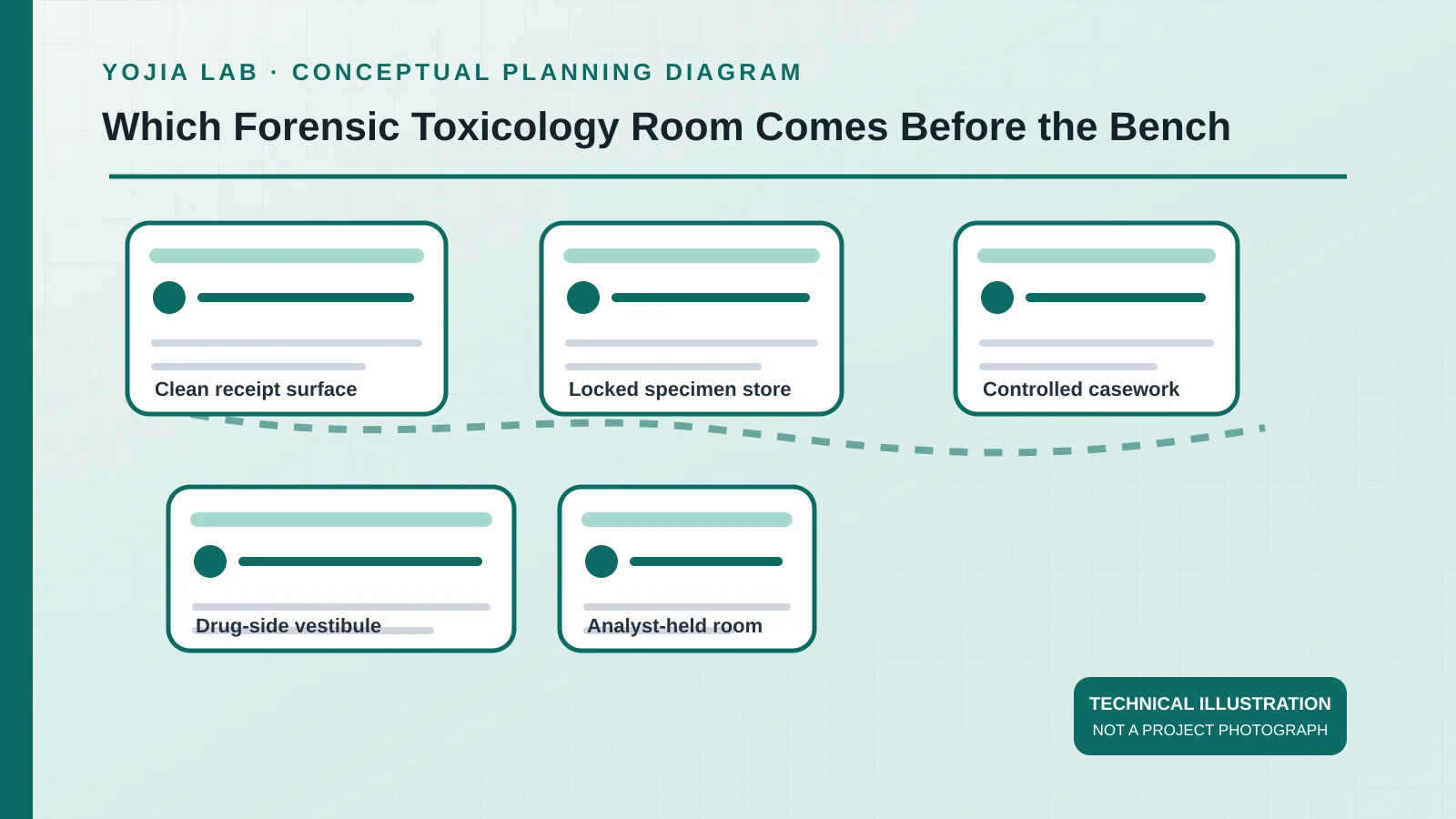
The brief these documents support is a room list with one rule each. Collection gets a clean surface and a separate secure temporary store. Original specimens get a locked room or locked refrigerator, few keys, and a reason for each entry. Aliquots leave and do not return. Shared clinical space gets written hours. The 1998 handbook adds a biovestibule and a separation from the drug section, plus a decision on separate processing and preparation rooms. The Canadian annex adds reception, circulation, controlled casework, and a room the analyst holds while the examination is open. Each line belongs to the document named beside it.
Selection is then a set of questions a factory can answer from drawings. How many analyst positions remain after processing and preparation are marked separate or shared. Which units are locked refrigerators rather than open shelves. Which doors are the vestibule, the controlled zone, and the analyst-held room. Which surface is only the clean receipt top and is not asked to store a specimen overnight. A blank request for a general bench fits none of these standards well. Filling the list in does not certify the laboratory.
When the plan is ready for a factory review, send the quantities, hazards, and unresolved room limits to a laboratory furniture manufacturer in China. Open items should stay open rather than being written as a confirmed specification.