01
Put the solvent step in the procedure first
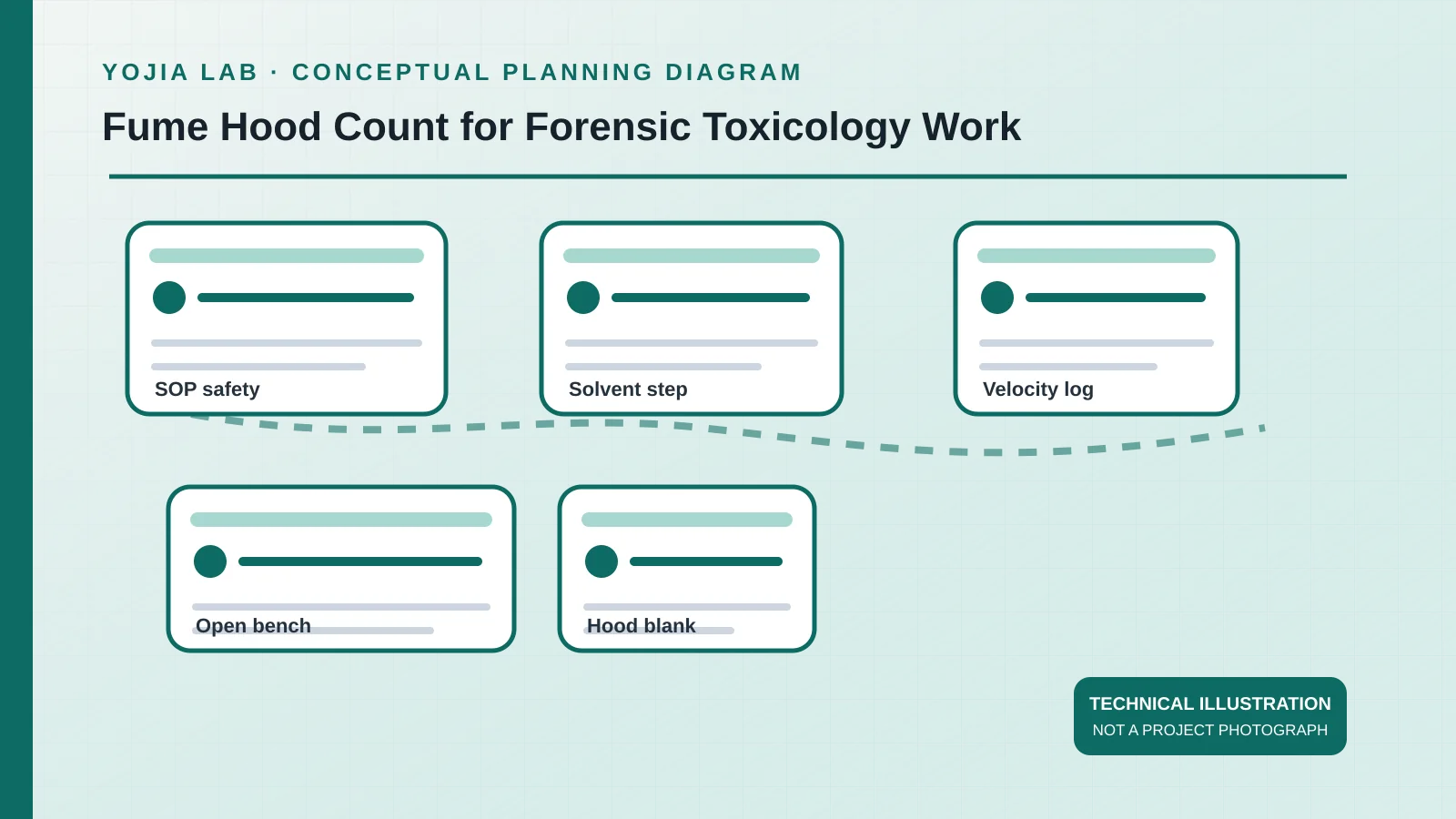
Section 4.6 asks for precautions against chemical, biological, physical, or radiological hazards. Section 4.7 asks for instruments, supplies, chemicals with grade or minimum purity, reagents, and reference materials. Section 4.8 asks for the preparation steps and names extraction, derivatization, and reconstitution as examples. That is where a fume hood is named. If extraction is present and ventilation is absent, the quantity for that step stays open.
The scope includes driving cases and court-ordered work such as probation, drug courts, and child services. A laboratory running only a regulated workplace program should check that program against the 2021 scope. Heading order may change, and a procedure may cite another controlled document. The citation is a written decision. Habitually opening a sash does not satisfy section 4.6.
02
Keep one toxicology laboratory’s wipes in that laboratory
NIOSH report 2021-0115-3388 records a June 2022 visit to one state toxicology laboratory in a building of about 100,000 square feet, built in the early 1900s, renovated in the 1980s, and used as laboratory space from the early 2000s. Toxicology had 28 employees. The crime laboratory had 30, and 2 of them analyzed seized drugs. The figures belong to that building.
Methamphetamine was on the supply vent (1 of 1), the return vent (1 of 1), centrifuges (2 of 4), and benches (3 of 11). Cocaine was on both vents and on 1 of 4 door handles. No toxicology surface exceeded the state methamphetamine remediation level of 1.5 micrograms per 100 square centimeters, which NIOSH notes matches a California health-based level for remediated spaces. One crime-laboratory fume hood sash sample did exceed it. That discussion lists no surface remediation level for cocaine, fentanyl, or heroin. Hand samples from 13 scientists at the start and end of the day were not detectable for the four drugs. NIOSH reported no indication the levels had affected health, and still recommended lower residues.
03
File face velocity as a band with a top and a bottom
Contractor certificates covered 2020 and 2021. Most fume hoods displayed face velocity, and a few displays matched NIOSH measurements. The recommendation is a quarterly staff check, an annual contractor check, and velocity inside the ANSI/ASSP band of 80 to 120 feet per minute, with tracer-gas testing if containment is the question. At the shared hallway, air mostly moved from the toxicology laboratory toward the hallway, and one doorway was neutral. NIOSH quotes ANSI/ASSP Z9.5-2022: airflow should run from lower-hazard toward higher-hazard areas, and pressurization opposes migration without stopping it.
Report 2018-0116-3370 measured chemical hoods in controlled-substances units at seven forensic laboratories, which is drug chemistry rather than the 2022 biological-specimen room. On the first visit, 10 of 16 hoods (62 percent) averaged outside the ANSI/AIHA 2012 band of 80 to 120 feet per minute. Only laboratories A and E had every assessed hood inside the band. At laboratory G, averages of 325 and 248 feet per minute came with chemist reports that airflow lifted powders and weigh papers. Laboratory C had seven staff and one hood. NIOSH called one hood per chemist ideal for those rooms, and recorded that the visits did not find that layout. Readings above the band are part of the miss.
04
Give stored bottles a cabinet and the opening a procedure
Section 1910.1450 applies to employers using relatively small quantities of hazardous chemicals on a non-production basis. The chemical hygiene plan must require fume hoods and other protective equipment to function, and must state how that performance is kept. For particularly hazardous substances, the plan considers containment such as fume hoods or glove boxes where appropriate. The drawing does not replace the plan.
Appendix A is non-mandatory. It treats chemical hoods as a main protection, keeps chemicals out of the hood, sends vented storage to a vented cabinet, and says waste should not be evaporated in a hood. Hoods should be maintained, monitored, and tested. In the seven drug laboratories, NIOSH found bulk solvents, other chemicals, and liquid waste stored in hoods, plus a dead zone at laboratory F where containers blocked the slots. Management wanted net weights taken in the hood. The visits mostly found those weights on a bench scale. A fume hood used for storage is not the extraction position in the procedure.
05
Release a quantity only where a step and a record meet
In the 2022 visit, staff in both laboratories generally used fume hoods for solvents and other reagents, and might not use them for biological evidence or bulk drugs. NIOSH recommended one consistent policy for those evidence types. Standard 152 already requires the precautions and the equipment list. Until those sections name the step, a floor plan cannot set the hood count.
A quotation may list each fume hood that has both a named step and a velocity record inside the adopted band, the services at the wall, and the open-bench instruments left outside the hood. It may not list a maker’s face velocity, a wipe result, or a claim that the room meets ANSI/ASSP Z9.5. The inquiry number only labels the exchange. The certificate and the safety section go with the sketch. A hood missing either one stays off the quantity.
Before pricing, place the room interface, quantities, and service points for the laboratory fume hood configuration with the workflow notes above. Airflow, performance, and compliance stay with the project's responsible reviewers.