01
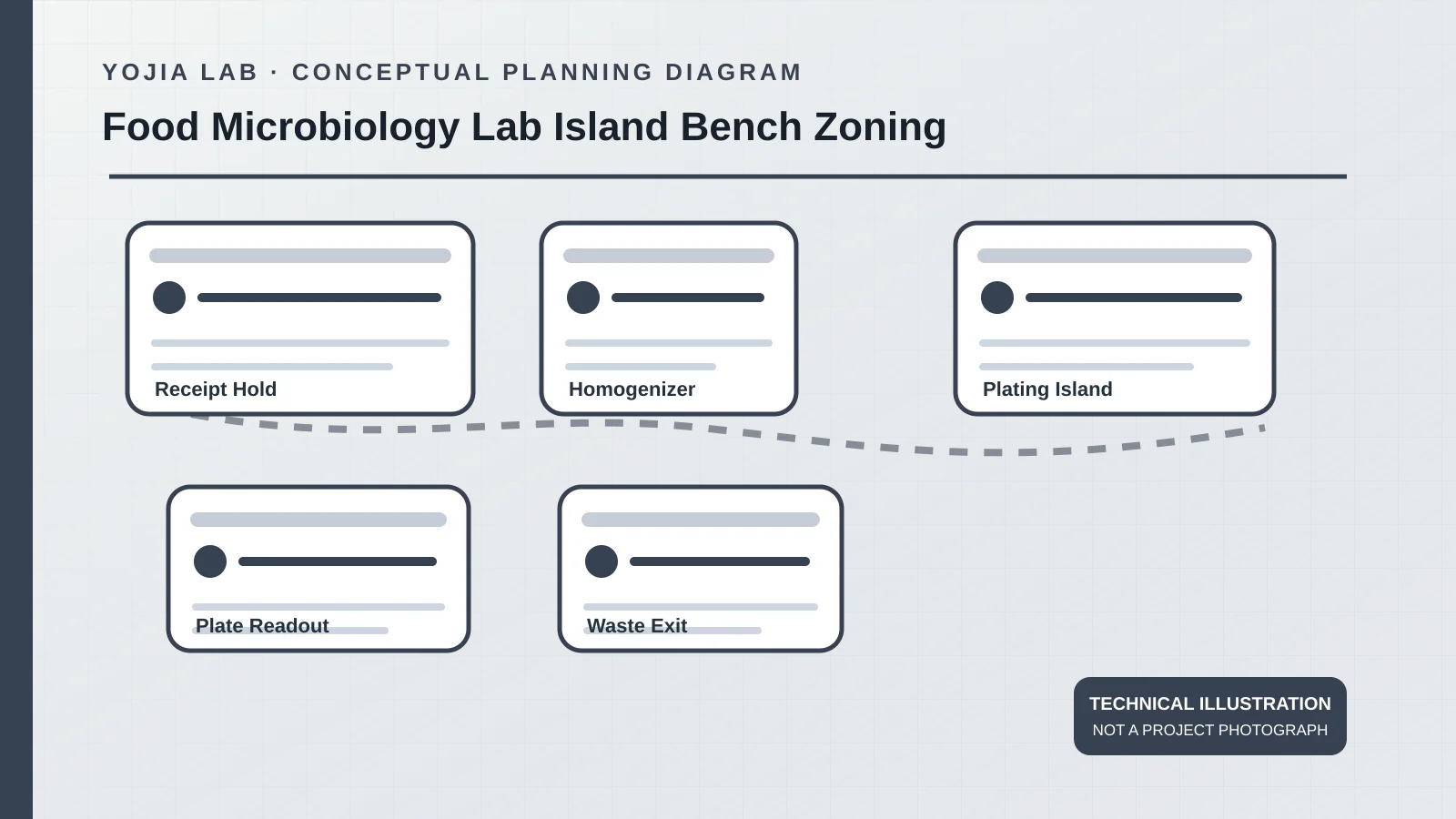
Keep incoming food off the plating island
ISO 7218 treats sample receipt and storage, before and after testing, as its own room or a clearly marked area, and it separates powders, high-count foods, and commercially sterile products. An island laboratory bench in the plating room is the wrong shelf for those holds. FDA’s sampling chapter asks, when the product allows it, for at least 100 g per sample unit in a clean, dry, leak-proof container, preferably not glass. Those vessels stay on a receipt shelf.
The same standard sets short-term holding temperatures: stable products at 18 °C to 27 °C, products that are not stable at room conditions at 5 °C ± 3 °C, and frozen products below −15 °C, preferably below −18 °C. Loose water ice is discouraged because a leak can contaminate the food, so the cold hold is a refrigerator, a freezer, or cold blocks around a closed container. WHO’s design monograph adds that corridors and exits are not storage. A trolley parked in the doorway is not a receipt hold.
02
Give the blender its own splash zone
For most foods, FDA adds 450 ml of buffered dilution water to 50 g and blends for 2 minutes. Each later dilution is shaken 25 times through a 30 cm arc within 7 seconds, and no more than 15 minutes may pass from blending until the dilutions are in media. A frozen dinner made of several foods is portioned or fully macerated, depending on the question. That work throws droplets. It does not belong on the island bench where agar is poured or a spiral plater runs.
Draw the blender on a preparation surface with its own splash boundary, and draw the walk to the island. The 15-minute limit is why the surfaces should be near, and why they should not be the same top. WHO expects a bench top to resist water and the disinfectants the laboratory actually uses. Record that disinfectant. A catalog material name does not fill the line. If the room cannot hold a second surface, ISO 7218 allows a time split only when the laboratory’s cleaning steps are written down.
03
Use the two island sides for dilution and plating
The island laboratory bench is the place for decimal dilutions and transfer into agar. FDA’s January 2026 plate-count chapter describes a pour plate with 12–15 ml of agar cooled to 45 °C ± 1 °C, then 48 ± 2 hours at 35 °C. The spiral plater in that chapter is compact: about 50 plates an hour, an alignment check under 2 minutes, and a stated window of about 500 to 500,000 microorganisms per millilitre. Pre-poured plates use about 15 ml of agar at 60–70 °C, cool level, stack no higher than 10, and wait inverted at 0–4.4 °C for at most one month. Pouring happens elsewhere. The island receives plates that are already solid.
Give the two long sides to different hands. One side holds dilution bottles. The other holds the pour-plate space or the plater, including the chapter’s rinse between samples: 1 second in hypochlorite and 1 second in sterile dilution water. Do not stand an incubator on either side. Counting happens after incubation, on plates that have left the island. WHO asks that tops and aisles hold only what is in immediate use, and that the floor under furniture stay reachable. Fabric seats are a poor fit because fabric holds contaminants.
04
Move incubation, readout, and waste off the island
Once a dish goes into an incubator, it has left the island bench. Readout is a later station. Incubator doors that swing into the dilution side block both the 15-minute walk and cleaning access. Waste is a third address. ISO 7218 lists biohazard-waste decontamination and glassware washing as their own areas. WHO asks for space to hold waste before decontamination, and asks that autoclave heat and odor stay off the people counting plates. That hold needs trolley width, and it stays off the exit.
Hand washing is not the homogenate sink. WHO places a basin in each room where work, including waste handling, is done, near the exit and separate from sinks that receive chemicals or contaminated liquid. A hands-free tap is preferred. The island gets a small sink only if the laboratory has decided the sink sees dilution water and not blended food. If one bowl must do both, it stays off the island. An island length that assumes a sink, a blender, an incubator, and a waste bin does not match the method sequence.
05
Treat a time split as a shift card
ISO 7218 allows connected rooms when hygiene rules are met, and it allows a small laboratory to separate activities by time instead of by walls. That is not permission to buy one island and rename every job a shift. A time split needs a sequence: receipt cleared, preparation finished, the surface cleaned with the named disinfectant, plating done, and waste removed before the next receipt. The 15-minute clock still runs inside the plating shift. It does not cover a dirty blender left on the plating top.
WHO’s monograph is a planning aid, not a furniture specification. Size the floor for specimens, people, and waste before drawing benches. ISO 7218 points biosafety layout to the WHO manual, notes that levels 1 and 2 are routine in food microbiology, and says national rules can ask for more. Record which organisms this room will see, and leave the level blank until the laboratory’s assessment is attached. The island drawing then shows two working sides, a path inside 15 minutes, and the jobs refused a place on that top.
Before pricing, place the room dimensions, user sides, and service interfaces for the island laboratory bench layout with the workflow notes above. The final configuration remains the approved quotation and drawings.