01
Convert the method register into a storage-state register
Begin with the methods actually offered by the laboratory and create one record for every sample fraction, blank, standard, extract, digest, and retain that may wait between receipt and disposal. Record the container material and size, preservation already applied or still required, temperature and light condition, time origin, next processing step, contamination sensitivity, responsible role, and release condition. The current eCFR Table II illustrates why one generic refrigerator schedule is unsafe as a planning basis: approved parameters can differ in container, preservation, and maximum holding time, and the stated time is a maximum rather than a target queue time. The project should reproduce only the rules that apply to its approved scope and jurisdiction.
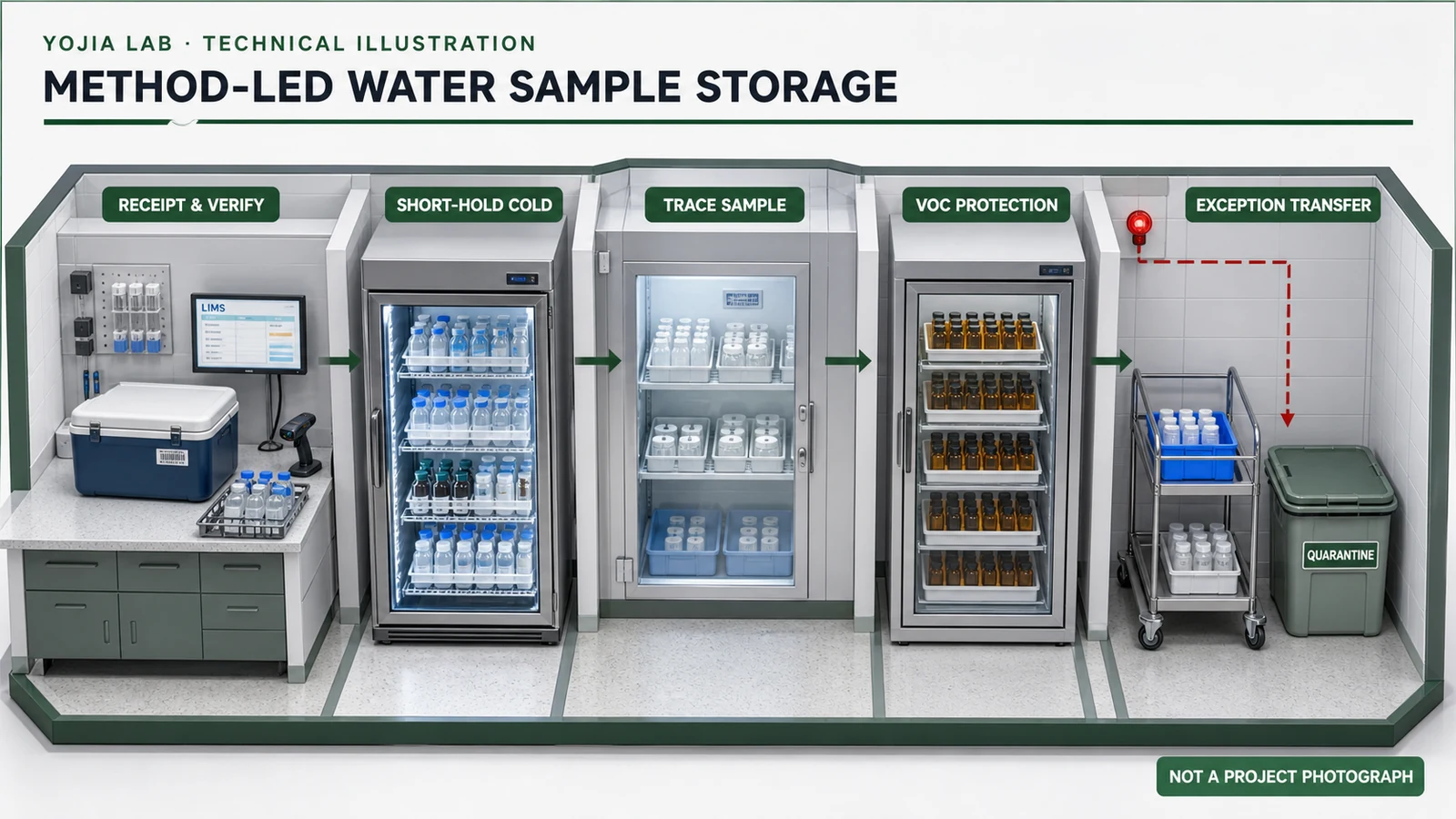
Turn each record into a visible state transition. A bottle may move from expected shipment to arrival check, acceptance pending, accepted cold storage, aliquoting, method-specific preparation, analysis queue, retention, and authorized disposal. A late, warm, leaking, unsealed, wrongly preserved, or unidentified bottle follows an exception path instead. The EPA drinking-water laboratory manual calls for documented checks of containers, temperature, preservation, paperwork, holding time, sample integrity, and rejection criteria. Those controls require a receipt bench, temporary containment, protected information access, and separate locations for accepted and unresolved material; they cannot be solved by adding shelves after the room is built.
02
Size cold storage from time bands, bottle geometry, and operating peaks
Capacity should be calculated as usable positions by storage state, not as the manufacturer's empty internal volume. Model the largest credible arrival wave, container footprint and height, secondary containment, shelf spacing, air circulation, door opening, rejected-sample hold, rerun allowance, retention policy, and the time at which each item leaves the unit. Short-window microbiology or conventional chemistry samples need a front-of-queue layout that supports immediate identification and dispatch; longer-held preserved fractions should not bury them. Include cooler unpacking and temporary staging so incoming ice, wet packaging, and external dirt do not enter controlled storage by default.
Divide the model into operational time bands such as immediate action, same shift, short hold, prepared fraction, retention, and exception hold, then assign each band to a monitored location and accountable role. Avoid turning those bands into invented universal temperatures or durations. USGS Chapter A5 treats bottling, filtration, preservation, handling, and shipping as linked processing decisions, while EPA Method 200.8 distinguishes dissolved and total-recoverable trace-element fractions and their preservation sequence. The design implication is that storage capacity must follow the chosen data objective and preparation state, with space for field blanks and other quality-control items to travel and wait under the same defined conditions as their associated samples.
03
Separate contamination risk without breaking identity or custody
Create a segregation matrix before selecting refrigerators, cabinets, or shelving. Potential divisions include low-level trace work, volatile-organic containers, microbiology, high-concentration wastewater, standards and reagents, prepared extracts or digests, enforcement or confidential samples, and unknown or suspect material. The matrix should state whether separation is achieved by a dedicated unit, enclosed secondary containment, shelf zone, time separation, access control, or another validated rule. The drinking-water certification manual specifically describes isolating stored samples from laboratory contaminants, standards, highly contaminated samples, and sometimes from each other. That is a performance need, not a request to duplicate every appliance.
Protect the identity chain at every physical boundary. Provide a scan-and-check position at receipt, readable shelf addresses, containers that remain visible without excessive handling, and a clear LIMS event for every transfer. Restrict access where custody or client confidentiality requires it, but do not create locked spaces that delay urgent samples or prevent temperature response. EPA Method 200.8 warns that trace-element results can be affected by the laboratory environment, labware, and container interactions, and calls for a designated clean handling area. Therefore low-level sample storage should not share an uncontrolled opening and decanting zone with dusty packages, concentrated materials, or acid-preservation work merely because all are part of sample control.
04
Treat monitoring, alarms, and transfer capacity as one storage system
For each controlled unit or room, define what is measured, where the sensor sits, how limits are authorized, how readings are retained, who receives an alarm, how quickly the condition is assessed, and what happens outside normal hours. Provide a manual-reading fallback and a way to distinguish an equipment fault, sensor fault, open door, power loss, room-condition problem, and true sample exposure. EPA's environmental monitoring SOP links refrigerators, freezers, laboratories, and sample storage rooms to recorded conditions, incident logs, corrective action, contact with building staff when room conditions drift, and backup arrangements for the monitoring system. A project should adapt that control logic to its own quality system rather than copy another facility's alarm values.
Reserve qualified transfer capacity before an outage occurs. The backup location must have compatible temperature, contamination protection, custody, shelf space, electrical support, and an accessible route; an empty domestic refrigerator in another department is not automatically a recovery plan. Assign who may authorize transfer, who documents elapsed time and observed conditions, how items are prioritized, and what prevents accepted samples from mixing with exceptions. During commissioning, challenge alarm notification, simulate a full-unit transfer, verify that labels remain readable, and confirm that the route works with loaded secondary containers. The drill often reveals that the real constraint is decision time or destination capacity rather than cooling hardware.
05
Commission the storage workflow with representative loads and exceptions
Acceptance should test the operating system, not only whether equipment powers on. Use representative bottle sizes and secondary containers to verify shelf capacity, location coding, access, airflow clearance, door recovery, receipt-to-storage timing, scan points, cleaning reach, spill containment, and maintenance removal. Confirm that preserved samples can reach any required controlled work position without crossing a trace-clean or microbiology boundary. Review the result with sample-control staff, analysts, quality personnel, facilities, safety, and the equipment supplier so open assumptions are assigned before routine intake begins.
Run exception scenarios for a warm arrival, damaged bottle, expired holding time, missing custody seal, alarm after hours, failed refrigerator, blocked transfer route, peak-day overload, and a changed analytical method. Record the evidence needed to accept, reject, quarantine, transfer, or dispose of material, and identify who owns each decision. Then place the method-to-storage register under change control: a new analyte, client requirement, container, preservative, retention rule, sampling program, or laboratory instrument can alter bottle counts, segregation, alarms, and preparation deadlines. Periodic capacity review keeps the storage plan aligned with the laboratory's real scope instead of the opening-day estimate.