01
The manuals ask for space and print no length
The January 2005 manual for certifying drinking-water laboratories, EPA 815-R-05-004, uses “must” for items required by the National Primary Drinking Water Regulations or the approved methods, and “should” for criteria the Office of Water judges necessary for scientifically valid data. Chapter IV, chemistry, says facilities should be clean, with adequate temperature, humidity, and bench-top lighting, and should meet applicable OSHA standards. The appropriate type of exhaust hood is required where applicable. There should be sufficient bench space, convenient to a sink, water, gas, vacuum, and electrical sources free from surges. Instruments should be properly grounded. Inorganic and organic facilities should be in separate rooms, and organic analysis should be separated from sample extraction. None of those sentences prints a metre.
When a method requires it, the same chapter says the laboratory must have reagent water of at least 0.5 megohm resistance, conductivity less than 2.0 micromhos per centimetre at 25°C. That is a water specification, not a bench depth. The 2025 Ohio chemical manual, written for Ohio drinking-water certification under Ohio Administrative Code Chapter 3745-89, is narrower. Plans go to Ohio EPA before construction under rule 3745-89-03, and the manual says not every listed item applies to every laboratory. It does require, where they apply, an ambient temperature of 65°F to 80°F, acid- and alkaline-resistant sinks if concentrated acids or bases are used, and a stone balance table or slab for every analytical balance. Bench space is “an appropriate amount” per certified method for each chemical group. Still no length.
02
Method 200.8 splits the bottle from the hot plate
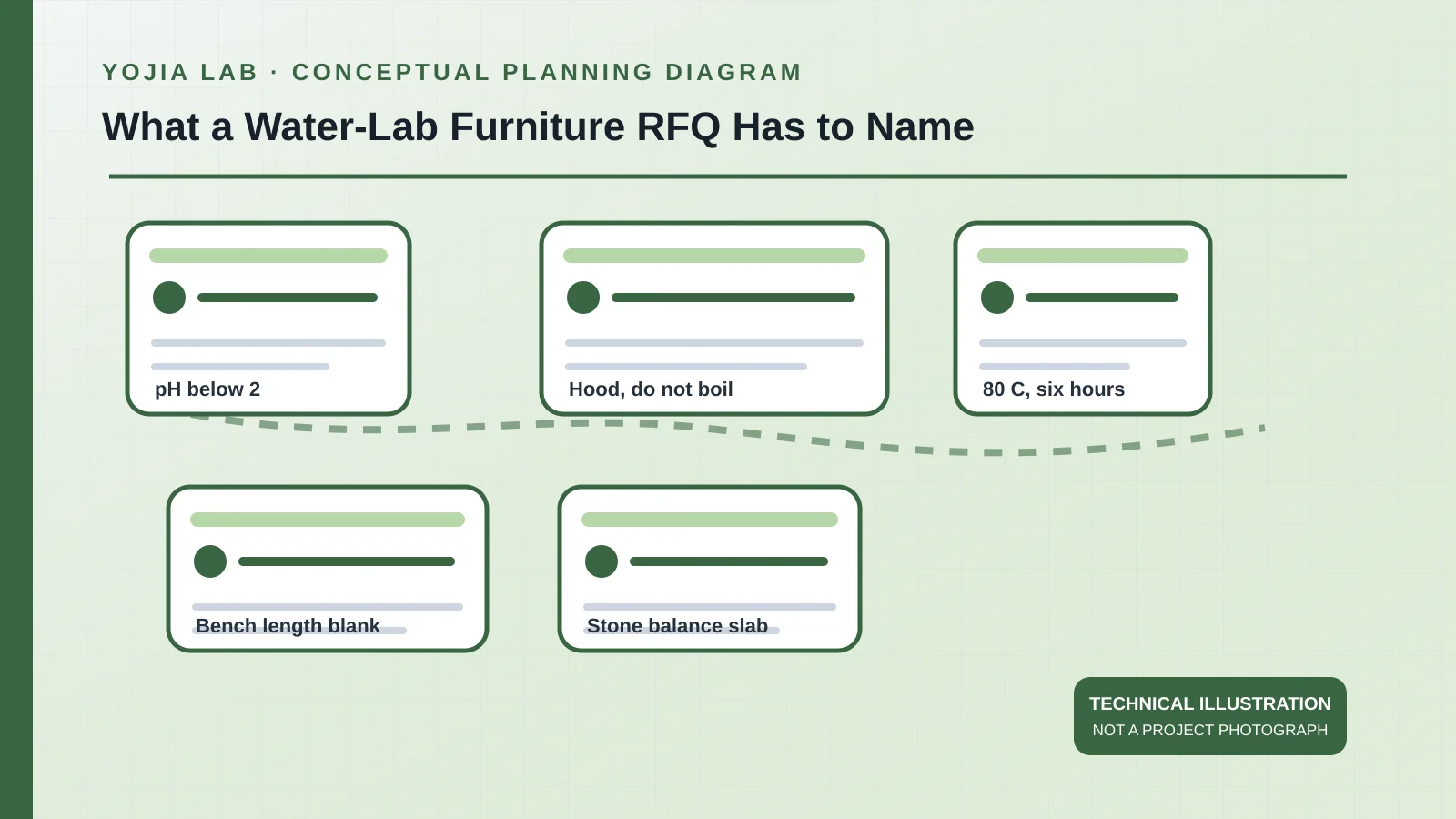
Method 200.8, Revision 5.4 (1994), tells the laboratory to decide dissolved or total-recoverable data before collection. Dissolved elements are filtered through a 0.45 µm membrane, and the filtrate is acidified at once with (1+1) nitric acid to a pH below 2. Total-recoverable samples are not filtered. They are acidified with (1+1) nitric acid to a pH below 2; the method says 3 mL of (1+1) acid per litre is normally enough for most ambient and drinking waters. It recommends returning those samples within two weeks and preserving them on receipt, then mixing, holding 16 hours, and checking that the pH is still below 2. If alkalinity leaves the pH above 2, more acid is added and another 16 hours pass. A properly acid-preserved sample may be held up to 6 months. Section 8.4’s 4°C storage is for solid samples, not for these bottles.
The digestion is a second address. For aqueous samples other than drinking water already under 1 NTU, a 100 mL aliquot, ±1 mL, goes into a 250 mL Griffin beaker with 2 mL of (1+1) nitric acid and 1.0 mL of (1+1) hydrochloric acid. The hot plate sits in a fume hood. Uncovered, evaporation is kept at approximately, and no higher than, 85°C; once a watch glass covers the beaker the water temperature rises to about 95°C. Volume is taken to about 20 mL, about two hours from 100 mL, and the method says do not boil. A 30-minute reflux follows. Dissolved solids in the measured solution are not to exceed 0.2 percent weight/volume. Direct analysis, without that digestion, is limited to acid-preserved drinking water with turbidity under 1 NTU, silver excepted in the method’s own warning. An unknown or hazardous acidification is also done in a fume hood. The hood, the 16-hour hold, and the receiving bench are not one piece of furniture.
03
The British oven is not that hot plate
The Standing Committee of Analysts booklet from 2018, in the series Methods for the Examination of Waters and Associated Materials, determines metals in raw and drinking waters by ICP-MS. Samples are preserved with dilute nitric acid to about 1 percent volume/volume. On receipt, total-metals samples are acidified with concentrated nitric acid to that same approximate concentration. The booklet points to the current BS EN ISO 5667-3 for preservation practice and says samples should be collected in acid-washed high-density polyethylene bottles. It does not reprint that ISO table here, so this note does not invent holding temperatures from it.
Digestion in the booklet is the capped bottle, top on, in an oven set at 80°C ± 5°C for a minimum of 6 hours, or overnight as the practical alternative. After cooling, visible particles may be removed on a 0.45 µm membrane so the instrument tubing does not block. That oven is not Method 200.8’s hooded hot plate, and 80°C ± 5°C is not “no higher than 85°C, then about 95°C under a watch glass.” A quotation that types one setpoint has merged two procedures. The factory can price a bench, a hood, or an oven stand only after the sheet says which procedure is in the room.
04
The missing length stays an open line
Ohio’s equipment lines, still only for laboratories seeking that state’s chemical certification, split the hood by duty. An exhaust hood used for acid digestion must be corrosion resistant. A hood used with solvents must have explosion-proof motors and switches and must be labeled as such. Solvent refrigerators must be suitable for flammable storage. The building is not to be adversely affected by vibration or dust, and glassware plus non-corrosive reagents get floor or wall cabinets. Those are Ohio sentences. Chapter IV’s federal “should” does not copy them onto every water laboratory, and Ohio’s corrosion-resistant acid hood does not become the federal manual’s unspecified “appropriate type.”
A usable request therefore lists rooms, the named method, whether acidification is at receipt or in the field, the hood duty if a hood is in scope, the balance support if Ohio’s stone slab applies, and the services Chapter IV already listed: sink, water, gas, vacuum, surge-free power, and reagent water when the method calls for it. The bench length that neither Chapter IV nor the Ohio chemistry line printed stays blank. A contractor who types a length there has added scope. The factory quote answers the lines that were actually written.
Before pricing, check the distributor and contractor project support against the room and workflow conditions already recorded above.