01
The ordinance already splits the answers
The 2023 Grade “A” Pasteurized Milk Ordinance defines an official laboratory as a biological, chemical, or physical laboratory. The standards are not one number. Individual producer raw milk is not to exceed 100,000 per mL, and commingled milk is not to exceed 300,000 per mL before pasteurization. The pasteurized block states bacteria not to exceed 20,000 per mL and coliforms not to exceed 10 per mL, except that bulk transport tank shipments shall not exceed 100 per mL. Phosphatase there is less than 350 milliunits/L for fluid products. Drug residues are “no positive” on a method the ordinance has found acceptable.
The enforcement paths stay separate. Two of the last four bacterial counts, somatic cell counts, coliform determinations, or cooling temperatures are one path. A confirmed positive drug residue is investigated under Appendix N, and reinstatement follows that appendix rather than the two-of-four schedule. A positive phosphatase test requires the cause to be found, and a confirmed result is a reason to investigate pasteurization. Somatic cells use 750,000 per mL in the enforcement example. Goat milk is kept at 1,500,000 per mL. None of these counts is a length of wall laboratory bench.
02
Compatible work is the only open share
FORM FDA/NCIMS 2400, revision March 2024, scores a level table or bench with ample space. Item 1.e allows only compatible functions and requires freedom from congestion and traffic. Item 1.f.6 asks for a functioning fume hood only if necessary, and points to the direct microscopic procedure. Item 1.f.7 keeps flammable-solvent areas continuously ventilated. Eating and drinking are not permitted. A wall laboratory bench that is also the route through the room, an open solvent area, or a place for a meal has already missed those lines.
Compatibility is a finding about the functions performed, not a property of a long top. The somatic-cell stain, a flammable solvent, and a drug-residue confirmation stay different functions until someone writes why they are compatible. The ordinance already allows a biological laboratory and a chemical laboratory to be different places. The open run receives only the work the evaluation has accepted. It does not receive a function merely because the sample was milk.
03
The stain leaves the open run
FORM FDA/NCIMS 2400d, revision March 2024, covers the direct microscopic count for raw commingled cow, goat, sheep, water buffalo, and camel milk. It requires a functional fume hood at 100 ft/min, checked annually, with records and a tag. The Levowitz-Weber stain adds 0.6 g of certified methylene blue chloride to 52 mL of 95 percent ethyl alcohol and 44 mL of reagent-grade tetrachloroethane. Gloves are required, and the stain is prepared in a fume hood because tetrachloroethane is toxic. It stands 12–24 hours at 4.5–7.5 °C, is filtered, and then receives 4 mL of glacial acetic acid. Staining steps 24.a.2 through 24.a.4 are also done in a ventilated hood.
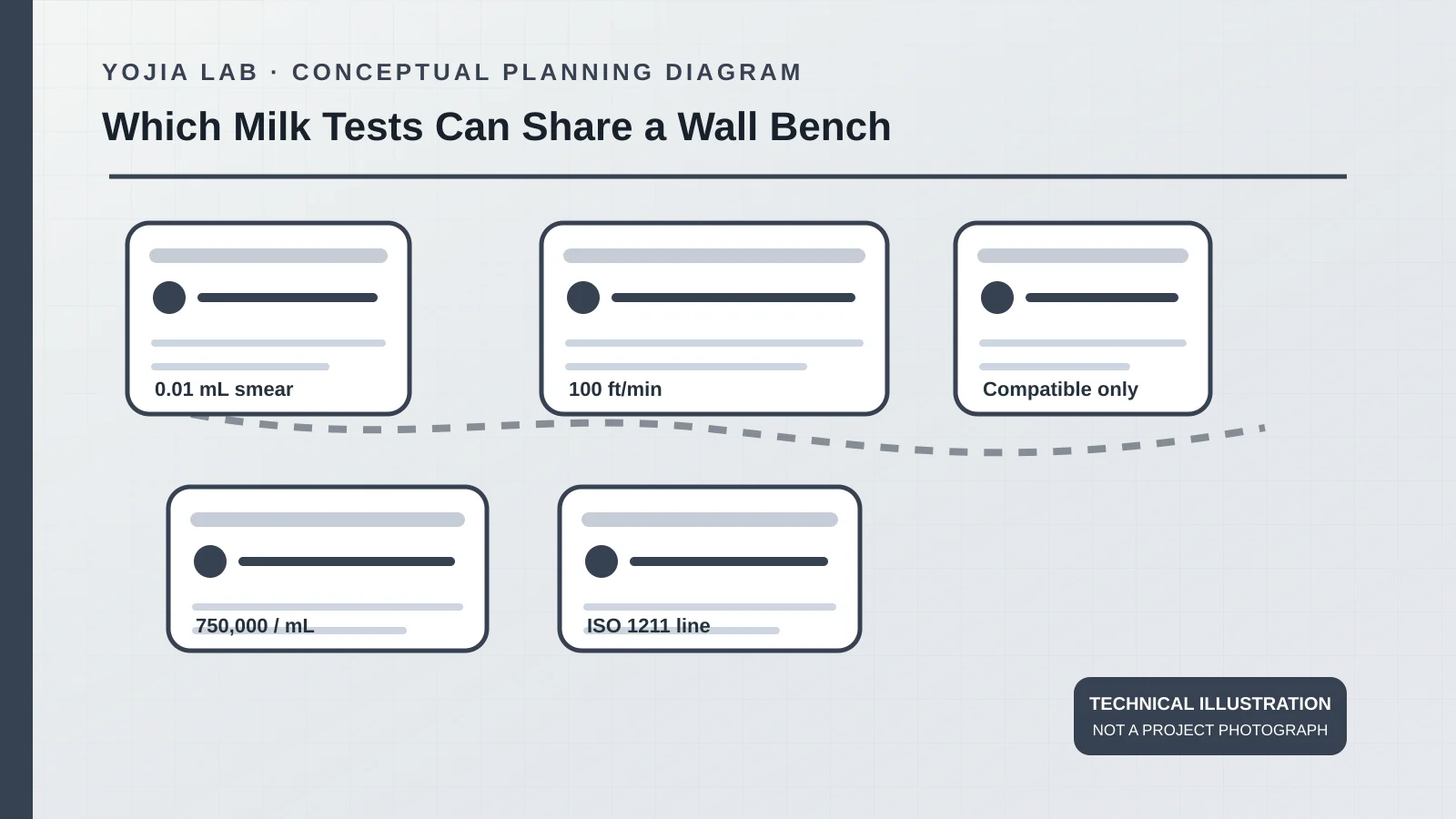
The film is 0.01 mL. The syringe or micropipettor is checked to deliver 0.0103 ± 0.0005 g as the average of 10 weighings with milk. The smear dries at 40–45 °C within 5 minutes on a clean, dust-free, level surface. That surface is the slide drier in item 6, not the wall laboratory bench. The single-strip factor is 10,000 divided by 11.28 times the field diameter in millimetres. A microscope can stand on the open bench once the film is dry, if that reading is compatible. Making the stain cannot. The 100 ft/min tag is a hood record, and the form's ±5 percent tolerance does not turn it into a module.
04
The reference fat method is a third line
Commission Regulation (EC) No 273/2008, applicable from 31 March 2008, allows a routine method only when it is calibrated and regularly checked against the reference method, accounting for bias, repeatability, and reproducibility. In a dispute, the reference result is decisive. For milk and cream of CN code 0401, the annex names ISO 1211:2001 | IDF 1D:1996 at or below 6 percent fat by mass, and ISO 2450:1999 | IDF 16C:1987 above 6 percent. The regulation prints no bench length. A routine instrument reading is not the result that settles a dispute.
That line is neither the compatible wall laboratory bench nor the tetrachloroethane hood. A phosphatase result below 350 milliunits/L, a “no positive” drug result, and a fat result that a dispute would send to ISO 1211 are not three labels for one top. Where the ordinance's reverse-osmosis or ultrafiltration criteria apply, raw supplies are tested for antibiotic residues under Appendix N before processing. That sentence belongs to those criteria and should not be copied onto every plant. It still shows a drug test can be a gate before processing. The usable split is an open run for compatible work, a hood for the named stain, and a separate place for the reference method a dispute would require.
Before pricing, place the usable wall length, modules, and service points for the wall laboratory benches with the room notes above. Final materials and supplied scope remain the approved quotation.