01
The room band is not the viscosity band
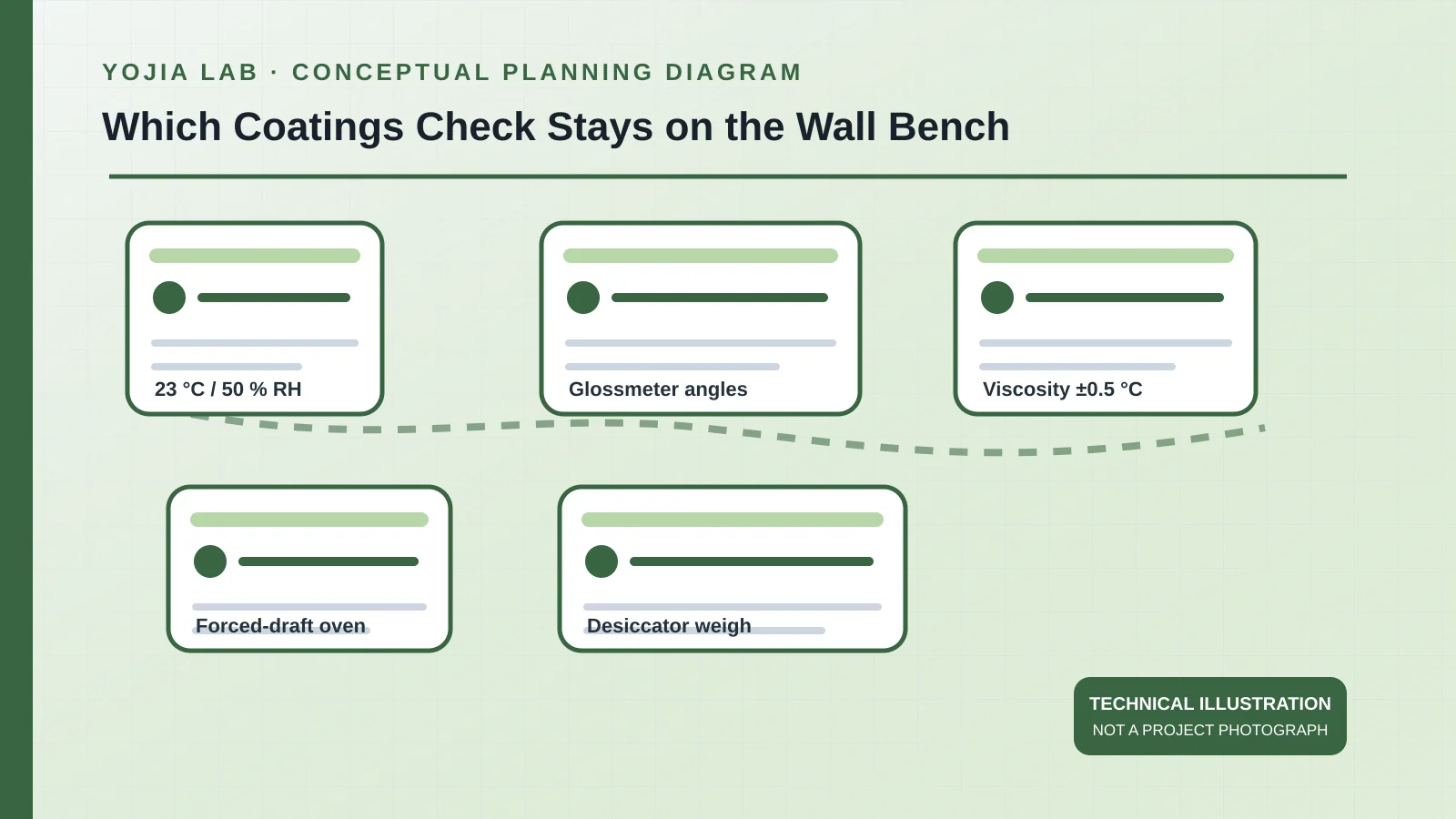
Clause 4.1 is 23 ± 2 °C and 50 ± 5 % relative humidity, used whenever possible. Clause 4.2 keeps 23 ± 2 °C and leaves humidity ambient. Viscosity or consistency is given a recommended limit of at most ± 0.5 °C, tighter than the room, so a wall bench at 23 ± 2 °C does not itself control a viscosity portion to ± 0.5 °C. Older flow and density data often used other temperatures, and much glassware is not calibrated at 23 °C, so a stated deviation may be necessary. The same data should also be taken at the standard conditions.
Conditioning time is set by the method in hand. Panels and the relevant apparatus equilibrate out of direct sunlight, in an atmosphere that should be clean. Panels stay at least 20 mm apart and 20 mm off the enclosure walls. A wall bench does not create that gap. Testing uses the conditioning atmosphere unless the method says otherwise. Standard conditions are reported with the hours of conditioning. Other conditions, allowed by clause 4.3.1 when the standard atmosphere is hard to hold and the test is not a referee test, shall be written down. This 1984 text does not reprint 27 °C and 65 % relative humidity.
02
Gloss angles are fixed; the room line is not in the pages read
ISO 2813:2014 measures gloss at 20°, 60° and 85° on non-textured coatings on plane, opaque substrates. The preview stops before clause 7.3. The value is a ratio times 100 against glass of refractive index 1.567 at 587.6 nm, in gloss units, not percent reflection, rounded to an integer. That black glass is 100 at all three angles. The text assigns 20° to high gloss, 60° to semigloss and 85° to matt, and the geometry shall be named with each result. Visual class 9 is given as 35, 70 and 95 gloss units at those three angles. The example is not a pass limit.
Beam angles are (20.0 ± 0.1)°, (60.0 ± 0.1)° or (85.0 ± 0.1)°, and the receptor axis must fall within ± 0.1° of the mirror line. ISO 3270 would condition the relevant apparatus, but that rule is not in this preview. A line reading “23 ± 2 °C and 50 ± 5 % relative humidity per ISO 2813” overclaims the pages read. The wall bench holds panels that still need the 20 mm gap, and it holds the meter only when the laboratory’s own gloss procedure keeps the meter in that room. The conditioning line for the meter stays blank until clause 7.3 or the full standard is filed.
03
The non-volatile dish leaves the bench
ISO 3251:2019 measures non-volatile matter by mass. Note 1 says the figure is not absolute: temperature, time, retained solvent, decomposition and loss of light fractions all move it, so it mainly compares batches of one product. The oven is held within ± 2 °C up to 150 °C and within ± 3.5 °C from there to 200 °C, with forced ventilation. Phenolic resins may use natural convection and a shelf at one-third of the oven height. Flammable volatiles carry a fire and explosion warning. The paint dish is 75 ± 5 mm across, with a rim of at least 5 mm. The balance reads to 0.0001 g and the dry dish is weighed to 1 mg.
The oven is not the wall bench. The dish may wait in a desiccator. At or above 500 mPa·s, or a flow time of at least 74 s in a 6 mm cup, the portion may be spread with a tared wire after 2 ml of solvent. Tests are duplicated. None of this is a gloss reading, and the oven is not at 23 °C. The wall bench keeps conditioned panels and, only if the procedure says so, the glossmeter. Dish, balance and oven are the next station.
04
Method 24 fixes one oven hour
EPA Method 24, internet text headed 8/3/2017, says it is not the official version and points to the Code of Federal Regulations. Section 11.2.2 puts 3 ± 1 ml of solvent in an aluminum dish and weighs the coating to 1 mg by difference. The posted sizes are 0.3 + 0.10 g below a believed 40 percent volatiles and 0.5 ± 0.1 g above it; the plus sign is printed that way. After 1 to 24 hours the dish spends 60 minutes at 110 ± 5 °C (230 ± 9 °F) in a forced-draft oven. Ventilation must match accepted laboratory practice so vapor does not become dangerous. Dishes cool in a desiccator and are weighed to 1 mg, in pairs.
Table 24-1 gives ± 0.015 times the volatile fraction inside one laboratory and ± 0.047 times it between laboratories. That is a statement about Wv, not about a bench. The 110 °C hour is neither ISO 3251’s agreed oven temperature nor the 23 ± 2 °C wall bench, and the ventilation caution names neither a hood model nor a face velocity. Three lines are enough: the wall bench and its 20 mm gap, with ± 0.5 °C noted only for viscosity; the glossmeter with angle, unit and a blank conditioning line; and whichever oven the method actually names.
Before pricing, place the usable wall length, modules, and service points for the wall laboratory benches with the room notes above. Final materials and supplied scope remain the approved quotation.