01
Attach the rejection rule instead of inventing one
Under the U.S. clinical-laboratory rule at 42 CFR 493.1242, a laboratory must establish and follow written policies, where applicable, for collection, labeling, storage and preservation, transport, processing, acceptability and rejection, and referral. The furniture package can point at that document. It cannot draft the rejection criteria in the quotation so the line looks complete. If the policy is not written yet, the cell says missing and names the laboratory person who owes it.
The same section says the laboratory must document the date and time it receives a specimen. That is a record, not a shelf depth. A writing surface at intake helps only if the procedure says the record is made there. WHO's reception guidance asks the procedure to cover integrity checks, accept-or-reject, registration, labels that tie portions to the primary sample, urgent samples, and verbal requests. The quotation lists the surface and leaves that text attached or blank.
- 42 CFR 493.1242 enumerates eight written-policy subjects when applicable, then separately requires the laboratory to document both the date and time it receives a specimen. In the RFQ, ask for the policy owner and the record-system field; do not convert either into a furniture dimension.
- For molecular amplification outside a closed system, 42 CFR 493.1101 names three separate areas—specimen preparation, amplification, and product detection—with reagent preparation separated when applicable. This is a conditional workflow requirement, not a default room template.
- Ask the laboratory director to mark the workflow as applicable, not applicable, or pending before the supplier lays out the footprint; an assumed workflow is not a valid room input.
02
Do not paste the molecular arrow onto every room
42 CFR 493.1101 asks the laboratory to be arranged so space, ventilation, and utilities support every phase of testing, and so contamination of specimens, reagents, and supplies is minimized. A separate sentence applies only when molecular amplification is not contained in a closed system: the workflow must be uni-directional, with separate areas for specimen preparation, amplification, and product detection, and for reagent preparation where that applies. A specimen-processing room that does not do that work should not inherit the sentence.
Write one yes-or-no line, signed by the laboratory: open molecular amplification in this room, or not. If yes, the areas named in the rule become separate rows and quantities follow them. If no, or not yet known, do not draw extra casework to look thorough. The facilities standard also says safety procedures must cover physical, chemical, electrical, and biohazardous risks, and that retained slides, blocks, and tissues need preserving conditions. Each item has an owner.
03
Ask for the rotor sheet before drawing a gap
OSHA's centrifuge quick facts say most centrifuge accidents come from user error and that staff should follow the instructions for the make and model in front of them. The sheet calls for matched tubes, safety cups, a crack check, a limit on filling, a balanced rotor, and a closed lid. For infectious loads it says to wait 10 minutes after the rotor has fully stopped before opening the lid. Another rotor can differ.
The RFQ line is the model, the machine supplier, and the clearance that sheet prints. Furniture around the rotor should not invent a gap, a cup, or a wait time. If the model is unknown, the cell stays open and casework that would touch the machine is not released. Record where a leak would be held and that accidents are reported to the supervisor, as that sheet instructs. A furniture date is not that report.
- OSHA’s centrifuge QuickFacts gives a 10-minute wait after the rotor has completely stopped before opening the lid when centrifuging infectious materials. Carry it into the procedure field only when applicable.
- The same guide asks users to follow the instructions for the specific make and model and to use properly matched, balanced loads. The RFQ should identify the model and attach its operating sheet.
- Include a pre-spin leak inspection and a named response procedure in the laboratory’s inputs; neither is a furniture supplier’s clearance value.
04
Quote the container rule, not a cabinet performance
Where OSHA's bloodborne-pathogens standard applies, specimens of blood or other potentially infectious materials go in a container that prevents leakage. If the outside is contaminated, a second leakproof container is used. If the specimen could puncture the first, the second is also puncture-resistant. Those are container duties, not a claim about a storage cabinet. Offer a shelf only after someone states which container conditions this room must support.
The standard requires engineering and work-practice controls to minimize exposure, and it defines an exposure control plan as the employer's program. Paragraphs for HIV and HBV research laboratories and production facilities apply only when that part of the standard applies. They should not be copied onto a general receiving bench. Ask whether this room is in that category. Until the answer is written, those cells stay blank.
05
Put a name beside every open cell
A usable package holds the laboratory's policies, the machine sheet, a drawing with blanks still visible, and a list of owners. Section 493.1242 allows referral only to a CLIA-certified laboratory or one CMS finds equivalent, and it requires written client instructions when referral specimens are accepted. The furniture line does not choose the referral laboratory. It asks whether those specimens enter this room and where the instruction sheet is kept.
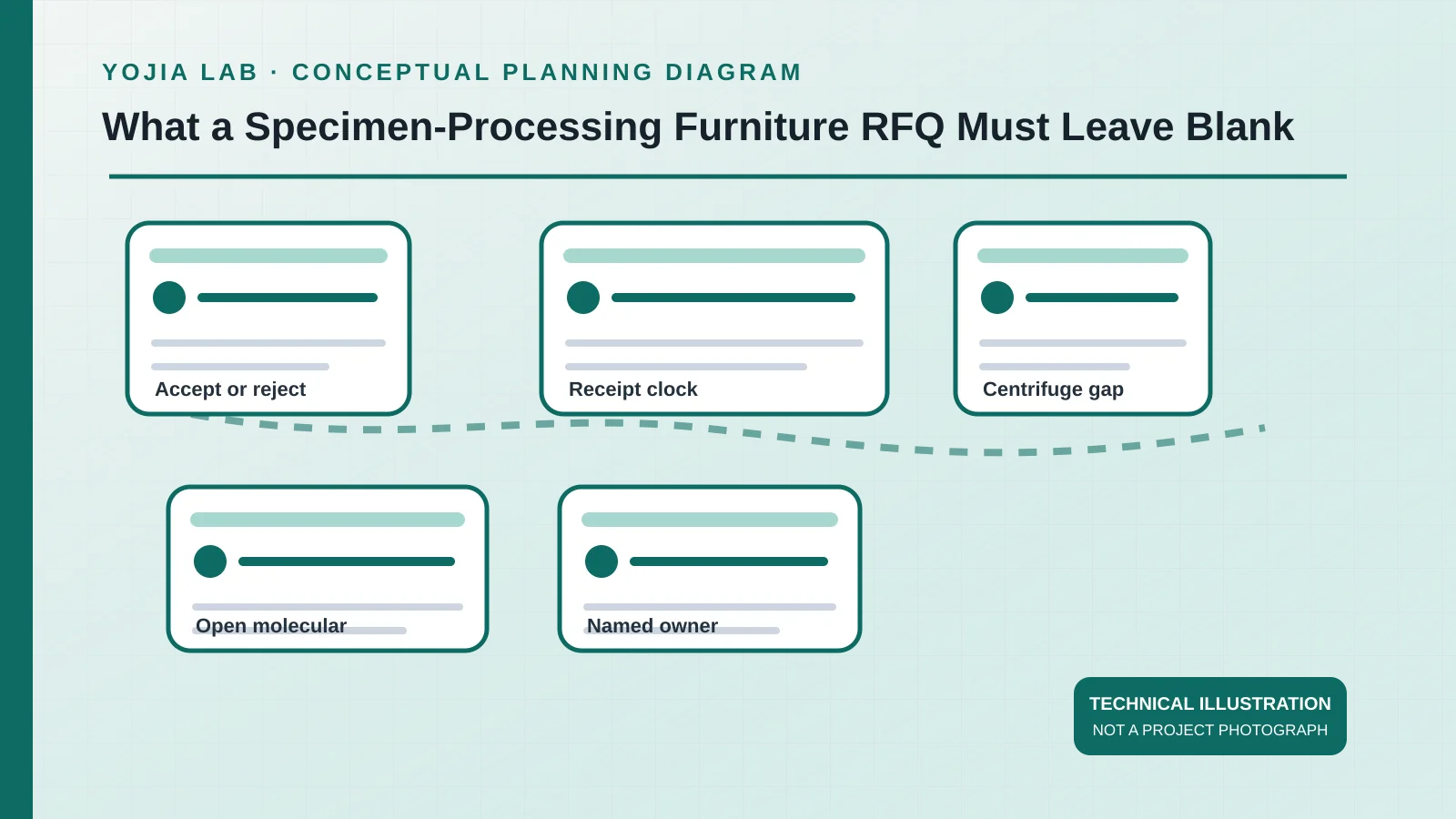
WHO's reception note expects a register that can show collection, reception, and acceptance dates, the examinations, and who performed them. A specialist workstation can hold that register. It does not create the fields. Before prices are compared, walk the blanks with the people named on them. A cell that still says the supplier will confirm it is unfinished, because the supplier does not own rejection rules or the rotor's instructions. The figure is a checklist diagram, not a completed order.
Before pricing, check the laboratory furniture support for distributors and contractors against the room and workflow conditions already recorded above.