01
Write a shutdown record before anyone prices removal
WHO's design monograph defines decommissioning as stopping work, decontaminating, and making a space safe. Proving a surface is decontaminated, in that glossary, means the laboratory has checked the method against a detection limit with a chemical, physical, or biological indicator. For a clinical specimen room, the shutdown record names the last run, the person who stopped accession, and the indicator or other evidence the laboratory accepts for the surfaces that crews will touch.
The CDC diagnostic-laboratory guidelines say there is no national area-per-person rule, and they offer 300 to 350 square feet per person and a five-foot clearance behind a seated worker only as planning suggestions. The same text says a poor layout is hard to repair later, so the laboratory director, the section supervisor, and a biosafety professional should speak before a specimen room is rebuilt.
02
Label equipment an outside crew will touch
OSHA's bloodborne pathogens standard requires employers to look at equipment that may be contaminated with blood or other potentially infectious materials before it is serviced or shipped, and to decontaminate it as necessary unless they can show that full decontamination is not feasible. Where a portion cannot be cleaned, that portion is labeled, and the information is given to affected employees and to the servicing representative before they handle, service, or ship it. A 1993 OSHA interpretation letter repeats that sequence. They should not open a centrifuge that still lacks this label.
CDC's diagnostic guidance asks laboratories to write procedures for nonlaboratory work, including contracted maintenance, housekeeping, and construction and utility operations, and to write those procedures with the service providers. Training and a competency check for those providers are documented. Work surfaces that contact blood or other potentially infectious materials are cleaned after procedures, after spills, and at the end of a shift when contamination may have occurred. During a partial shutdown, name which benches stay in service and therefore stay on that cleaning schedule, and which benches are already inside the labeled, out-of-service zone.
- Machines cleaned, and the evidence the laboratory accepts
- Machines labeled because cleaning could not be finished
- Names of crews told about those labels
- Benches that remain in service and on the cleaning schedule
03
Keep specimen custody and the one-way molecular split
CDC's receiving guidance says containers are looked at for leaks before they go onto rockers, into centrifuges, or onto automated aliquot and slide systems, and that a broken or spilled container is a reason to ask for a new specimen when that is feasible. While the room is partly closed, write where those rejected containers are held so they are not walked through the construction opening.
For laboratories in the U.S. CLIA program, CMS interpretive guidelines on 42 CFR 493.1101 expect space, ventilation, and utilities for every phase of nonwaived testing, and a layout that limits mix-ups in handling, examination, and reporting. Work surfaces should be large enough and lit for the tests, with water, gas, suction, and electrical outlets as the methods need them. Open molecular amplification that is not inside a closed system needs separate areas for reagent preparation where that applies, for specimen preparation, and for amplification and detection, and amplified material is not carried back. If this renovation joins two of those areas, the laboratory is changing a regulatory arrangement, not only a wall.
04
Decide gases, waste, and power for the closed week
CDC suggests locating carbon dioxide and anaerobic gas tanks outside the laboratory, shielded or beyond the wall, so exchanges do not require entry, with synthetic lines that can be rerouted later and with gauges read daily unless an alarm exists. A renovation is the moment to say whether those tanks move. WHO's monograph keeps corridors clear of storage and gives waste its own floor space before it leaves.
If waste is treated in the building, CDC says the autoclave has to be large enough for the load, placed where heat and odour are managed, or fitted with a capture hood over it, and that cycles for the expected loads are checked. A capture hood over an autoclave is a local exhaust question, not a bench order. If treatment is by contract instead, the contract has to cover the week the usual room is unavailable. CMS adds that power should be a stable outlet sized to the instrument, not an extension cord.
05
Leave lengths open until the shutdown record is accepted
WHO notes that renovation and repurposing need the same early statement of purpose as a new laboratory, because the building will be used for a long time, and that builders, designers, and laboratory managers are all readers of the monograph. The statement for this specimen room is short: which tests continue elsewhere, which machines are labeled, which gases and waste paths change, and which walls might move.
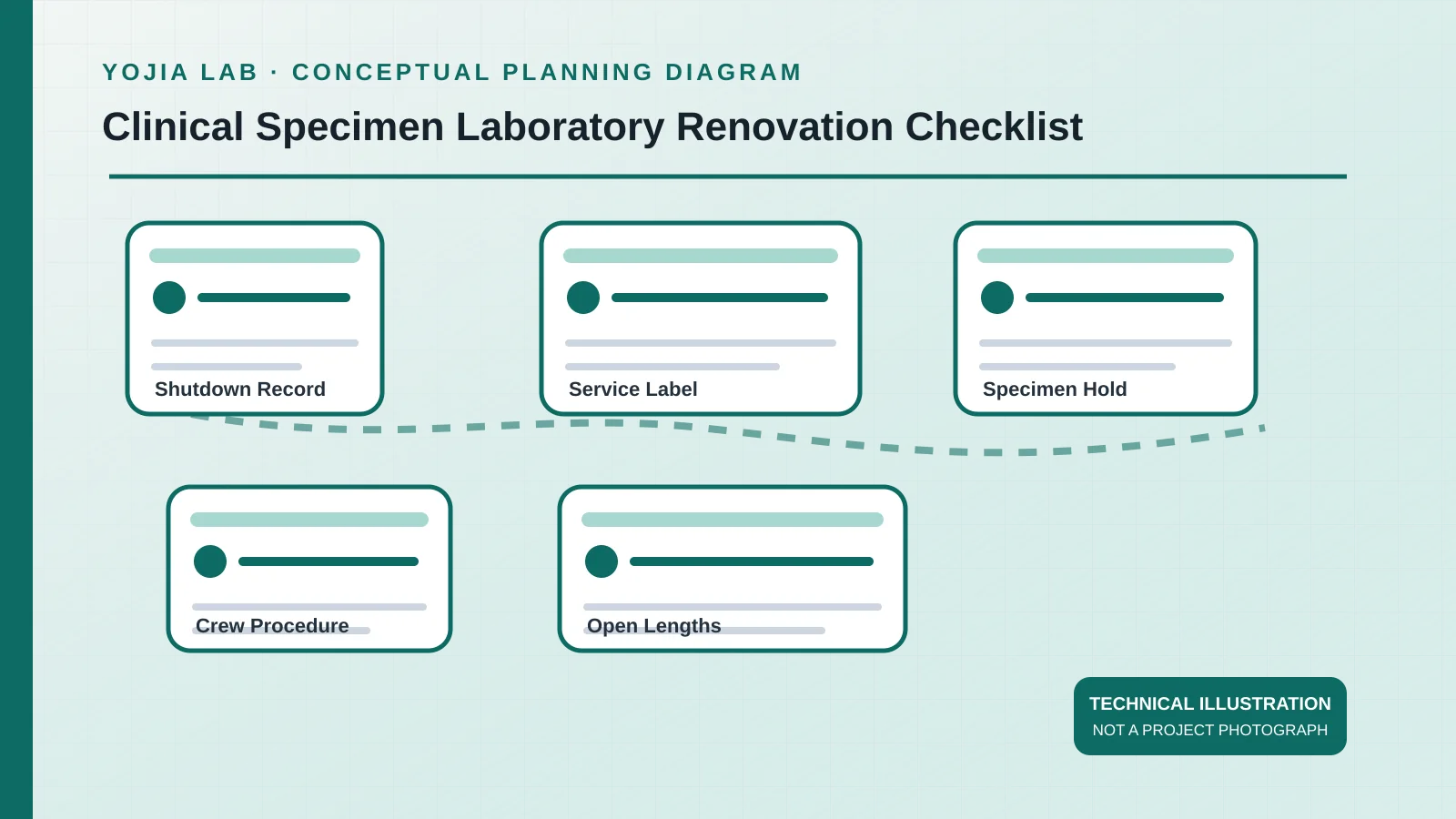
Storage can mark a temporary hold for logged tubes. Support pieces can mark a basin that has to remain reachable while one side of the room is closed. The figure shows five planning zones. It is a technical illustration, not a demolished room and not a clinical authorization.
Before pricing, check the distributor and contractor project support against the room and workflow conditions already recorded above.