01
Fix the direction before choosing a counter
CDC's guidelines for medical diagnostic laboratories ask that specimen placement, flow, and bench workflow run in one direction, from clean areas toward dirty areas, and that every operator use the same pattern. The point is to make engineering controls easier to use. A receiving station that faces the exit while the aliquot seat faces the door will train people to carry open tubes across a clean keyboard. Write the path as receipt, login, processing, short hold, and exit, and mark which step is still clean.
The same CDC text expects procedure manuals to say how instruments and supplies are arranged, and how often surfaces are cleaned. Supervisors are asked to inspect cleanliness as a routine. Keyboards need covers that are disinfected with the work surface, at least at the end of the shift. A brief that omits the keyboard cover and the waste opening will force a laptop onto the wet side. Mobile stands can hold a printer only if they do not become a second, backwards path.
02
Leave surface resistance as a laboratory answer
BMBL, sixth edition, lists facility expectations that start at biosafety level 1 and are built upon at higher levels. The room can be cleaned. Gaps between benches, cabinets, and equipment stay reachable. Furniture can support anticipated loads and uses. Benchtops are impervious to water and resistant to heat, organic solvents, acids, alkalis, and other chemicals. Chairs used for laboratory work have a non-porous cover that can be cleaned and decontaminated. Those are criteria for the laboratory to match to its agents and disinfectants. They are not a catalog claim.
WHO's fourth-edition biosafety manual expects laboratories that handle biological agents to keep walls, floors, and furniture smooth, easy to clean, impermeable to liquids, and resistant to the disinfectants normally used there. Benchtops are impervious to water and resistant to disinfectants, acids, alkalis, organic solvents, and moderate heat. Open space under benches, cabinets, and equipment can be cleaned. Ask which disinfectant and which moderate heat are actually in use. Until that list exists, the surface grade stays blank.
03
Put handwashing on the way out
The WHO design monograph places a handwashing basin in each room where procedures, including waste handling, are performed, as close as practical to the exit. That basin is for hands only and stays apart from sinks that receive chemicals or contaminated liquids. Running water should be available, preferably with a hands-free control, plus soap. BMBL likewise expects a handwashing sink and a readily available eyewash at the base level. Furniture can reserve the basin and the dispensers. It cannot decide water temperature or the drainage code.
OSHA's bloodborne pathogens standard, 29 CFR 1910.1030, requires a written cleaning schedule based on the place, the surface, the soil, and the task. Surfaces that contact blood or other potentially infectious materials are decontaminated after procedures, after visible spills, and at shift end if contamination may have occurred. Protective coverings are replaced when visibly soiled or at shift end. A top that cannot tolerate the laboratory's disinfectant will fail that schedule even if the color matches a brochure. Write the disinfectant beside the surface line.
04
Seat the instrument without reversing the path
Diagnostic work often keeps one person at an instrument for a long stretch. CDC's guidance says a four-foot cabinet used for plating and smears is limited to one person at a time, and a wider cabinet is shared only after the maker's advice and a risk assessment. That limit also sizes the seat, the waste, and the clean approach. Give the seated station a knee space, a covered keyboard, and a waste opening on the soiled side. Do not add a second chair where the assessment has kept the station to one person.
Support pieces and specialist stands should follow the manual's layout. If an analyzer needs clearance on one side for maintenance, that side stays open. Chairs follow the BMBL expectation of a non-porous, cleanable cover. Cloth seats are a poor match for a room that disinfects surfaces at shift end. Clean consumables stay on the clean side. Short-hold racks for logged tubes stay downstream. A mobile table that shuttles between those sides needs a written rule, or it erases the direction the CDC text asked for.
05
Send the brief with the blanks still visible
A useful review starts from quantities, hazards, and the lines that are still open. Include the specimen path, the disinfectant list, the basin, the seated stations, and the load each top must carry. BMBL's phrase is anticipated loads and uses. If the laboratory has not weighed the analyzer, write unknown and the person who will answer. A guessed kilogram should not become a written duty.
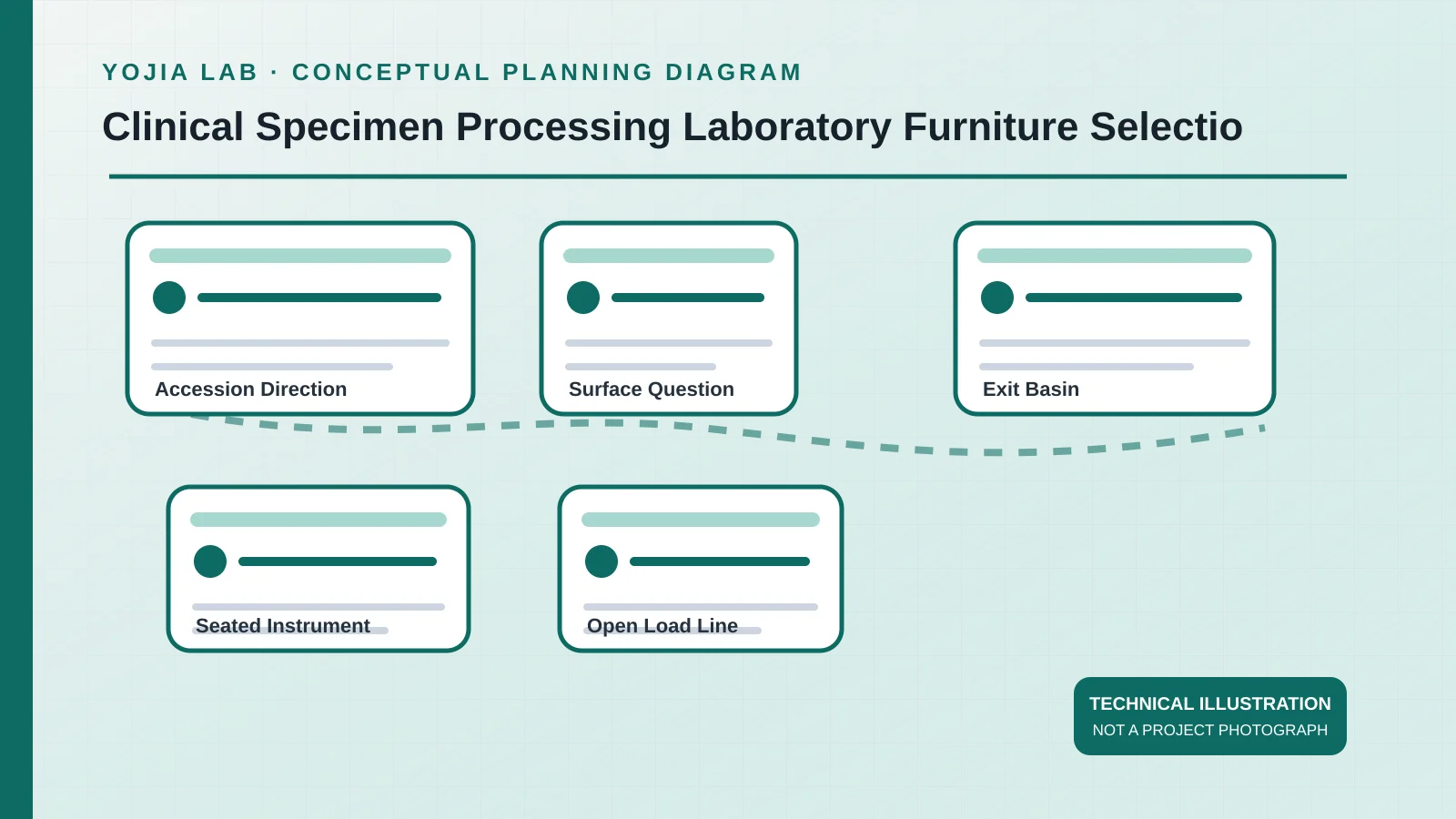
Selection here is a set of questions, not a finished room. Specialist stands can mark the seated instrument. Mobile pieces can mark a printer that stays on the clean side. Storage can separate clean consumables from short-hold tubes. Support pieces can mark the basin and the waste opening. None of those families chooses the biosafety level, the disinfectant, or the clinical method. The diagram is five questions, not a photograph of a receiving room.
When the plan is ready for a factory review, send the quantities, hazards, and unresolved room limits to a China laboratory furniture manufacturer. Open items should stay open rather than being written as a confirmed specification.