01
Give electrolyte filling a different address from the open floor
Pacific Northwest National Laboratory’s Advanced Battery Facility page describes a dry room and a separate ambient laboratory. In that facility the ambient laboratory is where anode materials, slurry, and electrolytes are developed and where pouch-cell lifetime testing is run. The page also states floor areas for that building. Do not paste them onto another project. What transfers is the split: moisture-controlled fabrication is not the same room as the ambient work.
A Department of Energy paper hosted by OSTI states that common organic carbonate solvents are highly flammable and that the electrolyte is highly hygroscopic. It states that a short exposure to ordinary air can let lithium hexafluorophosphate hydrolyze, and that preparation, storage, and handling of those electrolytes is done in an argon glovebox held under 5 ppm water or in a dry room. That sentence is about the chemistry, not about a bench product. An island laboratory bench standing in ordinary air does not become the fill station because the drawing has empty floor. If the method still requires the dry room or the glovebox, the island line stays empty.
02
Keep abuse tests off the cycling island
A 2011 Sandia National Laboratories prototyping note places electrode coating and cylindrical-cell winding inside dry rooms. The same note lists a separate abuse laboratory: thermal ramp, cell crush, overcharge, module crush, simulated fuel fire, water immersion, accelerating-rate calorimetry, and short circuit. Those operations fail in different ways. Lifetime cycling of an intact pouch is not a reason to put a crush fixture or a fire simulation on the same island laboratory bench.
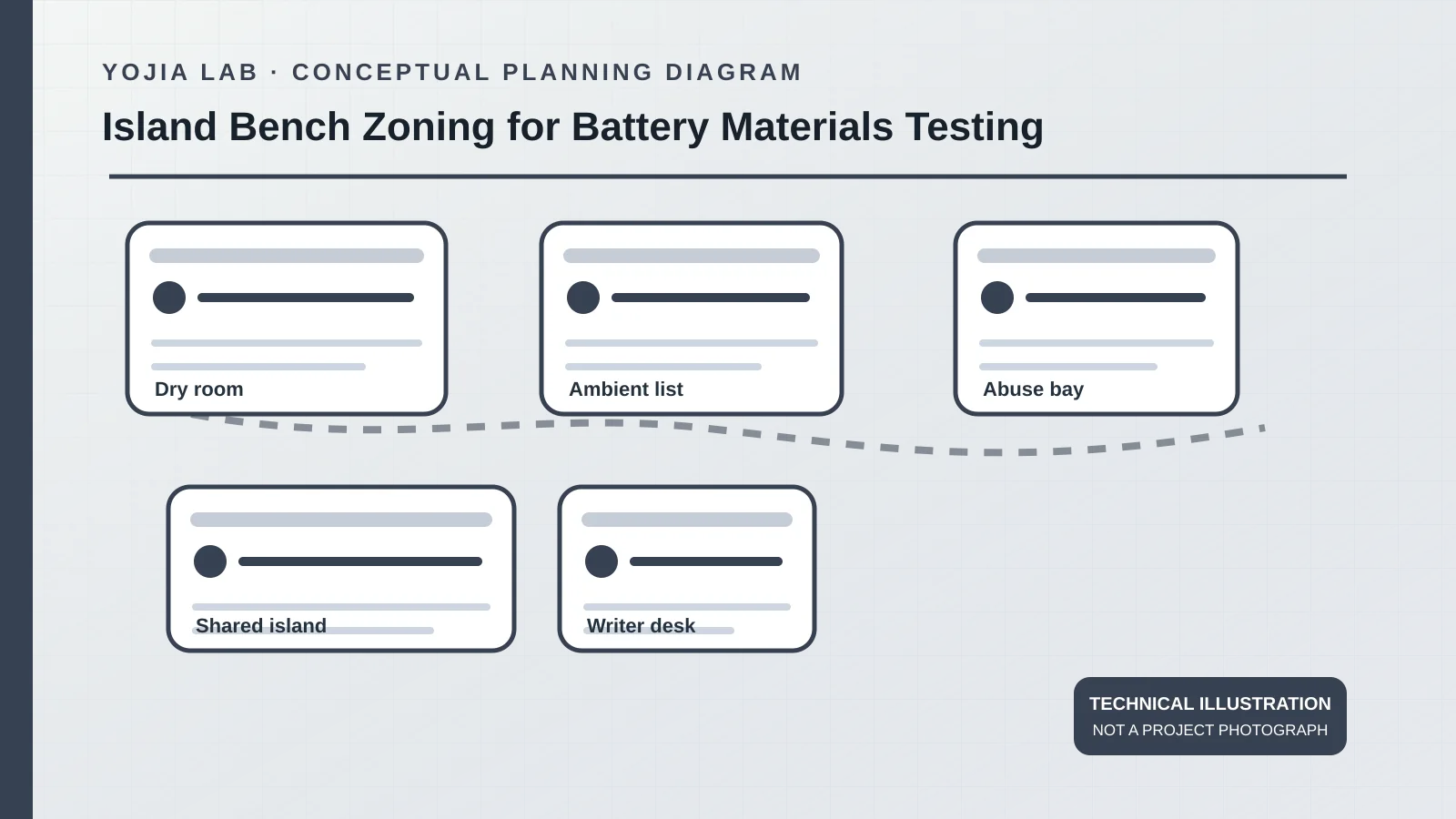
Draw three addresses. Moisture-controlled making of electrodes and filled cells is one. Ambient materials work that the review has accepted in room air is the second. Abuse is the third. The island laboratory bench sits only in the second. The other two addresses are usually an enclosure or a protected bay, outside this furniture package.
03
Use the island for shared instruments only
The National Academies’ facilities chapter says shared equipment is easier to share when it is outside one person’s work zone, and it warns that some tools must stay dedicated. In the ambient room, an island laboratory bench can carry a balance, a conductivity meter, or a cycler rack when the group has already agreed those tools are shared and that they do not need an enclosure. A coater that the method keeps in the dry room does not become shared by being redrawn in the middle of the ambient floor.
The same chapter notes a habit of keeping fixed sinks and chemical hoods on the outer wall so the center of the room can be rearranged. That is a description of a habit, not an order to buy a movable island for every battery group. If the shared list is empty, do not add an island laboratory bench to make the plan look occupied. Bare floor is an acceptable answer until a real shared instrument appears.
04
Let the employer mark the designated area
Where 29 CFR 1910.1450 applies, the employer keeps a written chemical hygiene plan. For particularly hazardous substances the plan has to consider a designated area, containment such as a glovebox, removal of contaminated waste, and decontamination. Lithium metal and some electrolyte additives are decided in that plan, not on a furniture form. If the plan marks a designated area, the island laboratory bench stays outside it. The drawing does not create the area, and it does not choose the containment.
People still write notes and watch cycler screens. Put that writing where a solvent splash from the electrolyte step cannot reach it. The facilities chapter treats an open aisle as a weak split between writing and active chemistry. If the only gap between the person logging data and the fill step is a walkway, move the logger. An island laboratory bench is a work surface for the shared instruments. It is a poor desk.
05
Record length only for the ambient shared list
The National Academies’ table of engineering controls separates ordinary room ventilation, environmental rooms, chemical hoods, and gloveboxes. In that table an environmental room is shown with no routine air exchange and is listed for materials that need special conditions, with only nonhazardous amounts of flammable, toxic, or reactive chemicals. Do not set solvent electrolyte work on an open island inside a room that barely changes air and then treat the room as finished. This note does not publish an air-change target. The employer’s ventilation review does that.
A quotation may record the island laboratory bench length, the sides people stand on, and the services the shared instruments actually need, and only for the ambient zone. It may not record a dew point, a glovebox moisture reading, or a result from an abuse test. Inquiry codes name the conversation. They are not evidence that a surface has been accepted for carbonate electrolyte or for a crush setup. Send the three-address list with the sketch. Any step without an address stays off the island.
Before pricing, place the room dimensions, user sides, and service interfaces for the island laboratory bench layout with the workflow notes above. The final configuration remains the approved quotation and drawings.