01
One campus guide locks clearance and finish
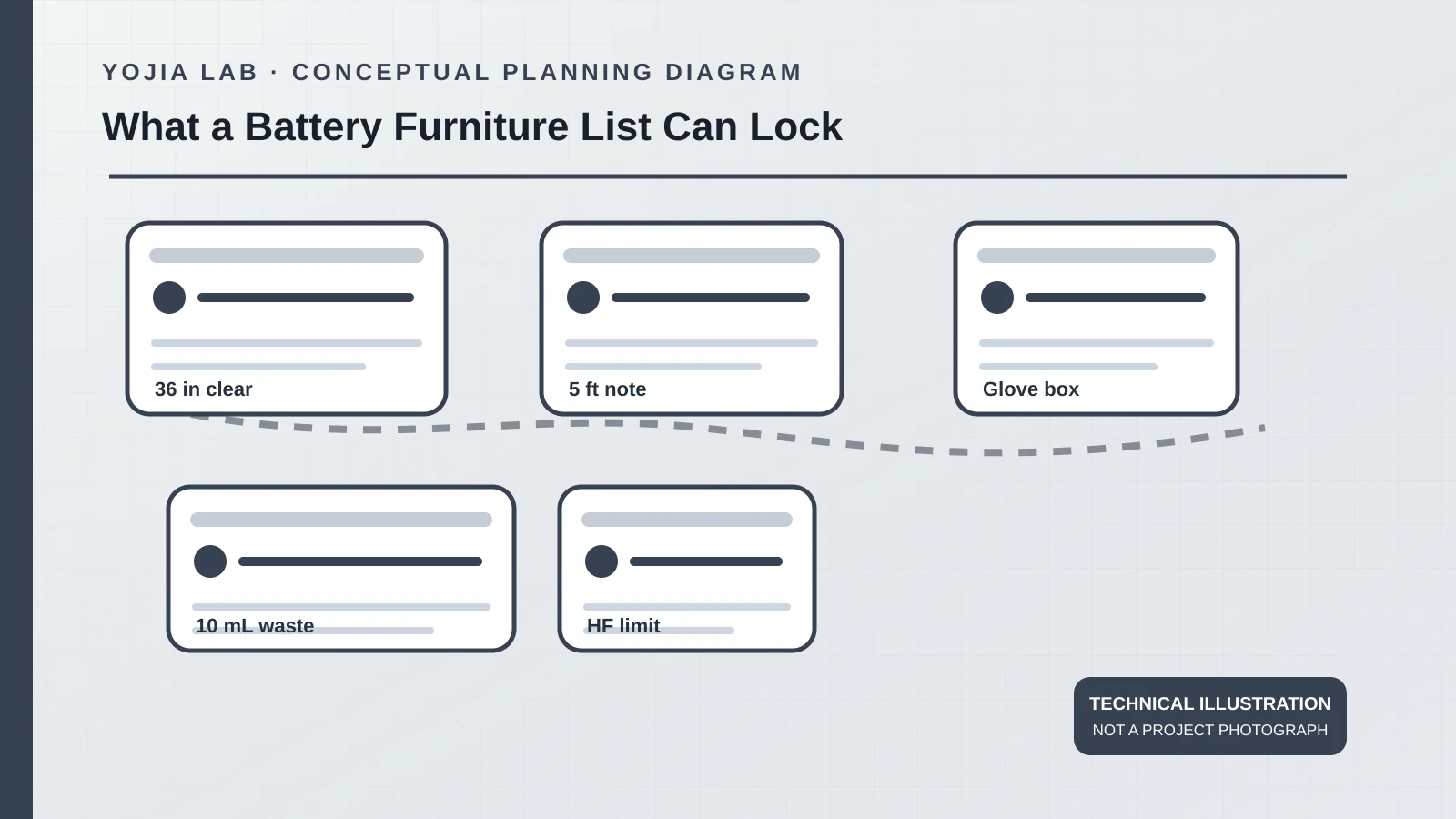
The Maryland guide applies to that university’s laboratory projects. It requires at least 36 inches of clearance in aisles and normally occupied spaces for emergency egress, citing DCFS 01.81.10 and ADA 403.5. This note has not opened those two documents. A best-practice line wants at least 5 feet between benches, work surfaces, and equipment, citing Guidelines for Laboratory Design, 4th edition. Five feet does not restate 36 inches. A sheet that prints one aisle has to name which label it used.
Where hazardous materials are present, the guide requires smooth, non-porous furniture and casework, citing NFPA 45 section 5.1.5. This note has not opened that standard. Flooring is sealed against downward leaks under the same citation. Chemical storage sits near the work, cited to section 5.3. Chemical fume hoods and compressed-gas storage are placed as far from the exits as feasible, cited to section 7.9. Carpet is not recommended. Resistant tops, and keeping moveable furniture off an egress path, are recommendations rather than requirements.
02
Opened salt is not an open-bench chemical in that plan
The Santa Barbara file is that battery facility’s safety manual and chemical hygiene plan. The file name includes 2025; the opening pages print no separate issue date, and this note does not quote the Cal-OSHA duty the manual mentions. The procedure says the lithium and sodium salts react with moisture and can decompose on heating to hydrogen fluoride and PF5. The salt stays in the glovebox, an opened bottle is not taken outside or stored in glass, and it is kept under inert gas. The designated area is only inside fume hoods or gloveboxes.
The carbonate procedure names ethylene carbonate, diethyl carbonate, dimethyl carbonate, and ethyl methyl carbonate. They dissolve the lithium salt, are volatile and flammable, and can form a peroxide the procedure calls pyrophoric after long contact with air or oxygen. They should always be used in the glovebox. After the seal is opened they are not stored in air, and the opened bottle stays inside. Stated conditions are ambient temperature, ambient pressure, and a scale of 1 mg to 1 g. That scale is the procedure’s experimental range, not a bench load rating. One open bench labeled “electrolyte work” has not recorded the glovebox rule either procedure prints.
03
Waste limits are not cabinet dimensions
The salt procedure caps glovebox waste at 10 mL of liquid or 5 g of powder and says not to keep it in glass. A later sentence stores that waste in the fume hood, avoids a 50 mL accumulation, and limits holding to one week. The solvent procedure wants a container smaller than 50 mL in the glovebox during work, and the same hood, 50 mL, and one-week limits afterward. Both places and both volumes stay on the sheet. One cabinet width would drop that distinction.
Small antechambers cycle at least three times, with 10 minutes or more of evacuation, unless left under vacuum overnight. Glass, paper, and plastics use the large antechamber overnight because they give off water. The drying oven behind the box is described as set at 100 °C. These are transfer steps for one installation. They print no oxygen, moisture, or humidity setpoint, including after the power-loss note that readings rise when the blower trips.
04
The fluoride limit belongs to the gas, not the bench
The NIOSH Pocket Guide entry for hydrogen fluoride, last reviewed 30 October 2019, lists an immediately dangerous value of 30 ppm. The recommended limit is a time-weighted average of 3 ppm (2.5 mg/m³) and a 15-minute ceiling of 6 ppm (5 mg/m³). The OSHA limit on that page is a time-weighted average of 3 ppm. One ppm equals 0.82 mg/m³. The entry says hydrogen fluoride will attack glass. The Santa Barbara warning that the salt can generate hydrogen fluoride is a reason to read the page. It is not a test of any bench, cabinet, or glovebox against 3 ppm or 6 ppm. This note measured no air.
Under the Maryland guide, copy the required 36-inch clearance and, on another line, any 5-foot best practice the project adopts. Copy the non-porous finish only with the guide’s citation. Mark opened salt and solvent bottles as glovebox materials, and keep 10 mL, 5 g, 50 mL, and one week as waste rules. Put the hydrogen fluoride numbers in an exposure cell with the unit, the averaging time, and the agency. Leave face velocity, humidity, and any oxygen setpoint blank. The list is not a chemical hygiene plan or a test report.
When the plan is ready for a factory review, send the quantities, hazards, and unresolved room limits to a laboratory furniture manufacturer in China. Open items should stay open rather than being written as a confirmed specification.