01
Three drying temperatures are not one surface
ISO 11464 dries soil in air, in a forced-ventilation oven not above 40 °C, or by freeze-drying. It prefers 40 °C because faster drying limits microbial change. FAO GLOSOLAN-SOP-20, effective 24 January 2023, uses that ceiling, then stores the soil airtight, out of sun, at 3 °C to 30 °C. Moisture is measured separately at 105 °C ± 5 °C for about 24 hours, until one more hour loses under 0.1 percent of the soil mass.
Kellogg method 1B1b2b, in SSIR 42 Version 6.0 (2022), air-dries bulk soil on a tared tray at 35 °C for 2 to 4 days. Where organic matter is high, FAO says 105 °C can decompose it and bias moisture, so consider 60 °C to constant mass for up to 24 hours. Method 3050B, Revision 2 (December 1996), lists a drying oven at 30 °C ± 4 °C and heats digestion to 95 °C ± 5 °C. The island bench gets a setpoint only after the procedure is named.
02
The 2 mm split is a station, not a room
ISO 11464 generally sieves at 2 mm on an ISO 565 plate and tells the lab to check later methods for another aperture. Finer work uses 250 µm or the stated mesh, and subsamples under 2 g are milled. The standard generally assumes at least 500 g of fresh soil. That mass is not a bench length. Kellogg tests the air-dry fraction under 2 mm and, citing Bates (1993), says most U.S. and Canadian labs sieve to 2 mm.
For oven-dry reporting, FAO dries at no more than 40 °C, sieves at 2 mm or finer if required, quarters a large pile, and stores the soil in a labelled airtight container that does not add water or the analyte. ISO 11464 then constrains the bench: remix after sieving or milling, because neighboring samples can cross-contaminate by dust. Field soil and finished fine earth do not share one open top. Give the two piles a gap, or give them two surfaces.
03
Grinding stays on the table the method names
Kellogg step 8.11 grinds on a named table. Soil sits on kraft paper over a 76 cm by 76 cm by 0.5 cm plate, on a downdraft bench 0.91 m by 1.8 m, with a wooden roller 25 cm by 15 cm. The manual keeps dust below OSHA limits without printing the number, and it requires the canopy and flexible-arm filters on and close to the work. A NIOSH N95 mask is optional and must be fitted if it is used.
FAO notes that pulverizing dust can cause conditions such as silicosis, so a mask is encouraged while preparing and cleaning. Hydrocarbons or acids call for a visible notice and a respirator with matching filters. ISO 11464 tells contaminated-soil drying to avoid skin contact and to discharge air, because chemicals, spores, or pathogens such as leptospirosis may be present. Those controls sit at the grinding spot. An open island bench can still hold trays and soil that is already sieved.
04
Acid digestion leaves this peninsula
Method 3050B runs two acid digestions, ahead of flame atomic absorption or ICP-AES and ahead of graphite-furnace atomic absorption or ICP-MS. It is not a total digestion. Silicate-bound elements usually remain, and Method 3052 is the pointer when a total is required. Use 1–2 g wet or 1 g dry, and a USS #10 sieve when sieving applies. Section 7.1 puts every acid step in a fume hood with trained staff, at 95 °C ± 5 °C without boiling, with no more than 10 mL of 30 percent hydrogen peroxide.
That hood is not the island bench used for the 35 °C or 40 °C trays. Vessels beside drying soil would ignore the hood note and ISO 11464's exclusion of volatile tests. A quotation may list an island bench for the drying and sieving the chosen pretreatment uses. It may not call that bench the digestion spot, or attach a face velocity this room has not measured.
05
Write the method on the bench line
Give each step a row: drying document and setpoint, including 60 °C when organic matter requires it; 2 mm or the later aperture; the 0.91 m by 1.8 m downdraft bench when 1B1b2b is the method; a hood rather than this peninsula when 3050B acids are in scope. Volatile work sits outside ISO 11464. Quarantined soil is separate. Kellogg points it to 7 CFR 330 and does not turn that citation into a furniture size.
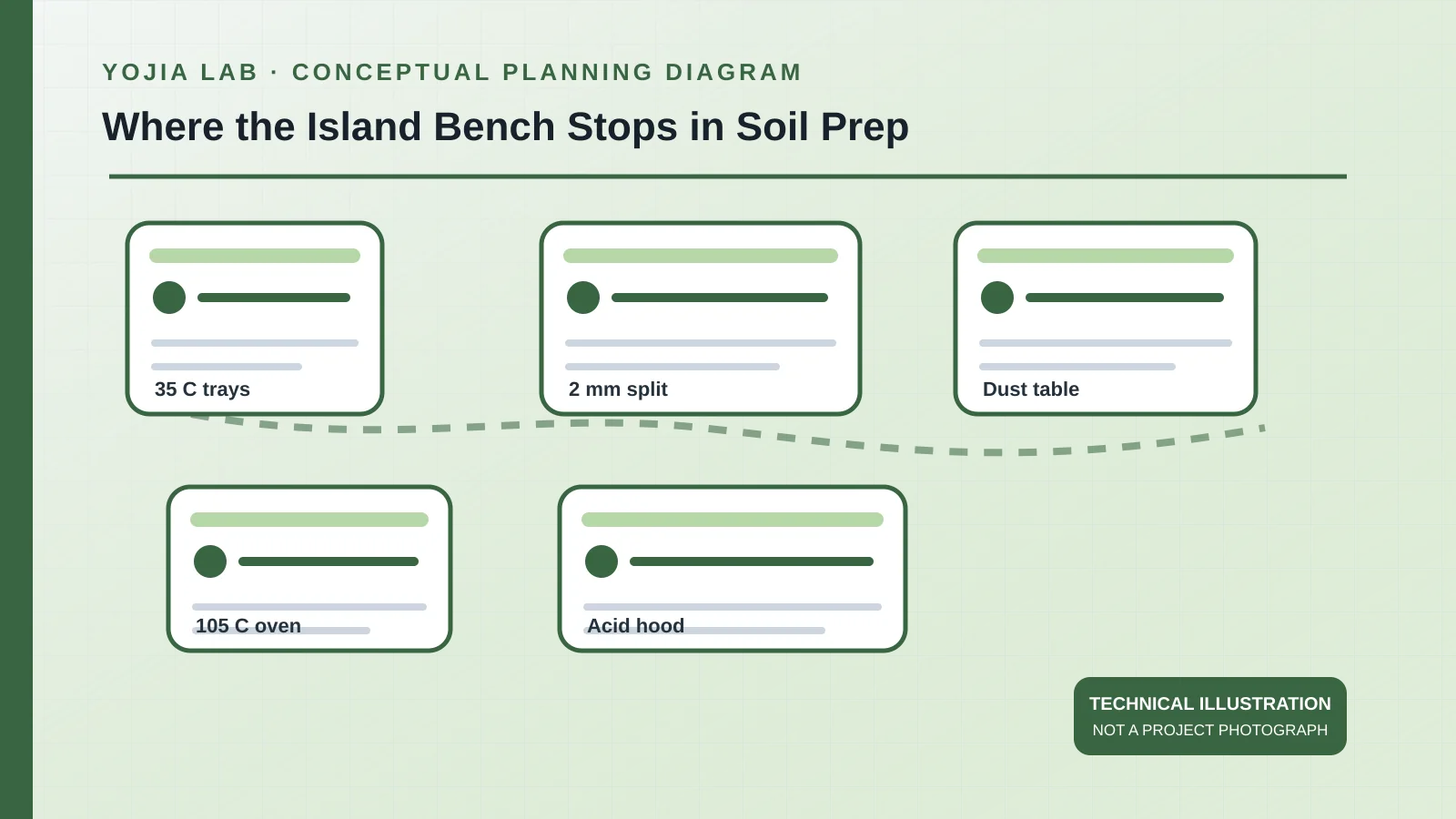
As an example only, a lab using Kellogg step 8.6 and the FAO moisture split can put 35 °C trays on the island laboratory bench and keep field soil off the fine-earth containers. The 105 °C oven, the downdraft bench, and the acid hood stay off that island. No cited source turns 500 g of fresh soil, or a 1 g aliquot, into a factory length. Leave the length blank until trays, sieves, and aisles are measured.
Before pricing, place the room dimensions, user sides, and service interfaces for the island laboratory benches with the workflow notes above. The final configuration remains the approved quotation and drawings.