01
Fine earth is a tray and a downdraft bench
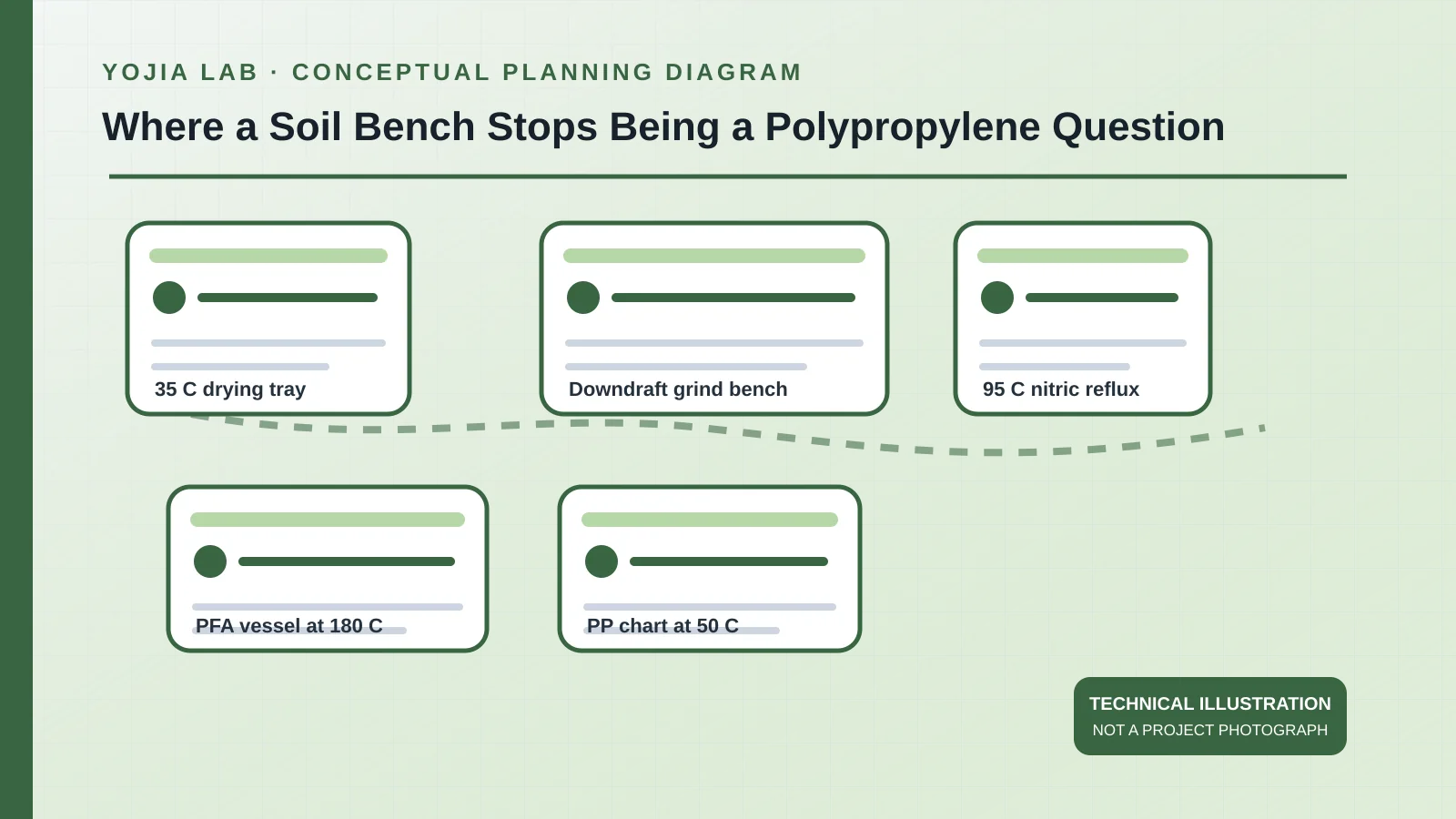
Method 1B1b2b in the Kellogg Soil Survey Laboratory Methods Manual, SSIR No. 42, Version 6.0, prepares routine work on the air-dry fine-earth fraction smaller than 2 mm. Citing Bates (1993), it notes that most US and Canadian laboratories sieve to 2 mm. The sample is spread on a tared fiberglass tray and air-dried at 35 °C for 2 to 4 days, longer if moisture or composition requires it. The list includes heat-resistant plastic trays, stainless sieves, a wooden roller, a jaw crusher, and a downdraft grinding bench 3 ft by 6 ft (0.91 m by 1.8 m) with a 76 cm by 76 cm plate. Those sizes describe that laboratory’s list. They are not a module to reorder without the rest of it.
Dust, in the same section, is a room problem rather than a resin problem. During processing the overhead canopy and the flexible-arm filter boxes must be on and close to the work. Draw-down tables are optional. ANSI-approved safety glasses are required, and gloves are specified only as a polymer with a suitable chemical-resistance rating. The preparation balance is ±1 g with a 15 kg capacity. None of this is hot concentrated acid. A polypropylene worktop is neither chosen nor rejected by a 35 °C tray. The question is whether this station is the ventilated grind position, with hands kept clear of the crusher, or a separate tray table.
02
A 95 °C reflux is not the preparation bench
EPA Method 3050B, Revision 2, December 1996, digests sediments, sludges, and soils for environmentally available metals. It is not a total digestion. Silicate-bound elements normally stay undissolved, and the method points to 3052 when a total result is required. A 1–2 g wet or 1 g dry sample meets repeated additions of concentrated nitric acid and 30% hydrogen peroxide. Hydrochloric acid is added for flame atomic absorption or ICP-AES. The heat source must hold 90–95 °C. The procedure refluxes at 95 °C ± 5 °C without boiling, in 250 mL vessels. The list also names a drying oven able to hold 30 °C ± 4 °C. That listing is not the Kellogg 35 °C tray dry, and the two should not be merged.
Section 6.2 says plastic and glass containers are both suitable once shown clean at or below the reporting limit. That is the incoming container, not a bench or a named polymer at 95 °C. The reflux uses concentrated nitric acid, peroxide, and, in part, hot hydrochloric acid under a vapor-recovery device. Method 3051A, Revision 1, February 2007, adds a drying limit for samples that cannot be mixed as received: 60 °C or less, then crush and sieve. Beside it sit the Kellogg 35 °C, 2-to-4-day tray dry and the 3050B oven listed at 30 °C ± 4 °C. Each temperature stays with its own method.
03
The microwave vessel is already named, and it is not polypropylene
Method 3051A puts the sample in a fluorocarbon vessel, with PFA or TFM as examples, or in quartz. Soils, sediments, and sludges are no more than 0.500 g, weighed to 0.001 g. Acid is added in a fume hood or other exhausted enclosure: 10 ± 0.1 mL concentrated nitric acid, or 9 ± 0.1 mL nitric acid plus 3 ± 0.1 mL hydrochloric acid. Temperature rises to 175 °C ± 5 °C in about 5.5 ± 0.25 minutes and holds for 4.5 minutes. The mixed acids build more pressure than nitric acid alone and call for vessels of 30 atm (435 psi). Outer layers are often less acid-resistant than the liner. Those sentences describe the digestion vessel, not a furniture panel.
Method 3052, Revision 0, December 1996, is the total path 3050B names when the silicate fraction matters. Initially no more than 0.5 g of soil goes into an inert polymeric vessel. The examples printed are PFA and TFM. The usual charge, added in a fume hood, is 9 mL concentrated nitric acid and 3 mL hydrofluoric acid, and the acid may run from 0 to 5 mL with silicon dioxide content. The program reaches 180 °C ± 5 °C in less than about 5.5 minutes and holds for 9.5 minutes. The method says a hydrofluoric solution must not touch glass. Calling that vessel polypropylene ignores the polymers on the page.
04
The labware chart stops at 50 °C and splits by concentration
The Thermo Scientific Nalgene guide rates labware, not furniture or centrifugeware. Each pair of letters is 20 °C then 50 °C: E, no damage after 30 days; G, little or none after 30 days; F, some effect after 7 days; N, not for continuous use. Ratings are estimates, and resistance falls as temperature rises. Polypropylene is E/E in 10% nitric acid, F/N in 50%, and N/N in 70%. Acetone is F/N. Pure hydrofluoric acid is E/G. The copolymer column rates acetone N/N, so a recycling mark does not identify which column was tested.
That guide lists a maximum use temperature of 135 °C for polypropylene labware, a heat-deflection temperature of 107 °C under the ASTM D648 condition it cites (66 psig, 0.01 in deflection), and a brittleness temperature of 0 °C. The short thermal ceiling is not a 30-day rating at 95 °C, 175 °C, or 180 °C. It also says not to store strong oxidizers in plastic labware except FEP or PFA. Concentrated nitric acid and 30% hydrogen peroxide are oxidizers here. The 10% nitric row does not justify a polypropylene cabinet, and an E for pure hydrofluoric acid at 20 °C does not make a polypropylene bench the 3052 vessel.
Selection here is a room configuration, not a generic catalog. Put the dimensions, materials, and interfaces to confirm for the PP laboratory furniture next to what a China laboratory furniture manufacturer can answer from drawings and a written brief.