01
The open reflux and the closed vessel do not share a mass
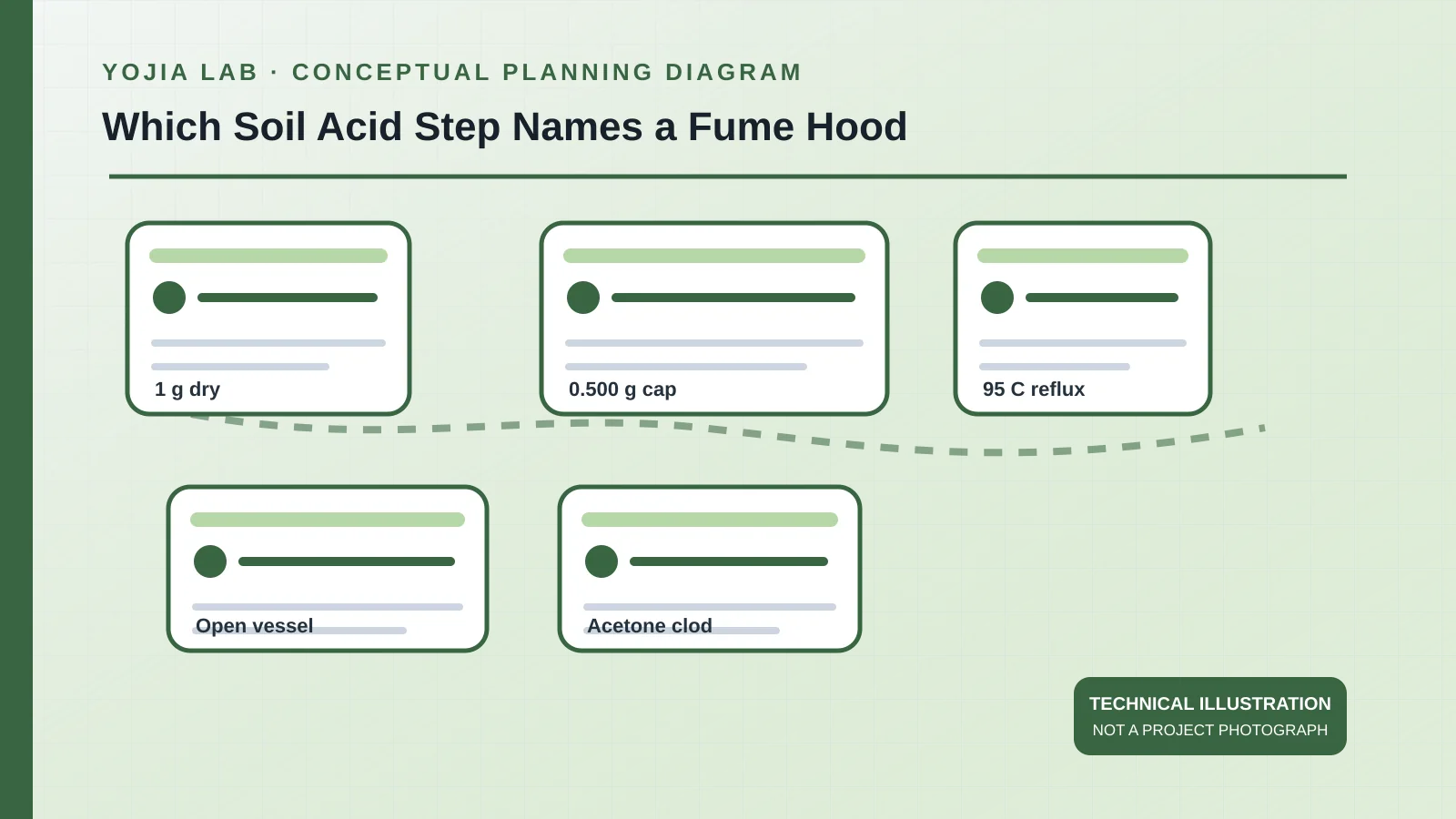
Section 7.1 of Method 3050B weighs to the nearest 0.01 g and transfers 1–2 g wet or 1 g dry. A wetter sample may be larger only if digestion can still finish. Section 1.2 says this is not a total digestion for most samples: silicate-bound elements are not normally dissolved, and an absolute total is pointed to Method 3052. This note has not opened 3052 and does not borrow its vessel rules.
Section 1.1 writes two preparations whose extracts are not interchangeable: flame atomic absorption or ICP emission, versus graphite-furnace atomic absorption or ICP mass spectrometry. Section 4.8 requires a source that can hold 90–95 °C. The procedure then uses 95 °C ± 5 °C without boiling. Both temperatures are printed, and averaging them invents a third number. A sample enlarged under section 7.1 is still not the 0.500 g microwave cap.
02
Where each method actually names the hood
The note under section 7.1 says every acid step should be done under a fume hood by trained people using appropriate safety equipment. An acid-vapor scrubber is encouraged for waste minimization. Encouraged is not the hood verb. On the graphite-furnace and ICP-MS path, section 7.2 adds 10 mL of 1:1 nitric acid and refluxes. A later note caps 30 percent hydrogen peroxide at 10 mL total on that path only. The path ends at 100 mL. No line states a face velocity.
Method 3051A, section 11.3.2, adds 10 ± 0.1 mL of concentrated nitric acid, or 9 ± 0.1 mL of concentrated nitric acid plus 3 ± 0.1 mL of concentrated hydrochloric acid, in a fume hood or a fume-exhausted enclosure. Hydrochloric acid must be added concentrated, not premixed, because a premix can build chlorine gas that may release violently on heating. Toxic nitrogen oxides and chlorine fumes are usually produced, so an open step, and any opening of a microwave vessel, must use a properly operating fume ventilation system. The next warning requires gloves and face protection. Vessels cool at least 5 minutes before removal. A reactive matrix may be predigested in a hood with the cap loose. That alternative is not the default soil row.
03
The closed vessel has a pressure story the reflux does not
Section 11.3.1 of Method 3051A weighs to the nearest 0.001 g and uses no more than 0.500 g for soils, sediments, and sludges. Oil, or oil-contaminated soil, starts at no more than 0.250 g. The vessel should hold at least 45 mL and withstand at least 30 atm (435 psi), with controlled pressure relief. Figures 1 and 2, marked as demonstrations, reached about 12 atm while heating the mixed acids with no sample. SRM 2704 more than doubled that pressure. Oils can reach about 25 atm, a remark pointed to Method 3052. Drying for mixing, when used, stays at 60 °C or less because volatile metals can be lost.
Temperature control is the method’s main feedback. Sensors should be accurate to ± 2 °C, including 175 ± 5 °C, and the instrument should sense temperature within ± 2.5 °C. Section 11.3.5 says each sample should reach 175 ± 5 °C in about 5.5 ± 0.25 minutes and hold that temperature for 4.5 minutes, or for the rest of a 10-minute digestion. Figure 2 and the section 17 recovery plots for antimony, iron, and silver are marked guidance only. Printing 175 °C copies a leach temperature. It does not measure capture, and it does not let a 1 g open reflux from Method 3050B move into this vessel.
04
A soil-survey hood is often a different task
The 2022 Kellogg manual, SSIR 42, Version 6.0, is a characterization manual, not SW-846. Method 3A1a1a dries soil at 30 to 35 °C, sieves it to less than 2 mm, and weighs 10 g to the nearest milligram. Each batch of up to 24 samples includes a quality-control standard. Concentrated acids and bases are dispensed in a fume hood. That sentence is about dispensing. It does not move the 10 g aliquot onto the 1 g metals row, and 30 to 35 °C is not the Method 3050B reflux.
Method 3B1a measures field-state bulk density on clods of about 250 to 550 cm³. Acetone in the saran lacquer is highly flammable, and a closed building is told to use a fume hood. Saran F-310 resin decomposes rapidly above 200 °C and releases hydrogen chloride, so clods are taken apart on a hotplate in a fume hood. Those sentences are about solvent vapor and a heated plastic coat. They are not the nitric reflux and not the 175 °C sealed leach. A fume hood quantity can be discussed only after each job has its own row, its own mass, and a blank where no airflow was printed.
Before pricing, place the room interface, quantities, and service points for the laboratory fume hood systems with the workflow notes above. Airflow, performance, and compliance stay with the project's responsible reviewers.