01
The monograph argues with itself on purpose
The WHO monograph Laboratory design and maintenance, 2020, accompanies the fourth edition of the Laboratory biosafety manual. The introduction prefers a risk- and evidence-based approach over a prescriptive one. The same text then says section 2 covers core-requirement features that must be incorporated in all laboratories. A veterinary room enters that category when the risk assessment places it there, not because the sign says veterinary. The furniture lines belong to that category.
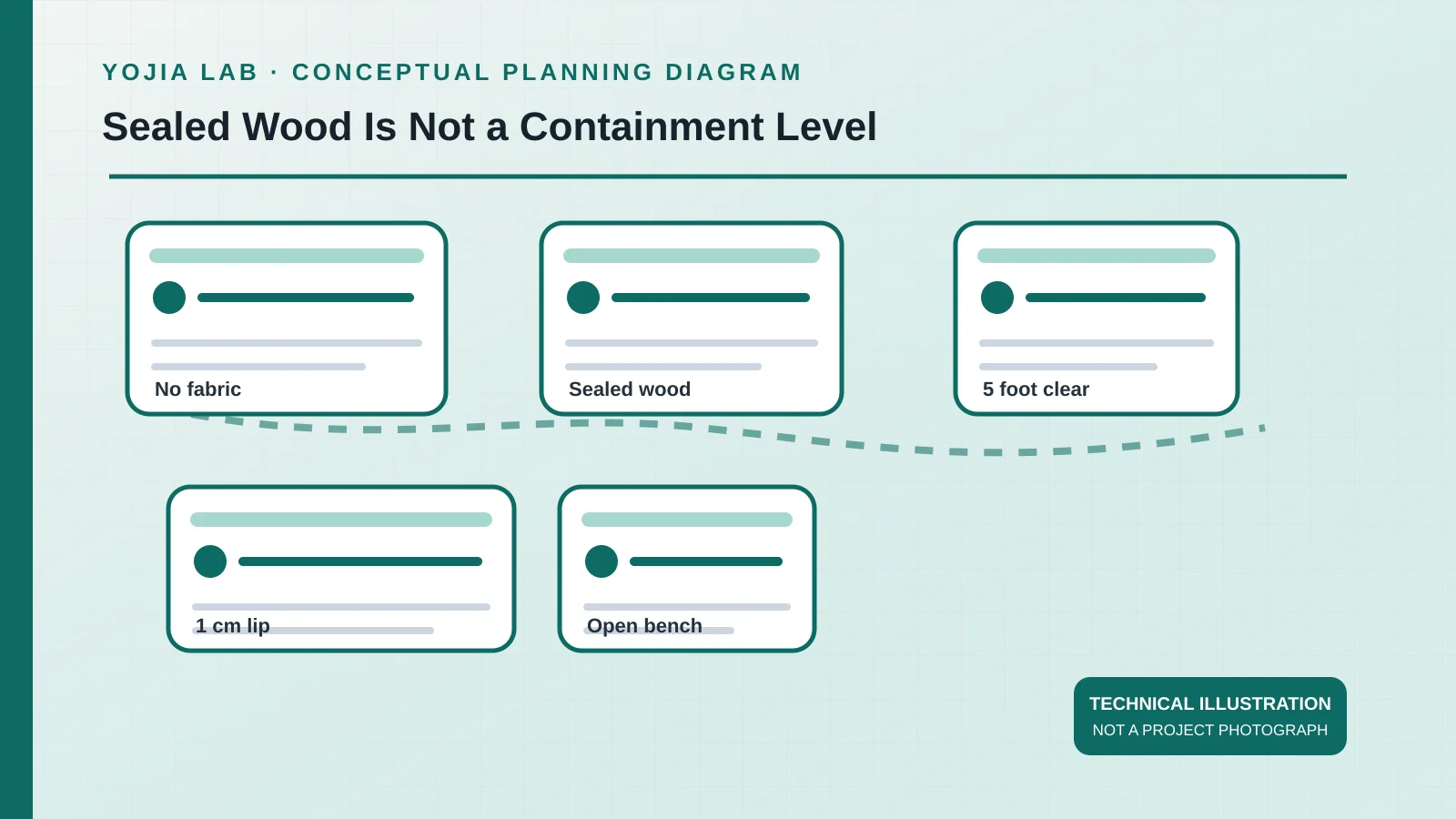
Section 2.4 says furniture must be cleanable, sized for the work, and robust. It must not include fabric that can hold contaminants. Lockable wheels can make moving easier, and ergonomic adjustment can reduce incidents. Those two lines are can, not must. Absorbent curtains and blinds must not be used, nor carpets, rugs, or carpet tiles. Bench tops must be impervious to water and resistant to heat and to the chemicals and disinfectants used; acids, alkalis, and organic solvents are the examples. Sealed wood, tile, metal, concrete, or painted tops are acceptable only when the seal stays cleanable and resists the chemicals actually used. Curved edges should be used where possible. Sealed wood is an example in this monograph, not a pass for every necropsy chemical.
02
Recommended is the BMBL verb
Biosafety in Microbiological and Biomedical Laboratories, sixth edition, revised June 2020, recommends the BSL-2 facility lines rather than requiring them. Tops are impervious to water and resistant to heat, organic solvents, acids, alkalis, and other chemicals. Chairs use a non-porous cover that can be cleaned and decontaminated. Carpets and rugs are not appropriate. Gaps between benches, cabinets, and equipment stay accessible for cleaning. The handwashing sink should be near the exit. No line names a manufacturer, a module length, or one finish for serology and necropsy.
With good practices, many BSL-2 agents can generally be handled on an open bench when splash and aerosol potential is low. Unknown agents in human, animal, or plant specimens can often be handled under conditions typically associated with BSL-2. A clinical miss shows the limit: Brucella melitensis was subcultured on an open bench, and eight infections occurred among 26 laboratory members, an attack rate of 31 percent. BMBL places that event in a clinical microbiology laboratory, not a veterinary necropsy. It still blocks treating every animal specimen as ordinary open-bench work.
03
The diagnostic guide offers dimensions and then limits them
The 6 January 2012 MMWR supplement on human and animal diagnostic laboratories offers design suggestions, not a national code. It says there is no national standard for area per person, and that 300 to 350 square feet per person in a laboratory department is a reasonable figure. Ideally, it leaves at least 5 feet between a seated worker and anything behind the chair. Overhead shelves might be preferred, and they need a 1-centimetre (one-half-inch) lip. Gas burners are no longer universally recommended. Might, ideally, and reasonable are the verbs. Printing them as minimum code changes the guide.
In that list, bench tops must be impervious, and laminate can delaminate and become hard to disinfect. The general human and animal microbiology laboratory should be BSL-2. Animal diagnostic virology, where most viruses are not human pathogens, is described as BSL-2 unless risk analysis finds a specimen likely needs BSL-3. Receiving needs a Class IIA2 cabinet, a handwashing sink, and an eyewash: containment and plumbing, not a benchtop line. Dry ice is not to be set directly on bench tops, tile, laminate, or ceramic sinks, because it can break the bond and crack the surface. That is an instruction, not a measured crack rate.
04
What a list can lock this week
A selection sheet can lock the performance sentence of the document the project chose, and the verb that document used. For a WHO core-requirement laboratory, fabric and carpet are out, and the top must resist water, heat, and the chemicals and disinfectants that will actually be used. Sealed wood remains an example only in that monograph, and only when the seal matches those chemicals. Under BMBL as a BSL-2 recommendation, the top is described by resistance to water, heat, organic solvents, acids, alkalis, and other chemicals, and the chair is non-porous. BMBL does not list wood. Pasting the WHO example into a BMBL cell pretends the sentences match.
Lock the MMWR figures only with their labels: 300 to 350 square feet per person as a reasonable figure, 5 feet behind a seated worker as an ideal, and a 1-centimetre shelf lip. Laminate stays under the delamination warning. Wheels remain a WHO “can,” for a fixed run that would hide a cleanable gap. These pages do not lock a brand, a module, one top for every veterinary room, or open-bench work before splashes and aerosols are answered. The 31 percent figure is one clinical incident, not a bench prediction.
When the plan is ready for a factory review, send the quantities, hazards, and unresolved room limits to a laboratory furniture manufacturer in China. Open items should stay open rather than being written as a confirmed specification.