01
The organ cut is not the culture
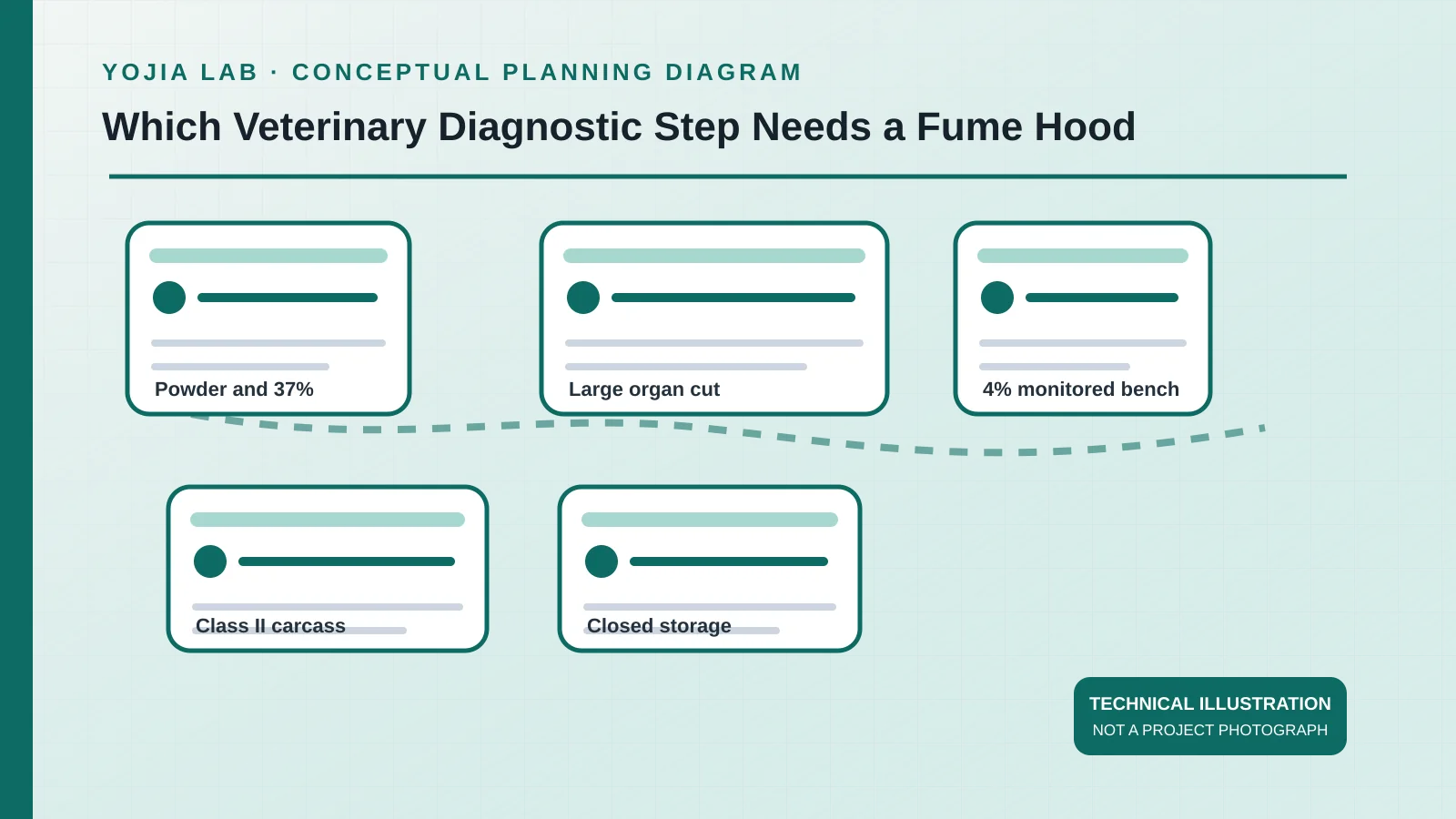
The CDC guide, issued as an MMWR supplement on 6 January 2012, is advice from a panel for human and animal medical diagnostic laboratories. It is not a building code, and it reports no count of installed veterinary labs. Staff cut large fixed organs in a fume hood or on a downdraft table. Grossing stations for formalin-fixed tissue are meant to pull formaldehyde fumes, and the guide says they are not biological safety cabinets. A station that only moves vapor away from the face is a chemical control.
A small carcass is a separate case. Cabinets are uncommon in autopsy suites because of the size of the work. A Class II cabinet is recommended when a small animal with a suspected zoonotic agent will fit. Large-animal necropsy of that kind of case is described as impractical inside a cabinet, so the guide points to protective equipment and controls built for that scale. The necropsy suite should be negative to surrounding rooms, at 11 to 12 air changes per hour. Air may exhaust outdoors or return through HEPA filters, but not into clean areas. That rate is only the guide's recommendation for the suite.
02
Thirty-seven percent does not inherit the four-percent bench
Cornell's animal biosafety procedure, reviewed 1 July 2024, covers 37 percent formaldehyde and paraformaldehyde powder on animals and tissues, and it flags perfusion as the higher exposure. The procedure applies OSHA's 0.75 ppm limit over 8 hours and 2.0 ppm over 15 minutes. Powder and dilutions go in a certified chemical fume hood. Other procedures use that hood, a ducted biosafety cabinet, local exhaust, or a downdraft table. A dilute solution, with 4 percent as the example, may stay on the bench only after the safety office confirms the air is under the limits. Making the 4 percent solution from powder remains a hood task.
Washington's November 2023 document applies a state rule, not a national veterinary standard. Ten percent neutral buffered formalin, the usual preparation on that campus, contains 4 percent formaldehyde. Solutions above 4 percent are limited to a certified chemical fume hood, an exhausted biosafety cabinet, a glove box, or other containment that does not exhaust into the room. Laminar-flow hoods are excluded. As that document summarizes WAC 296-856, the limits are 0.75 ppm for 8 hours, 2 ppm for 15 minutes, a 0.5 ppm action level, and a 0.1 ppm training threshold. Only the first two figures match the federal numbers in the CDC guide. The 0.1 ppm figure stays inside Washington.
03
A hood reading is a local finding
Washington monitored laboratories where formaldehyde-containing chemicals were used. Inside a chemical fume hood or an exhausted enclosure, exposures stayed below the state 8-hour and 15-minute limits. Many of those labs still exceeded 0.1 ppm, especially when the work was outside a hood. The note gives no room count, sample size, or interval, so it is not a share of veterinary diagnostic laboratories. In that program, routine use is acceptable only after monitoring has found levels below the 0.5 ppm action level.
Appendix A of 29 CFR 1910.1450 is non-mandatory. It points employers to Table 9.3 of the 2011 Prudent Practices for the choice of ventilation, and it calls laboratory chemical hoods the main protection from hazardous chemicals. Hoods should be maintained, monitored, and tested. Vented storage belongs in vented cabinets, not inside the hood. Chemicals should not sit in the hood, on the floor, in an egress, on the benchtop, or in heat or sun. Waste should not be evaporated in the hood. Cornell also allows a flammable cabinet or storage under a fume hood. Those two storage sentences cannot share one elevation.
04
What can be written down before a hood is priced
A small zoonotic carcass that fits is a Class II question. A large fixed organ is a fume hood or downdraft question. Powder and a 37 percent dilution are certified-hood tasks at Cornell, while 4 percent still needs a ventilation judgment in both campus documents. The CDC fixation sentence uses 10 percent formalin at ten times the tissue volume, so the enclosure accepts a container rather than a slide. That ratio is not a hood width.
Before anyone prices a chemical fume hood, write the task, the enclosure, and whether the air leaves the room. Washington excludes recirculation and laminar flow above 4 percent. The CDC badge pattern is one 8-hour reading and at least one 15-minute reading. Keep storage out of the working chamber unless the approved procedure says otherwise, and set that choice beside the non-mandatory appendix. The CDC guide also names an eyewash for the formalin area. These lines are not a face velocity and not a record of a finished laboratory.
Before pricing, place the room interface, quantities, and service points for the laboratory fume hood configuration with the workflow notes above. Airflow, performance, and compliance stay with the project's responsible reviewers.