01
Flexibility stops at a new principle
ILAC-G18:01/2024 quotes ISO/IEC 17011’s definition of a flexible scope: the scope is written so a conformity assessment body may change methodology and other parameters that fall within competence the accreditation body has already confirmed. The benefit, in that guide, is that the body can modify a method, validate or verify the change, and use it without asking for an extension. The same paragraph says the modification must not cover a new competency. The accreditation body is expected to define what a new competency is. Offering a flexible scope is not mandatory. Where a body does not offer one, this guidance does not apply, and a changed activity goes back to whatever assessment that body requires.
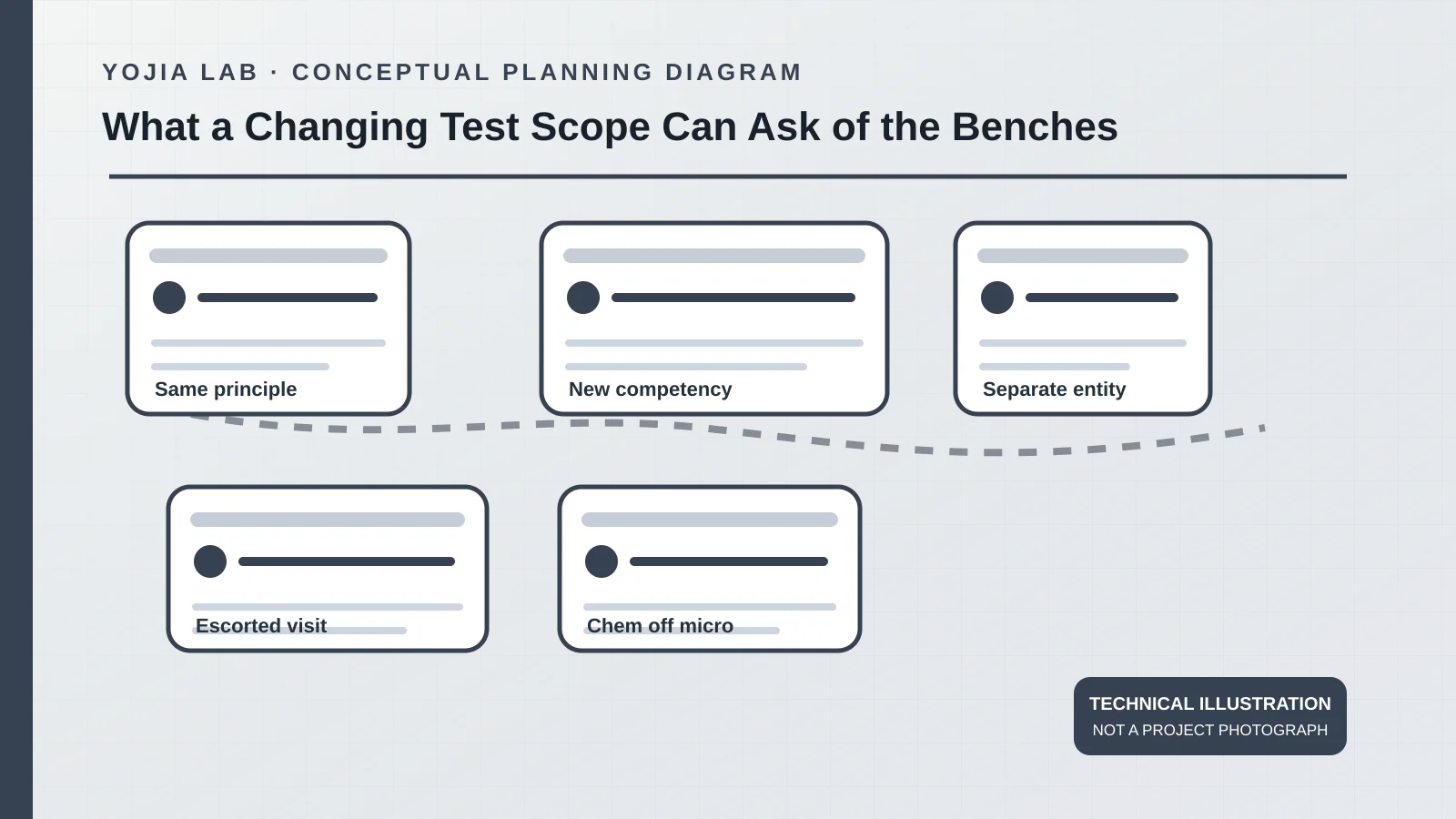
For testing laboratories, Appendix B is stricter. New standard methods, in-house methods, or modified methods under a flexible scope do not include a new measurement principle. The examples stay inside one principle: cadmium in fruit extended to vegetables, more trace elements by that same principle, a change in range or uncertainty, or an equivalent method from another body. A bench planned around one analyser is not automatically wrong because the analyte list grows inside that principle. It is an open question when the work needs a different principle, which is outside the flexible scope. Facilities remain one of the resources the guide says the laboratory must still have.
02
A scope addition is a letter, then a visit
NIST Handbook 150, 2020 Edition Update 1, incorporates ISO/IEC 17025 by reference for laboratories that want NVLAP accreditation. It adds its own definition: a laboratory is a physical entity, separate and apart from any other laboratory, whether or not they share ownership, management, or a quality system. Activities may occur at a permanent, temporary, or remote location. Two testing organizations that share one undivided bench and one manual are not, under that sentence, two laboratories that happen to sit near each other. They have not met the physical-separation test NVLAP states. The handbook does not convert that sentence into a module length.
Section 3.9 says a laboratory may request scope changes in writing. Additions must meet all NVLAP requirements for the added tests, types of tests, or standards, and NVLAP decides case by case whether another on-site assessment or proficiency test is needed. Deletions may be temporary or permanent. Monitoring visits may be unannounced and can check reported changes in personnel, facilities, or operations. An on-site assessment may examine equipment and facilities. Furniture that is fixed before that visit is a wager that the room will still match the written request. It is not the decision NVLAP has reserved.
03
Impartiality in one manual is access and ethics
FDA manual MAN-000025, revision 07, revised 1 July 2025, says it was prepared to meet ISO/IEC 17025:2017. Its impartiality section names no bench. It uses the Standards of Ethical Conduct, annual HHS-520 outside-activity requests, annual OGE-450 disclosures, a monthly list under 18 USC 208, and one hour of ethics training a year. Risks are reviewed continuously and corrected when found. Confidentiality is partly a building rule: controlled access, visitors named to security in advance, visitors escorted, and only approved areas entered.
A private testing laboratory cannot copy those federal forms and call the room settled. It can copy the questions the manual actually uses: who may stand at the work, whether a client’s presence is an impartiality risk, and whether the answer is an escort and a limited area rather than a different worktop. Section 6.3 of the same manual monitors room temperature and humidity, airflow at chemical hoods, metal contamination on benches and hoods where metals are tested, and microbiological contamination where that work exists. Testing stops when conditions would invalidate results. Those are records and stop-rules. They are not a brand of bench, and they do not travel unchanged into a laboratory that does not run the FDA’s scope.
04
Separation is a list of real incompatibilities
MAN-000025 keeps separate areas for incompatible activities: chemistry apart from microbiology, receiving and storage in designated areas, standards and cultures stored apart, and media preparation away from the work area. Access uses keycards, badges, escorts, and guards. That list is this agency’s procedure. A laboratory that does no microbiology does not gain a media-prep room by quoting it. A laboratory that does both cannot treat one continuous bench as if the separation sentence were optional.
NIST Handbook 150-17 (2021) shows how far one program goes past the base handbook. For NVLAP cryptographic and security testing only, simultaneous work for different vendors needs a separation system, workstations stay under laboratory control, records stay at the permanent site, mobile facilities are not approved, and hardware under test is not kept remotely. Those clauses do not apply to a food, textile, or minerals laboratory. The selection that can be written now is narrower: whether flexibility is offered, whether the next method is the same principle or a new competency, whether two legal laboratories share the floor, who may approach the bench, and which of this laboratory’s own incompatible activities need a break. The worktop comes after those answers.
When the plan is ready for a factory review, send the quantities, hazards, and unresolved room limits to a laboratory furniture manufacturer in China. Open items should stay open rather than being written as a confirmed specification.