01
The method already splits the solvent work
ISO 105-D01:2010, fifth edition, 1 May 2010, tests colour fastness to drycleaning in perchloroethylene. Any other cleaning solvent has to be named in the report. The test uses solvent alone, in containers without water, because water or detergent can change some results. Clause 4 recommends opening solvent only inside a fume cabinet or hood. Clause 6.2 defines that hood as apparatus able to confine solvent vapour. It states no face velocity, duct material, or sash height.
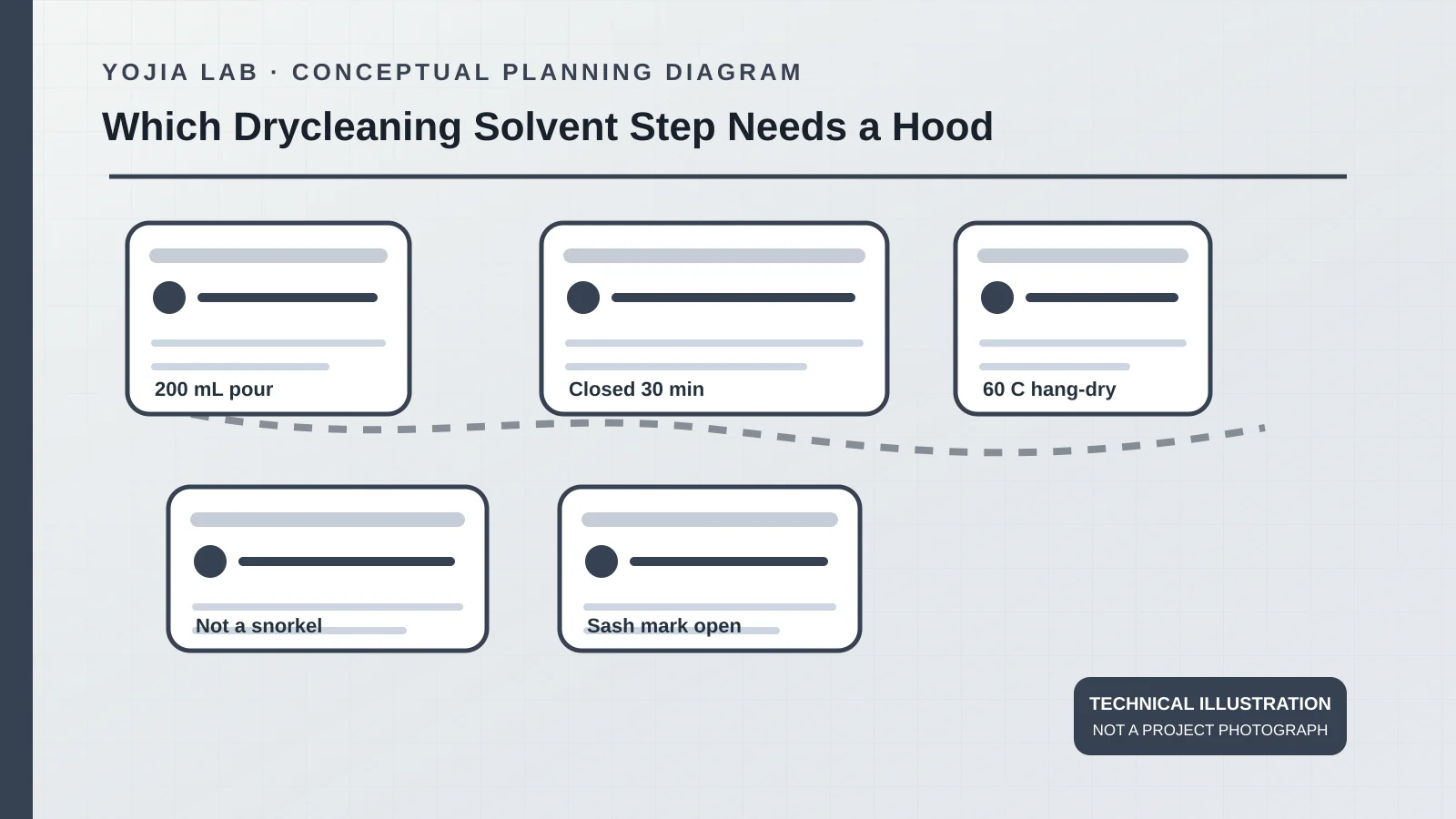
The hood is used twice and a machine once. Each steel container receives 200 ml at 30±2 °C inside the hood, is closed and treated for 30 minutes at 30±2 °C in the mechanical device, then is opened in the hood so the specimen can hang in air at 60±5 °C. The device is a water bath turning closed containers of 550±50 ml at 40±2 rotations per minute. A substitute is allowed only when results are identical. Twelve steel discs, each specified at 20±2 g, ride in the bag. The preview never sums them, so 12 times 20 g is only an illustration, and that mass stays in the closed container.
02
A snorkel is the wrong shape for this pour
The 2011 Prudent Practices volume says no regulation sets face velocity. Several organizations recommended 80 to 100 feet per minute for traditional chemical hoods; 100 to 120 was an older suggestion for very high toxicity; velocities approaching or exceeding 150 should not be used, because they can cause turbulence and re-entrain particles. The same chapter describes high-performance hoods designed for 60 or 80 feet per minute. Table 9.3 lists 10 to 15 air changes per minute or 60 to 100 feet per minute, depending on hood type. Printing one of those figures as this method’s requirement changes the source.
A snorkel in that chapter works only very near the hose: usually adequate at about 2 inches, inadequate at about 3, at 150 to 200 feet per minute. The examples are instrument exits and tubing, not a 200 ml pour and a specimen hanging in 60 °C air. Ductless hoods that filter and return air to the room are narrower still. Tracer-gas tests cannot be run on them as on a conventional hood, filters lose capture and can desorb chemicals back into the room, and the book quotes NFPA 45 (2004) as allowing them only for nuisance vapors and dusts without a fire or toxicity hazard.
03
Fourteen millimetres of mercury is not a hood model
The NIOSH Pocket Guide entry for tetrachloroethylene, reviewed 30 October 2019, prints 14 mmHg and does not attach a temperature. Liquid specific gravity is 1.62 and the boiling point is 250 °F. The NIOSH line is Ca: minimize workplace exposure concentrations. The same entry prints OSHA as a TWA of 100 ppm, a C of 200 ppm, and a maximum peak of 300 ppm, with “for 5 minutes in any 3-hour period” on that line, plus 1 ppm = 6.78 mg/m³. The immediately dangerous cell is separate: Ca [150 ppm]. The liquid is called noncombustible, yet it decomposes in a fire to hydrogen chloride and phosgene. That sentence assigns no shelf.
Prudent Practices uses vapor pressure as a sorting hint. Below 10 mmHg, general ventilation or a snorkel may be enough unless the material is heated. The printed 14 mmHg is outside that example, and the 60±5 °C hang-dry is heating anyway. The book does not turn 14 mmHg into a face velocity. The ISO preview already puts the open container in a fume cabinet or hood. The parts-per-million figures stay air limits and do not choose 60, 80, or 100 feet per minute.
04
What the drawing can lock this week
Appendix A to 29 CFR 1910.1450 is non-mandatory. It calls chemical hoods the main protection from hazardous chemicals, points to Table 9.3 of the 2011 book, and says hoods should be maintained, monitored, and tested. Chemicals should not be stored in the hood, and waste should not be evaporated there. Operable windows should not be used where hoods or other local ventilation are present. ISO 105-D01 keeps the reagent over anhydrous sodium carbonate. Read with the appendix, the stock bottle stays out of the hood. The 60 °C hang-dry is a specimen step, not that rejected waste practice.
Five cells can be locked before casework is fixed. The fume hood owns the 200 ml pour at 30±2 °C and the hang-dry at 60±5 °C. The machine owns the closed 30 minutes, the rotation rate, and the water bath, and its footprint stays blank until a device matching clause 6.1 is named. Exhaust type stays blank until the 2011 limits are applied: a snorkel’s few inches do not fit this pour, and a ductless hood returning air to the room still faces the nuisance-vapor limit and the NIOSH carcinogen note. Sash height is the tested height. The book’s common example is 18 inches, and acceptance at 18 inches may not hold at 24. Face velocity is whatever the hygiene plan records after naming which book range is in use. Buying a fume hood fills none of those cells.
Before pricing, place the room interface, quantities, and service points for the laboratory fume hood systems with the workflow notes above. Airflow, performance, and compliance stay with the project's responsible reviewers.