01
Start with the decision and preserve sample identity
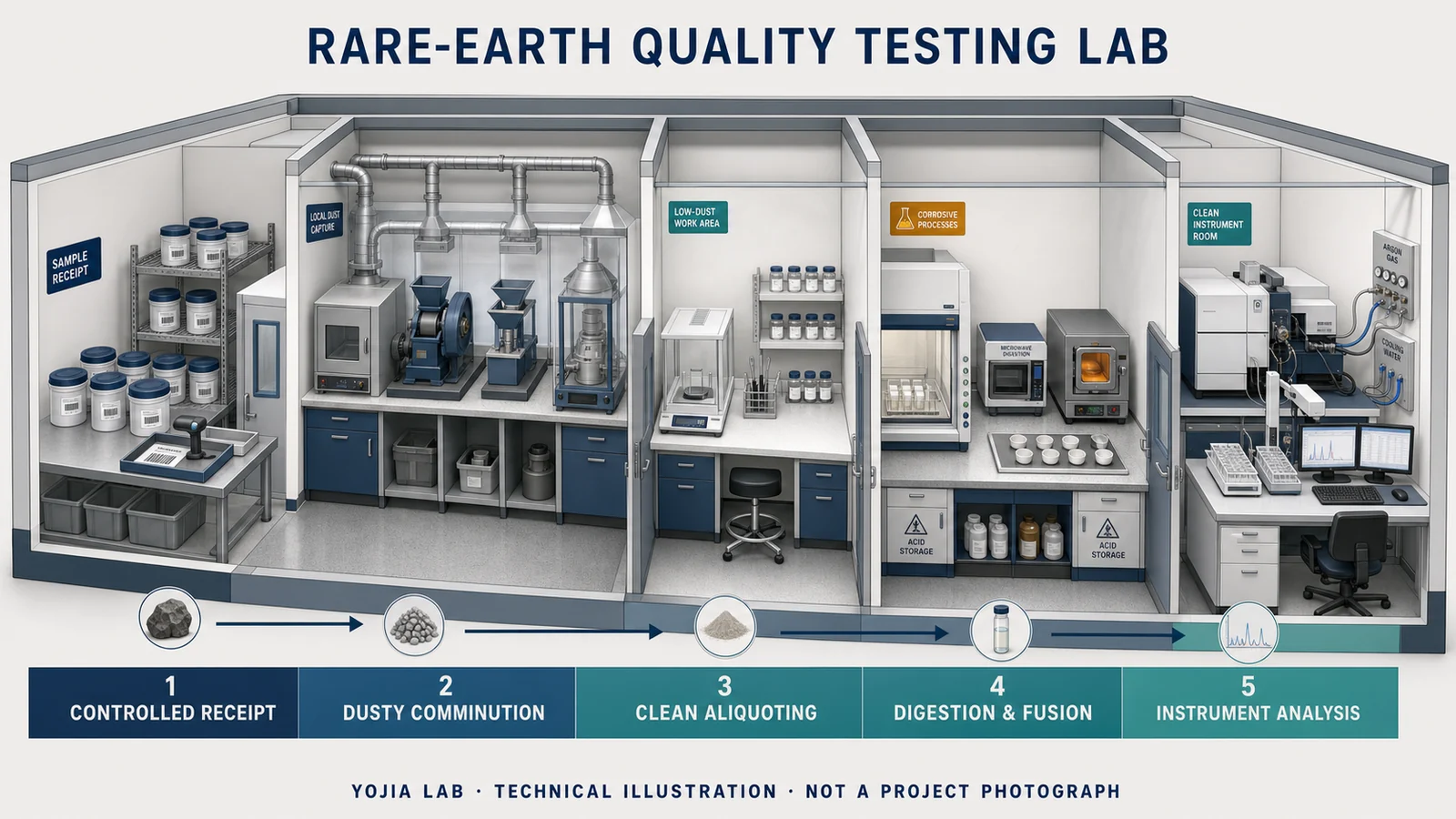
Map each route from the decision the result must support. Record the incoming material, required analytes, decision limit, approved method, reporting time, and the sample condition at every hand-off. A bulk solid may pass through condition check, drying, crushing, homogenizing, splitting, pulverizing, analytical aliquoting, digestion or fusion, dilution, instrumental measurement, data review, and retention. Another material may bypass several steps. Draw these branches explicitly so a fast process-control sample does not quietly displace a contract sample or enter an unapproved preparation route.
Give every physical split and prepared solution a traceable parent. Reception needs space to check identifiers and packaging without opening all containers in the general office. Define where custody is accepted, discrepancies are quarantined, priorities are marked, and sample mass is reconciled. The USGS geochemistry quality-assurance manual treats handling, preparation, analysis, instrumentation, and documentation as one control system. Translate that principle into labelled trays, controlled queues, recorded transfers, and status locations rather than relying on an analyst's memory or an unexplained row of bottles.
02
Contain coarse preparation before protecting trace analysis
Drying, crushing, sieving, splitting, and pulverizing create a different workplace from solution preparation or ICP analysis. Incoming solids can shed dust; crushers and mills add noise, vibration, heat, and cleaning work; contact surfaces can contribute elements that matter to the result. Put these tasks in a preparation zone designed around the actual machines, sample sizes, lifting route, dust-control assessment, clean-down method, and maintenance access. Do not infer a universal pressure relationship or extraction rate from the room name: those controls need project-specific industrial-hygiene and engineering decisions.
Within the preparation zone, arrange the sequence so the operator can handle one defined lot, clean verified contact parts, and produce representative splits without crossing incoming material with finished powders. Provide a deliberate transfer point into lower-dust weighing and aliquoting. The boundary may use closed containers, pass-through storage, or a documented wipe-down step; it does not need to imitate a cleanroom unless the method and risk assessment require one. Select mill and vessel materials only after reviewing target elements, expected concentrations, cleaning evidence, and the laboratory's blank and duplicate program.
03
Separate fusion, acid digestion, and routine dilution
Rare-earth minerals and products are not opened by one universal preparation. Thermo Fisher's technical note describes alternatives that include several fluxes and combinations of strong mineral acids, while Agilent's basalt example uses a defined weighing, pre-digestion, microwave digestion, dilution, and ICP-MS sequence. Treat each approved method as its own branch with identified reagents, vessels, temperatures, cooling stages, transfer containers, exhaust needs, and waste. A generic wet bench cannot be assumed suitable merely because the final solution will enter the same instrument.
Locate furnaces and fusion work around heat, crucible handling, ventilation, and safe cooling clearances. Locate reactive acid preparation around the exact chemistry and compatible containment selected by qualified professionals. EPA Method 3052, for example, requires microwave vessels to be vented in a fume hood and discusses hydrofluoric-acid interactions with sample-introduction components; it is a method reference, not permission to adopt that chemistry. Heated perchloric acid or other special hazards may require purpose-designed systems under local rules. Keep routine dilution and standards preparation outside splash, dust, and high-temperature traffic where justified by the contamination-control plan.
04
Design the analytical hand-off around blanks and interfaces
The instrument zone begins before the sample reaches an autosampler. Define where prepared solutions are checked, diluted, queued, and released; where blanks, calibration materials, certified reference materials, spikes, and duplicates are assembled; and how racks preserve sequence identity. High matrix loads, different acid compositions, and wide concentration ranges can change rinsing or introduction needs. The Agilent application example adapts wetted components to its ammonium-fluoride preparation. That illustrates why the selected method, not a generic equipment name, must drive the sample-introduction kit and nearby work surface.
Coordinate each XRF, ICP-OES, or ICP-MS model with its manufacturer data for electrical supply, gases, cooling, exhaust, heat rejection, data, environmental stability, service clearances, and cylinder or generator interfaces. Keep dusty returns, furnace traffic, and chemical-waste carts away from contamination-sensitive queues and instrument service paths. A separate room can help, but enclosure alone does not control quality: cleaning records, reagent purity, blank performance, container selection, and disciplined transfers remain essential. Show who owns each final connection and how a failed gas, cooling, exhaust, or data service places samples into a safe and traceable hold state.
05
Commission complete sample routes, including failures
Before routine use, challenge the layout with a representative suite of material states rather than an empty-room inspection. Walk a normal batch, an urgent sample, an oversized or leaking container, a high-grade sample followed by a low-level sample, a preparation duplicate, a blank failure, a digestion interruption, an instrument shutdown, and a waste pickup. Observe carrying distances, open-container moments, queue visibility, cleaning access, label reading, ergonomic handling, and whether staff must cross an incompatible activity to reach safety or maintenance equipment.
Handover should link room and furniture acceptance to method readiness without claiming that construction validates the analysis. Confirm installed interfaces, local exhaust and safety-device testing, equipment clearances, clean-down records, custody locations, data connections, alarms, isolation points, emergency actions, waste routes, and staff responsibilities. OSHA's Appendix A recommends separating higher-hazard wet chemical spaces where practicable and matching local exhaust to the operation, but applicable law and final controls remain jurisdiction- and project-specific. Reassess the zoning when materials, limits, throughput, methods, reagents, instruments, or maintenance arrangements change.