01
Start with the preparation the method actually uses
USGS rock-sample preparation treats physical reduction as part of the analysis, not as a chore that happens somewhere else. The published method reduces rock to about half-centimeter fragments in a jaw crusher, then grinds the split to roughly minus 100 mesh with a vertical pulverizer and ceramic plates, and it warns that careless preparation and contamination between samples undermine the chemical result. A furniture list that offers one general work surface for all of this has skipped the method.
The apparatus in that chapter includes a crusher, a pulverizer, a splitter, loaf pans, brushes, and a compressed-air cleaning step between samples. Those objects shed dust and they need a floor that can be cleaned, a place to set dirty pans apart from clean cartons, and room to service the machine. Selecting a specialist workstation for the balance does not equip this room. The crush room should be named on its own, with the mobile carts that carry pans out of it written as a separate line.
02
Keep the sinter step away from the balance
The USGS rare-earth method dissolves the elements by sintering the powdered sample with sodium peroxide, leaching with water, and acidifying with nitric acid. Crucibles go into a muffle furnace, then into bottles for the leach. The method's safety note calls for safety glasses, a coat or apron, and gloves, tells staff to read the chemical hygiene plan and the safety data for the procedure, and says digestion and flux preparation should be performed in chemical fume and dust hoods, respectively. That containment note is a scope item of its own. It is not settled by choosing a table.
Weighing 0.1 gram of sample into a crucible is a balance task. Heating sodium peroxide in a furnace is not the same task, and it should not share a surface with clean standards. National Academies guidance says to keep fuels away from oxidizers and to avoid storing chemicals on the work surface except those in current use. Sodium peroxide and nitric acid belong in the chemical list the laboratory already maintains. Furniture selection can reserve a cabinet group and a clear surface. It cannot assign the compatibility group or the exposure control.
03
Ask the instrument what the surface must do
After the leach, the USGS procedure introduces the solution to an inductively coupled plasma mass spectrometer, with internal standards added to cope with matrix effects and drift. The instrument has its own clearances, waste, gases, and data connections. A support table under that instrument is not the same object as the balance table, and neither one is the crusher pan. Writing all three as laboratory support furniture without saying which step they serve makes the quotation impossible to check.
If a balance or spectrometer manual asks for a stable or isolated surface, copy that request into the brief and leave the construction open until someone compares it with the manual. Do not invent a vibration number, a load, or a gas purity for the furniture line. OSHA's laboratory standard places hazardous-chemical work under a chemical hygiene plan written by the employer. The plan, not the furniture catalog, is where peroxide, nitric acid, and dust are already supposed to be named.
04
Use carts to protect the quiet steps
The preparation method's own pace is on the order of dozens of samples in a person-day, and the rare-earth method notes a similar order for the instrumental run. Those figures describe the published procedures. They are not a promise about how many samples a room will finish, and they are not a sizing formula for cabinets. They do explain why dirty pans and clean aliquots will meet unless the path between them is drawn.
Mobile furniture in this brief means a cart with a stated job: crushed splits toward the pulverizer, cooled crucibles toward the leach bottles, or finished solutions toward the instrument, without parking in front of the balance. A cart without a job becomes a shelf. Record the load the laboratory expects to roll, the door widths, and where the cart waits overnight. Leave blank any claim about dust capture. Dust capture is one of the open items, beside the containment note in the USGS method.
05
Compare answers only where the sheet is complete
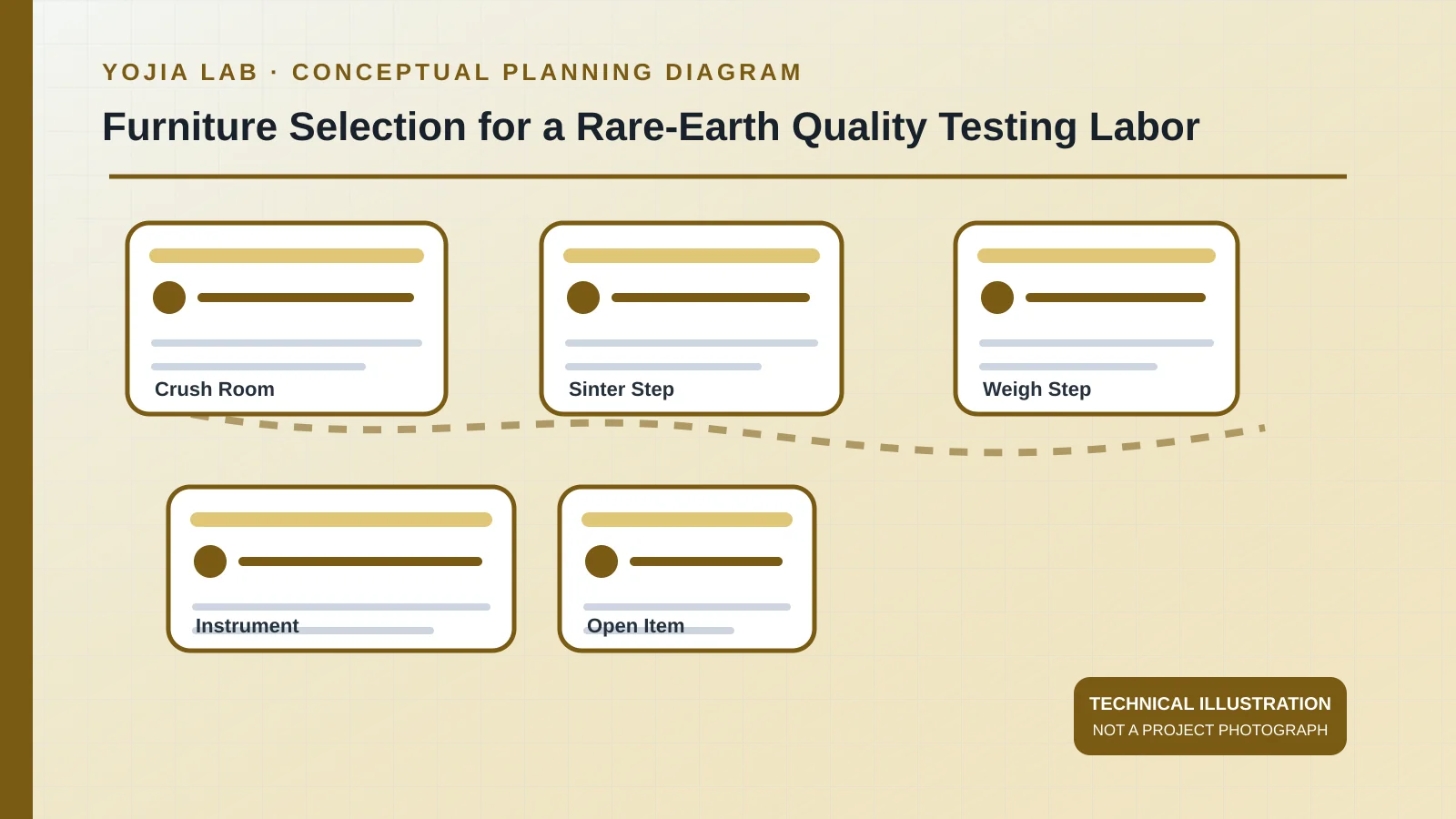
A useful selection sheet has four blocks: crush and pulverize, sinter and leach, balance, and instrument. Each block lists the equipment that must sit there, the chemicals or dust the step creates, and the utilities the equipment manual requires. Shared phrases such as quality-control laboratory or rare-earth bench do not distinguish the blocks. The distinction is the work.
Send that sheet when a factory review is actually useful. Dimensions, materials, and service holes can be answered from it. Containment for digestion and dust, the chemical hygiene plan, and the compatibility of sodium peroxide with neighboring chemicals cannot be answered by a furniture drawing. Keep those lines open. Selecting furniture here means refusing a single catalog row for four different steps.
When the plan is ready for a factory review, send the quantities, hazards, and unresolved room limits to a China laboratory furniture manufacturer. Open items should stay open rather than being written as a confirmed specification.