01
Do not put the acid block and the fusion on one line
The U.S. Geological Survey lists a contract method for forty-nine elements by inductively coupled plasma after a multi-acid digestion, and a different method for high-concentration rare earth elements by inductively coupled plasma mass spectrometry after a sodium peroxide fusion. One list entry is not the other. A room that runs both needs two preparation descriptions, because a hot acid block and a fusion do not share a vessel, a heat source, or a residue.
Write the method code, the sample mass, and the decomposition on each row before anyone names a bench material. If the quality lead has not chosen between a near-total acid attack and a fusion for high grades, both rows stay open. Polypropylene laboratory furniture cannot be selected by picking the row that sounds more corrosive. The material question waits until the preparation is known.
02
A polypropylene tube is not a bench specification
USGS Open-File Report 02-223 includes a multi-acid inductively coupled plasma mass spectrometry method for geological materials. The written procedure uses hydrochloric, nitric, perchloric, and hydrofluoric acids in Teflon vessels on an aluminum heating block, taken toward dryness at 110 degrees Celsius and then at 160 degrees Celsius. After a further perchloric step, nitric acid and hydrogen peroxide, the digest is heated in an oven and diluted. The dilution is placed in a polypropylene test tube.
That tube is a small, capped container for a diluted solution. It is not a work surface, a cabinet, or a sink. Copying the word polypropylene from the tube line onto a furniture schedule skips the heat, the hydrofluoric acid, and the perchloric acid. The same method text warns that a multi-acid attack does not fully dissolve some resistant minerals, and it names rare earth elements in monazite as one example. An incomplete dissolution is an analytical limit. It is not evidence that a polymer bench is suitable, or that it is unsuitable.
- Teflon vessel and heating-block row
- Polypropylene tube kept on the dilution row
- Monazite-type residues flagged as a method limit
- No furniture material copied from the tube
03
Give hydrofluoric acid and perchloric acid their own questions
Hydrofluoric acid in that digestion attacks glass, so the method uses Teflon vessels. The planning question is where the bottle, the transfer, and the spill tray live, and who is competent to handle the acid. A service fitting made of the wrong metal or glass is a design question for the engineer and the safety office. It is not answered by printing polypropylene on the bench line.
OSHA Method ID-121, a workplace metals method, gives a narrow safety note for perchloric acid: use it only in a hood approved for that acid, keep organic reagents away, and use a water wash-down of the ducts and the work surface on a periodic basis. Those sentences belong to that method's precautions. They are a prompt to ask whether this rare-earth digestion's perchloric step needs a dedicated enclosure and a wash-down, not a license to specify a hood or a bench. Organic reagents, if the room has them, stay off that line.
04
Leave the work surface blank until contact chemicals are listed
OSHA's 2013 amendment to the non-mandatory laboratory appendix says work surfaces should be chemically resistant, smooth, and easy to clean. It also says chemicals that need vented storage belong in vented cabinets rather than inside a chemical hood. Neither sentence names polypropylene, epoxy, stainless steel, or any brand. The surface duty for this room is the list of acids, the fusion flux, the temperature at the block, and the cleaning agent the quality lead already uses.
Until that list is written, polypropylene laboratory furniture stays a candidate, not a selection. Ask the manufacturer, later, against the written list and the drawings. Do not treat a catalog resin name as a compatibility chart. Spent acid and fusion residue are waste rows with their own containers. They are not a reason to evaporate liquid in the enclosure, which the same OSHA appendix advises against.
05
Release fittings only after the utility sheet is full
Power for the heating block, the oven temperature, the water for a wash-down if one is required, and the shutoff for any gas the fusion needs are separate cells. Each cell names an owner. A blank cell does not become a cutout. Specialist stands can follow the vessel footprint once the footprint is known. Service fittings follow the accepted cells. They do not set a temperature limit.
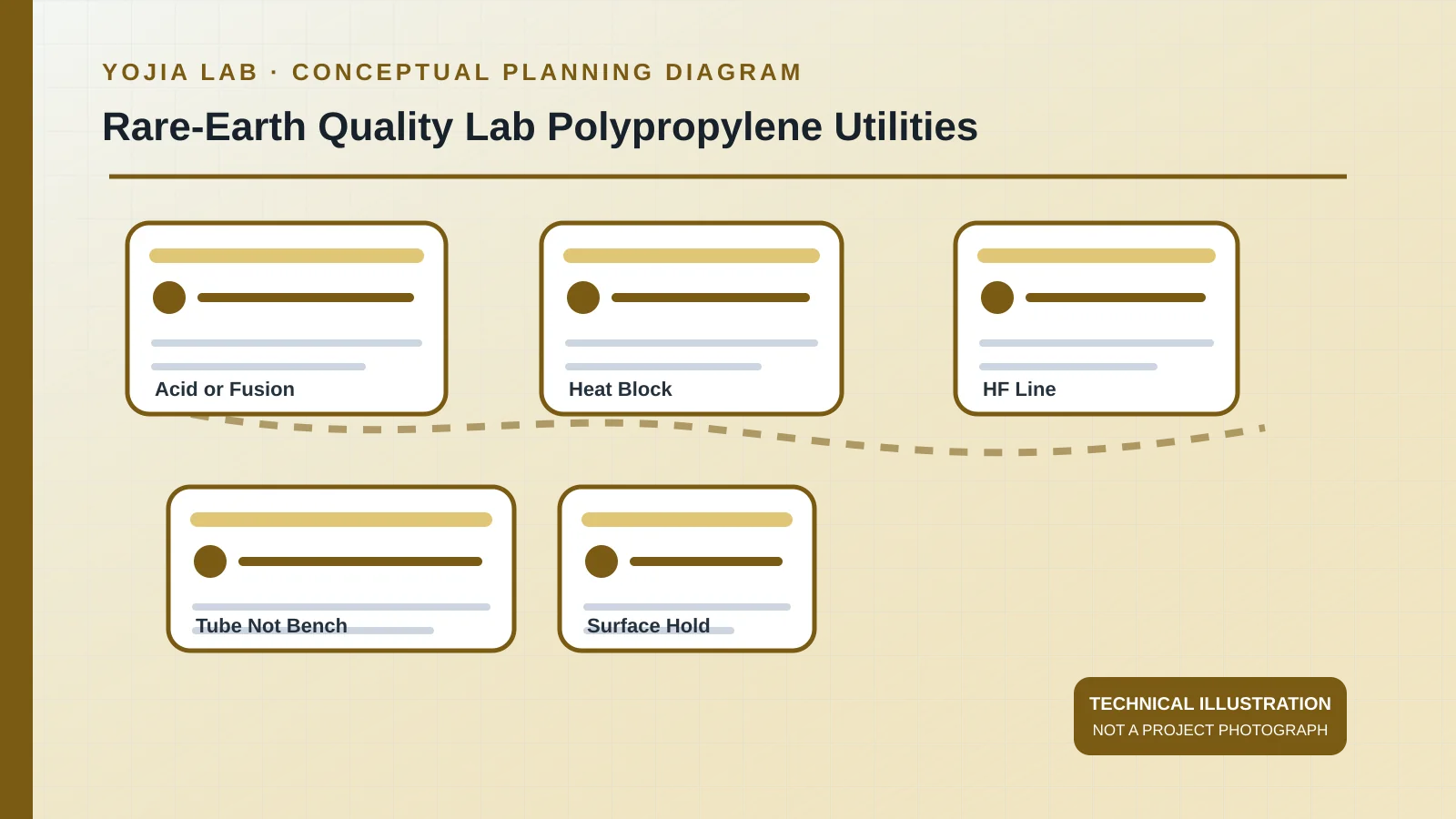
If the laboratory later swaps a multi-acid method for a peroxide fusion, or adds hydrofluoric acid where the sheet said none, reopen the material row. The figure on this page shows five planning zones. It is a technical illustration, not a dissolution bench and not a chemical-resistance report.
Where the storage duty is considering a polymer cabinet or bench, review PP laboratory furniture on its own. A material name does not show that it fits the chemicals, cleaning method, or fire requirements.