01
Let the method decide whether a hood exists
WHO's good-practices text for pharmaceutical quality-control laboratories says facilities should suit the work, and that each laboratory should have the instruments and equipment the work needs, including work benches, work stations, and fume hoods. That sentence is a checklist of kinds of equipment. It is not a quantity. The annex also prints an example list for a model first-stage or medium-sized laboratory. Copying the example's hood count onto this room would invent a size the monograph never measured.
The same annex treats highly toxic substances, including genotoxic substances, as a case that may need a separate dedicated unit or a named piece of equipment, such as an isolator or a laminar-flow bench, plus procedures that limit exposure and contamination. It also says unnecessary contact with reagents, especially solvents and their vapours, should be avoided, and that less toxic substitutes should be considered when a method is developed. A fume hood enters the matrix only for the methods that remain.
02
Split exhaust, makeup, and room pressure
OSHA's non-mandatory laboratory appendix treats a chemical hood as an engineering control and points employers to a table in the 2011 Prudent Practices volume when they choose a device. It asks for more air leaving than entering, local exhaust matched to the operation, laboratory air sent outdoors rather than recirculated, and the room held negative to the rest of the building. Local capture is left to an experienced engineer or industrial hygienist. Those lines are recommendations in that appendix, not a furniture rating.
The NIH desk guide, for NIH buildings, says every exhaust system is designed on its own. Hood ductwork, the discharge stack, dampers, controls, and variable-volume units are separate lines, as is the interlock between supply and exhaust. In a plausible failure, supply should drop faster than exhaust where the room is meant to stay negative. UNM's campus standard adds that a chemical fume hood is not the only room exhaust, and that makeup air enters at the far end so it does not wash the opening. Ask which pattern this engineer will draw.
03
Keep bottles, waste, and water out of the working chamber
The OSHA appendix puts toxic or corrosive chemicals that need vented storage in vented cabinets, not inside a chemical hood, and it says chemical waste should not be evaporated there. The opening stays clear. Hoods are maintained, monitored, and tested. Training before work covers how to confirm the device is running and what to do in a power loss. None of that text picks a cabinet. It does stop a cupboard from being drawn inside the fume hood.
UNM's campus standard says a cabinet vent discharges outdoors, or into hood ductwork that itself discharges outdoors, not into the working chamber. On water, the NIH desk guide wants an atmospheric vacuum breaker mounted high and exposed outside the hood, and it rejects an internal breaker. A fume hood can have a water stub. The stub does not decide the breaker or whether a sink belongs in the chamber.
04
Give gases, power, and the alarm their own owners
WHO's annex prefers gases in a dedicated store, isolated from the main building where possible, with distribution from that store so cylinders stay out of the laboratory. A cylinder that must remain is secured. The annex also asks teams to consider a gas generator. Safety showers and care with compressed-gas colour codes sit in the same safety rules. Write the gas source, any remaining restraint, and the shower location before they are treated as hood options.
The NIH desk guide expects a fume hood flow monitor: with the controls on a variable-volume hood, or with the hood on a constant-volume hood. It shows whether airflow is in range, gives an audible and a visual alarm when it is not, and includes an emergency ventilation switch. UNM publishes its own campus band for that speed, tied to hood type and an 18-inch opening. Print neither institution's number on a quotation. Ask this reviewer to write the target, the monitor's owner, and the emergency switch on one row.
- Gas source: remote store, generator, or secured cylinder
- Monitor provider and who answers the alarm
- Project-specific opening-speed target, left blank until named
- Shower and electrical questions kept off the hood shell
05
Release services only against the filled matrix
WHO's premises section also says lighting, energy sources, temperature, humidity, and air pressure are appropriate to the operations, and that those conditions are monitored, controlled, and documented so they do not invalidate results or spoil the quality of measurements. It is not a test certificate for a fume hood. A furniture release cannot substitute for that record.
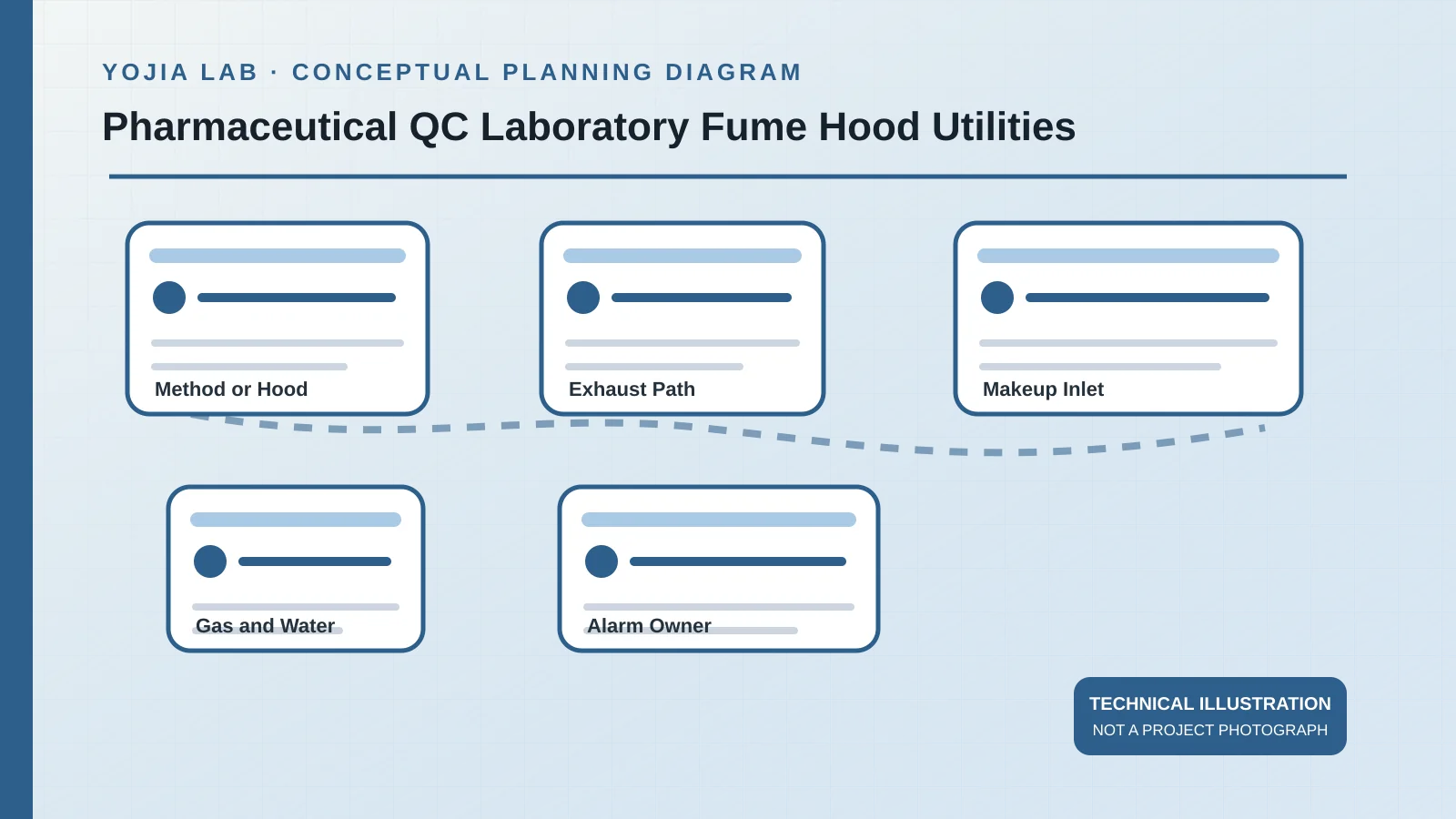
Count enclosures only after each method has an enclosure decision, the exhaust and makeup paths are drawn, gases and water are sourced, and the alarm owner is named. Service fittings can follow those rows. They do not choose a solvent method, and they do not replace the quality unit or the engineer. The figure on this page shows five planning zones. It is a technical illustration, not an installed fume hood and not a balance report.
Before pricing, place the room interface, quantities, and service points for the laboratory fume hood configuration with the workflow notes above. Airflow, performance, and compliance stay with the project's responsible reviewers.