01
The 0500 balance is its own area
Method 0500 collects total aerosol mass on a tared 37 mm PVC filter, 2 to 5 µm pore size, at 1 to 2 L/min. At the 15 mg/m³ reference the volume is 7 to 133 L, and loading should not exceed about 2 mg. The estimated limit of detection is 0.03 mg per sample. Those sampling figures still do not locate the balance.
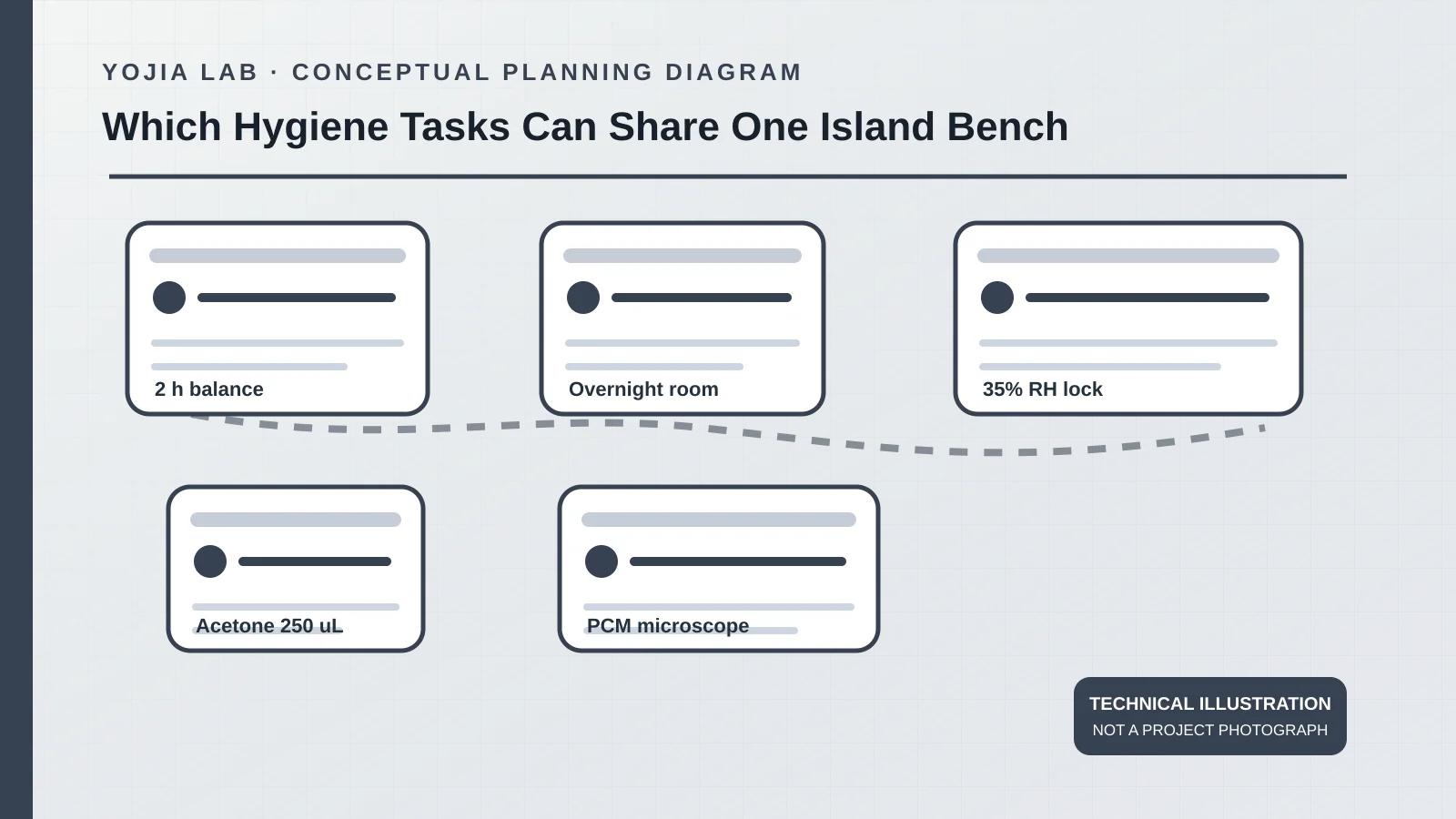
The microbalance reads to 0.001 mg and is the same instrument before and after collection, checked with NIST Class S-1.1 or ASTM Class 1 weights. Filters equilibrate at least two hours before the tare weighing and at least two hours again after sampling, before the cassette is opened. A chamber or room is listed, with 20 °C ± 1 °C and 50% ± 5% relative humidity given as an example. The note says the chamber is desirable, but not required. The Po-210 source is replaced nine months after its production date, and the filter passes over it again if it clings to the forceps or the pan. An open bench is not forbidden. A wet, busy top still defeats the static step.
02
MDHS 14/4 changes the wait
MDHS 14/4 covers respirable, thoracic, and inhalable aerosol. The balance should reach at least 10 µg and preferably 1 µg, be checked against a traceable weight immediately before use, and ideally stand on an anti-vibration worktop. Temperature and humidity should stay inside the balance manufacturer's range. The method says BS ISO 15767 states that humidity should be constant within ±5% and temperature within ±2 °C. That is an MDHS attribution, not a line checked here against the ISO text, and it is not the 0500 example of ±1 °C and 50% ± 5%.
Media equilibrate overnight with lids ajar. Some substrates take longer. One field blank is required for every ten samples, with at least three blanks in a batch. Returned samples equilibrate again on receipt. Outside dust is removed before weighing; deposit that belongs to the sample stays. A practical detection limit is three times the standard deviation of the blank weight changes. HSE says the guidance is not compulsory unless a passage says so. Overnight is still not two hours.
03
PV2121 locks a third climate
PV2121, March 2003, is partially evaluated and offered for information and trial use at OSHA's Salt Lake Technical Center. It does not tell every hygiene room to copy that room. The reliable quantitation limit is 66 µg. Filters are weighed at 21 °C ± 1 °C (70 °F ± 2 °F) and 35% ± 5% relative humidity, and a deviation is fixed before weighing. Only authorized people enter. The room is locked after hours and when idle. Equilibration is six hours, each filter is weighed at least twice, and a gap beyond ±10 µg forces another desiccation. Under 66 µg, the report may say none detected at that limit.
The 0500 example of 50% relative humidity sits outside 35% ± 5%, so the two instructions cannot describe one room at the same time. Drying differs as well. New PV2121 assemblies start at −15 inHg and 60 °C for 36 hours, then at 40 °C for 15 hours. Returned samples, except oil mist, chromium trioxide, or samples that may lose volatile organic compounds, start at 40 °C for 36 hours. Method 0500 has no vacuum oven. A laboratory that is not on the Salt Lake procedure should not adopt 35%. A laboratory that is on it cannot use the 0500 example room.
04
Acetone and the microscope leave
NIOSH 7400, Issue 3, clears a mixed-cellulose-ester wedge with acetone or with dimethylformamide and acetic acid. A settable hot block is about 70 °C, and about 250 µL of acetone is the minimum that clears the wedge. More than 1 mL is heated in a ventilated laboratory fume hood on a flameless, spark-free source. The smaller volume is still worked in a well ventilated area, with a fume hood as the example, because unventilated continuous use may produce unhealthful or explosive vapor. The block sits on a ceramic plate. Preparation stays away from bulk samples.
Counting uses a Walton-Beckett graticule made for that microscope, checked at 100 µm ± 2 µm. A counted fiber is longer than 5 µm and at least three times as long as it is wide. The method asks for a comfortable chair, the eyepiece at a comfortable height, room light close to the microscope light, and breaks of 10 to 20 minutes every one or two hours. That station can be the island laboratory bench after the slide exists. It is not the hot block, not the bulk-fiber bench, and not a weighing room on any of the three climates. One undivided top does not become three rooms because a drawing lists three tasks.
Before pricing, place the room dimensions, user sides, and service interfaces for the island laboratory benches with the workflow notes above. The final configuration remains the approved quotation and drawings.