01
The manual already separates the weighing from the heat
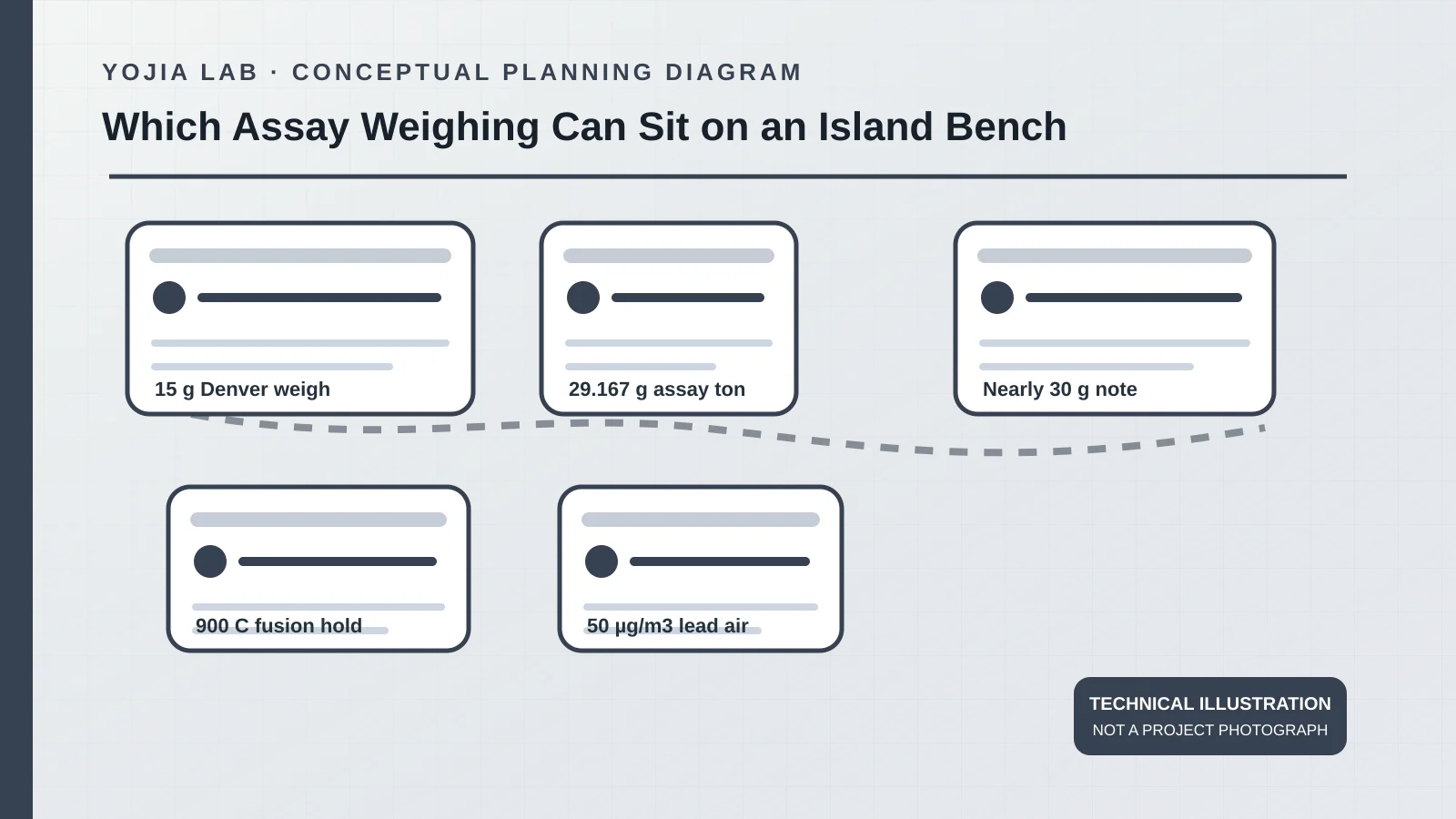
Before the crucible is charged, Bulletin 1445 weighs flux and ore on a Mettler single-pan balance of 120 g capacity, named Model p 120 in the reagent-room figure. Each component is weighed in turn, not stacked on the pan. The ground sample is spread about 1 cm thick, and portions come from the edges and the middle until 15 g are obtained. That 15 g portion is what the manual calls usual at its Denver laboratory. As many as 12 samples may be prepared and fused together. The 120 g figure rates the balance, not the bench under it.
Figure 7 is another room. Electric assay furnaces that can attain 1200 °C stand under canopy exhaust hoods, with steel tables for hot pieces. The furnace is brought to 1000 °C, crucibles are spaced about 0.25 in. (0.5 cm) apart — both units are printed, and this note does not reconcile them — then the setting drops to 900 °C for 17 minutes with 1 to 10 samples, or 20 minutes with 11 or 12. The bead is weighed later beside a Cahn electrobalance. No sensitivity is printed for that balance, so none is added. An island laboratory bench, if the plan uses one, can be the reagent-room surface for the 15 g weighing. It is not the steel table and not the bead room.
02
Three sample masses stay in three cells
A second mass serves a different report. Where 1 mg of noble metal should equal one troy ounce in a 2000 lb short ton, the bulletin says one ton contains 29,167 troy ounces, so the usual assay ton is 29.167 g. The 2240 lb long ton used in England and Australia gives 32.667 g. Those assay tons convert the report. They are not a second Denver portion and not a bench length.
Bureau of Mines MLA 97-82 describes that study’s fire assay as an assay-ton or nearly 30 grams, and calls it the most reliable of the three gold-and-silver methods it compares. The printed phrase is not 29.167 g and not the Denver 15 g. Typing 30 g smooths the Bureau wording. Typing 15 g chooses Denver and should say so. An island laboratory bench does not pick the mass. The reporting unit does.
03
Cupellation temperatures belong to the furnace
With flour or sulfides in the charge, the bulletin says litharge starts reducing to lead at 500° to 550 °C. That sentence is about the melt. Cupellation for platinum metals, using gold as collector, sets the furnace at 800 °C. After the lead looks domed, the manual holds 840 °C, then 860 °C, then 880 °C, each for 5 to 10 minutes, and then 900 °C until the lead is gone. A cold downdraft can push the finish to 910° to 920 °C when lead-oxide fumes show at the door. For gold collected with silver, the same manual starts at 820 °C and finishes at 880 °C. Copy the collector the method uses.
A cupellation is limited to 18–24 buttons. Buttons above 48 g are scorified toward 25–30 g, and the 2.5 in. (6.4 cm) scorifier is made up to 60 g with test lead. The 1977 text mentions asbestos gloves at the furnace; that clause is not a material to buy now. These temperatures are not a set-point for an island laboratory bench. In the reagent room, that bench is finished before the crucible sees 900 °C.
04
The lead numbers are air limits with different jobs
Section 1910.1025 covers occupational lead exposure except construction and agricultural operations under 29 CFR part 1928. Lead means metallic lead, inorganic lead compounds, and organic lead soaps. Litharge, being lead oxide, is inside that inorganic class when employees are exposed. The permissible limit is 50 µg/m³ as an 8-hour average; a longer day uses 400 divided by the hours worked. The action level is 30 µg/m³ over 8 hours, without counting respirators. Above the permissible limit on that basis, food and drink stay out except in the change rooms, lunchrooms, and showers the section names. Surfaces are kept as free as practicable of lead. The bulletin gives no furnace-room air result, and none is invented here.
The NIOSH Pocket Guide entry for lead, reviewed 30 October 2019, recommends 0.050 mg/m³ as an 8-hour average and prints the OSHA limit as 0.050 mg/m³ on the same page. That mass is 50 µg, which is why the two pages can show one concentration in two units. The guide’s immediately dangerous value is separate: 100 mg/m³ as lead. A note points other lead compounds to Appendix C; this article does not restate the appendix. The printed melting point, 621 °F, describes the metal on that page, not the cupellation schedule. An island laboratory bench meets none of these air limits. Monitoring does, or it shows the room has not reached them.
Before pricing, place the room dimensions, user sides, and service interfaces for the island laboratory benches with the workflow notes above. The final configuration remains the approved quotation and drawings.