01
Two archives already refuse one mass
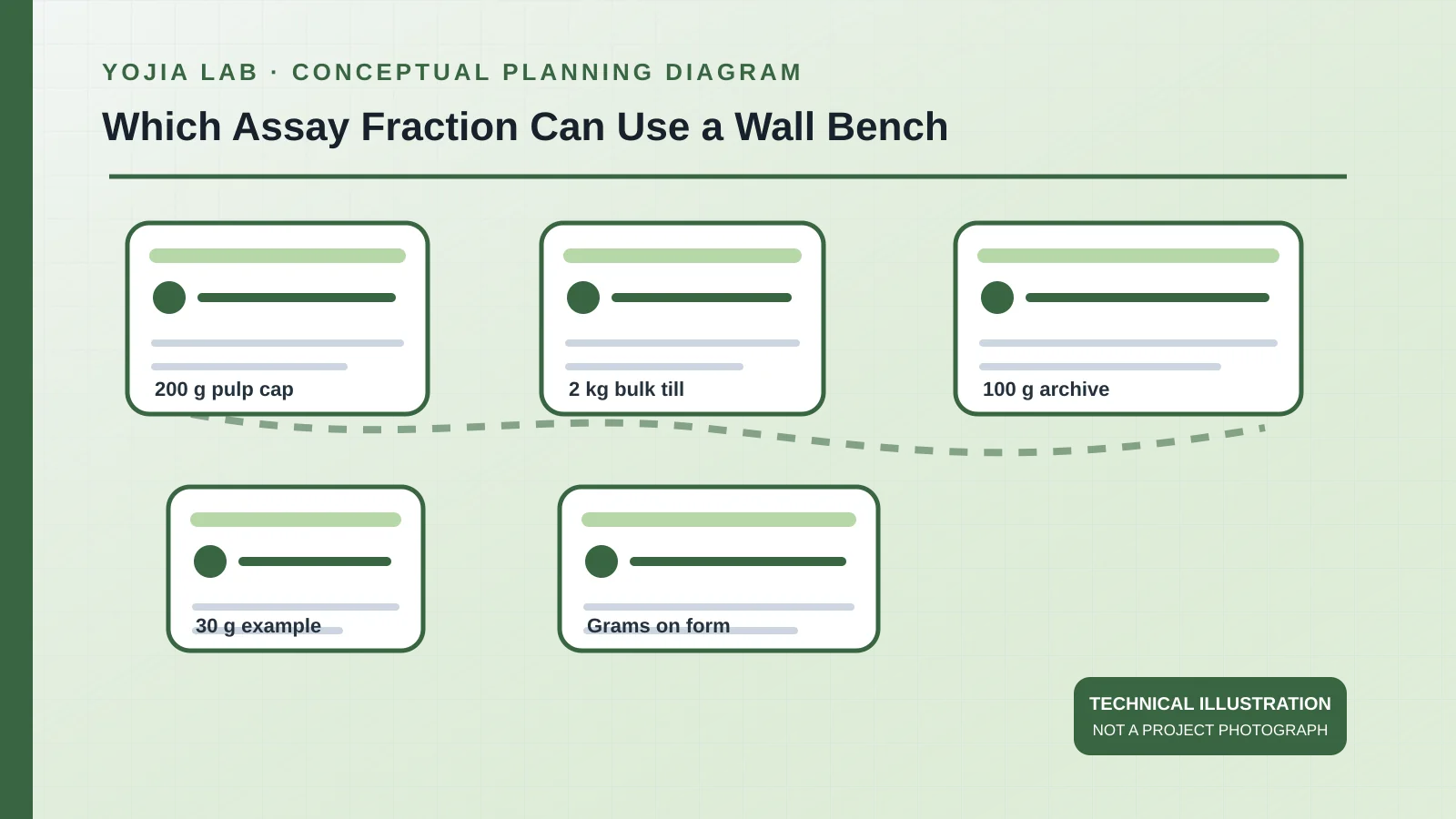
British Columbia Geological Survey Paper 2023-01 describes the Sample Archive moved in Victoria. Rocks, including hand specimens, slabs, core, and thin sections, sit in indexed banks. Geochemical media are different: pulverized rock or sediment, coarsely crushed rock, bulk sediment, sieved fractions, and heavy-mineral concentrates. The paper says archived bulk samples such as till are typically up to 2 kg, while the upper mass limit for processed media such as pulp and various fractions is 200 g. At the time of writing it had catalogued 29,698 rock samples and about 91,000 geochemical samples in 1,634 boxes. A sorting diagram asks whether chips, sieved fractions, or pulp above 200 g, and bulk sediment above 2 kg, need to be split before they are boxed.
Those two ceilings are not a cabinet load rating. They are the archive’s own mass limits for different media. A wall laboratory bench that offers one under-bench opening for “samples” erases the split the paper just made. Pulverized pulp at or under 200 g is not a 2 kg till bag, and neither is a coarsely crushed reject-like fraction. The paper also keeps Regional Geochemical Survey material as separate less-than-0.18 mm and greater-than-0.18 mm fractions. The fine fraction and the coarse fraction are already different objects before anyone chooses a drawer.
02
Active use is not the pallet room
USGS Circular 1410 (2015) separates active use from repository life. In active research a sample should carry its field or laboratory number, and each procedure, such as a thin section or a geochemical analysis, should be noted. When active use ends, the collection goes to the local repository for a retention decision. Ideal rock storage is large cabinets with labeled drawers. The circular says that ideal is expensive, so most samples will probably sit in rock boxes on pallets. Under-bench modules on a wall laboratory bench are not that pallet room.
The circular gives one retain mass for a specific stream. Bulk stream sediments and soils are often sieved, and an additional 100 g of each fraction is kept in the USGS National Geochemical Sample Archive. That 100 g is not a universal pulp weight and not the 200 g British Columbia cap. Samples should not leave USGS custody without repository evaluation and transfer documentation. Poor condition, missing documentation, and duplication can justify deaccession. An unlabeled bag in a drawer meets none of those sentences.
03
The 30 gram charge is an example, not a retain
The JORC Code (2012) is a reporting code, not a furniture standard. Table 1 asks for the measures taken to ensure sample security, and a significant project addresses the relevant rows on an if-not-why-not basis. Its sampling example of ordinary work is one sentence: reverse-circulation drilling used to obtain 1 m samples from which 3 kg was pulverised to produce a 30 g charge for fire assay. The 3 kg and the 30 g explain a report. They do not say what remains, where it sits, or that a wall bench must hold either number.
Putting the 30 g charge, the pulverized remainder, and the coarse split in one bin makes the example unreadable. Repeating an analysis on the charge cannot show that the 3 kg split was representative, and the code does not claim that it can. Security, in this table, is whatever measures the competent person actually describes. A lock on an under-bench door is not those measures unless the report says so. The wall laboratory bench can hold a labeled working set only while the laboratory’s own rule still calls that set active. It does not become the archive because the door closes.
04
The form records grams, the bench does not
Open-File Report 2006-1187 includes a chain-of-custody form for core samples. Each line records the amount taken in grams, the sampling location, and the section. The form has signature lines for the core curator, the chief scientist, and the borrower, and it asks for alterations made to the samples. More than five samplings require another form. This is a core-custody record in that open-file, not a procedure for assay pulps. It still shows what a temporary hold has to be able to support: a gram quantity, a place, and a named transfer. A wall laboratory bench with mixed bags and no gram line cannot host that record.
Before the under-bench run is fixed, lock the separations and leave the module count blank. Judge pulp against the 200 g cap, bulk till against the typical 2 kg limit, and a sieved retain against the circular’s additional 100 g only where that archive practice is in use. Keep coarse material out of the clean weigh or finish position. Material past active use is a repository question; the circular’s likely answer is labeled boxes on pallets. The 30 g figure stays in the reporting example. A transfer, when one happens, is the gram-and-signature line of the form that actually applies. None of these documents states a bench length.
Before pricing, place the usable wall length, modules, and service points for the wall laboratory benches with the room notes above. Final materials and supplied scope remain the approved quotation.