01
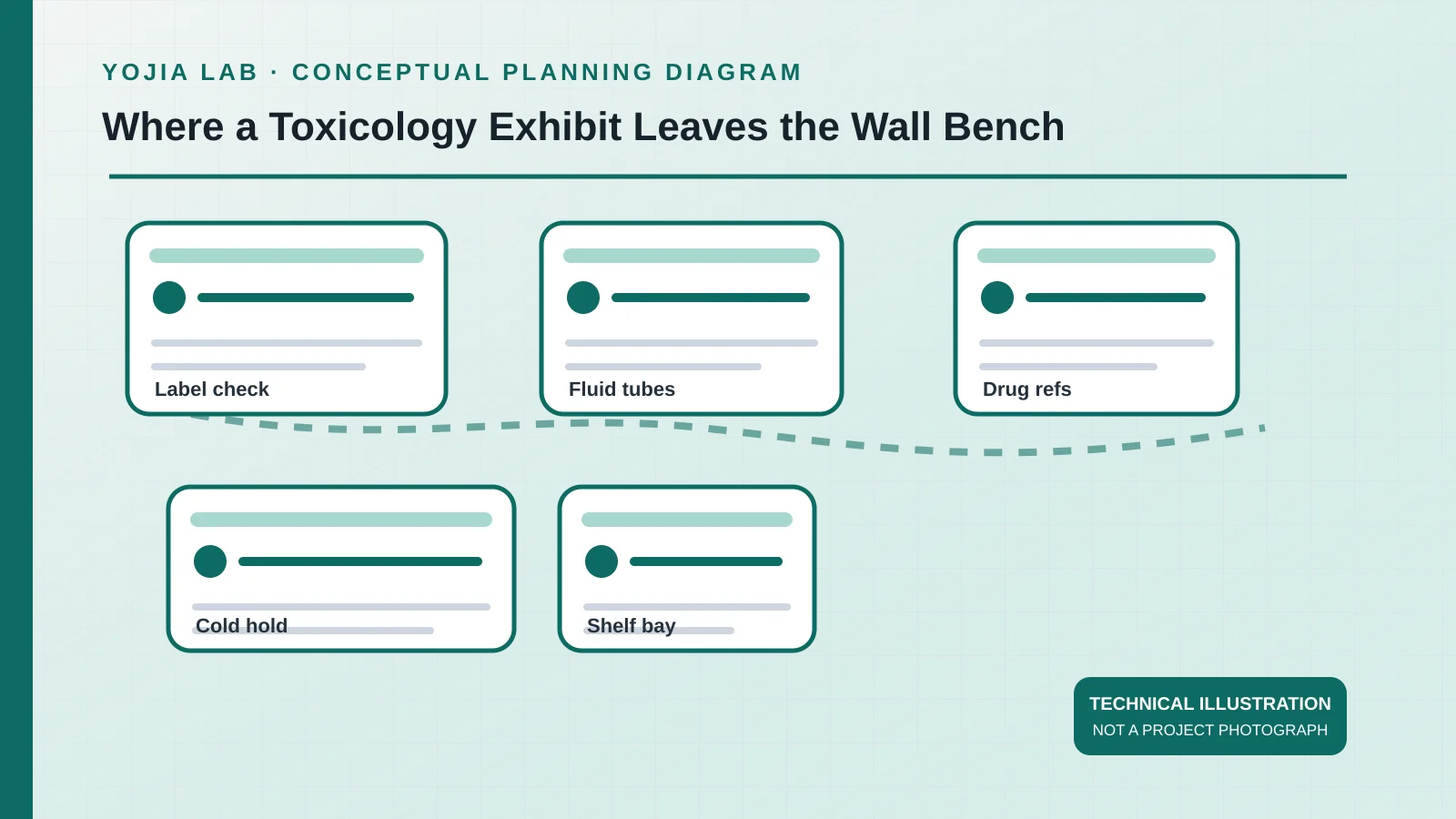
The code lists a bench and a cold appliance as different tools
Clause 23.1.2 of code version 2 says examination facilities shall include, as appropriate, accommodation and appliances. The same sentence lists laboratory benches, safety cabinets, refrigerators, and freezers, plus space to work safely and without contamination. Storage must have security and conditions that prevent loss, deterioration, and contamination, and that keep identity before, during, and after tests. Exhibit storage is limited to authorised people. Loading areas are isolated from casework; an unauthorised visitor is escorted and the entry is recorded. The text does not treat the bench as the refrigerator.
Clause 29.4.2 requires storage that prevents or minimises deterioration, including temporary storage, and it prints no Celsius value. Clause 29.2.8 requires a custody record of who held the item, when, and where, with a shelf or bay as the example when the item is stored. Clause 29.2.6 says identification inside the unit must be more than initials, a number, and a date. A wall laboratory bench can be where that identity is checked. The shelf or bay is the address written after the item leaves.
02
Booking-in is a rejection gate, not a worktop length
Clause 29.3.2 expects a written acceptance policy and a risk-based rejection route. Grounds include a label that disagrees with the papers or the item, illegible or repeated identifiers, a seal that could prejudice integrity, and earlier handling or tampering. A refusal is recorded and returned so the submitter can avoid the repeat. Clause 29.3.6 adds hazardous items, items that could compromise other work, and items that may not lawfully be kept, with human tissue as an example. A wall laboratory bench for this gate needs room to compare papers, inspect a seal, and hold a refusal off the accepted path. It does not need to store the case.
Section 47, FSA DTN 100, is analysis of human biological material for drugs, metabolites, alcohol, or noxious substances, including poisons, whether or not the person was alive at sampling. The code says compliance is shown by accreditation to ISO/IEC 17025:2017 or ISO 15189:2022, with the code and the sub-activities on the schedule. This note has not opened those standards and does not borrow their clauses. Sub-activity 47.3.1 includes measuring preservative in a sample. Type-approved breath-alcohol instruments and some roadside screens are outside DTN 100. A bench planned for DTN 100 is not automatically their bench.
03
Fluid and reference drug are named as an incompatible pair
Clause 23.3.7 requires effective separation of incompatible activities. How far the physical split goes decides whether objective evidence is required. A time split should be shown to work. The incompatible list includes, in one line, toxicology biological fluids and reference drugs, alcohol, or noxious substances. A wall laboratory bench that parks opened fluid and reference material on one top has not recorded a separation. A note that standards are put away at day’s end does not demonstrate the control.
UKIAFT’s 2018 guidelines, for post-mortem, human-performance, and criminal toxicology in the United Kingdom and Ireland, recommend a separate accessioning area where possible. Specimens are received there, numbered, and aliquots are taken or placed in a refrigerator or freezer. Transfers, including aliquots, enter the permanent record. Unauthorised people should be escorted and should sign a log with time, date, and purpose, and the layout should make undetected entry impracticable. Those are association recommendations, not statutory clauses. They fit a short wall laboratory bench for receipt and a cold appliance that is not the bench.
04
Temperature and preservative stay with the document that printed them
ANSI/ASB Best Practice Recommendation 156 (2023) is a consensus recommendation, not a statute. It excludes breath alcohol and says a jurisdiction may dictate the specimen. Human-performance whole blood is two 10 ml tubes, 1 to 2 percent sodium fluoride and 0.2 percent potassium oxalate, inverted at once, stored at or below 8 °C. Urine in that table is 20 ml, with no preservative or 1 to 2 percent sodium fluoride, at the same temperature. Post-mortem peripheral blood is 20 ml on the same preservative and temperature. Hair is 100 mg at room temperature, root end marked. Gel-separator tubes should not be used. Limit headspace, check the seal, and protect glass that will be frozen. Tell the customer why a specimen was refused.
UKIAFT in 2018 suggests 10 ml of femoral blood, site named, and for human performance at least 5 ml of blood and 20 ml of urine, while accepting less with a shorter menu. Ethanol blood and urine should contain sodium fluoride, and unstable drugs should where possible see at least 1.5 percent. Gel can absorb drugs and should be avoided or noted. Averaging 1.5 percent with the ASB band of 1 to 2 percent, or 10 ml with 20 ml, invents a figure neither document printed. On an England and Wales matter, clause 29.4.2 still governs deterioration, and 8 °C is an ASB recommendation until the unit adopts it. The wall laboratory bench is not that cold address.
Before pricing, place the usable wall length, modules, and service points for the wall laboratory bench run with the room notes above. Final materials and supplied scope remain the approved quotation.