01
Three receipt rules are not one thermometer
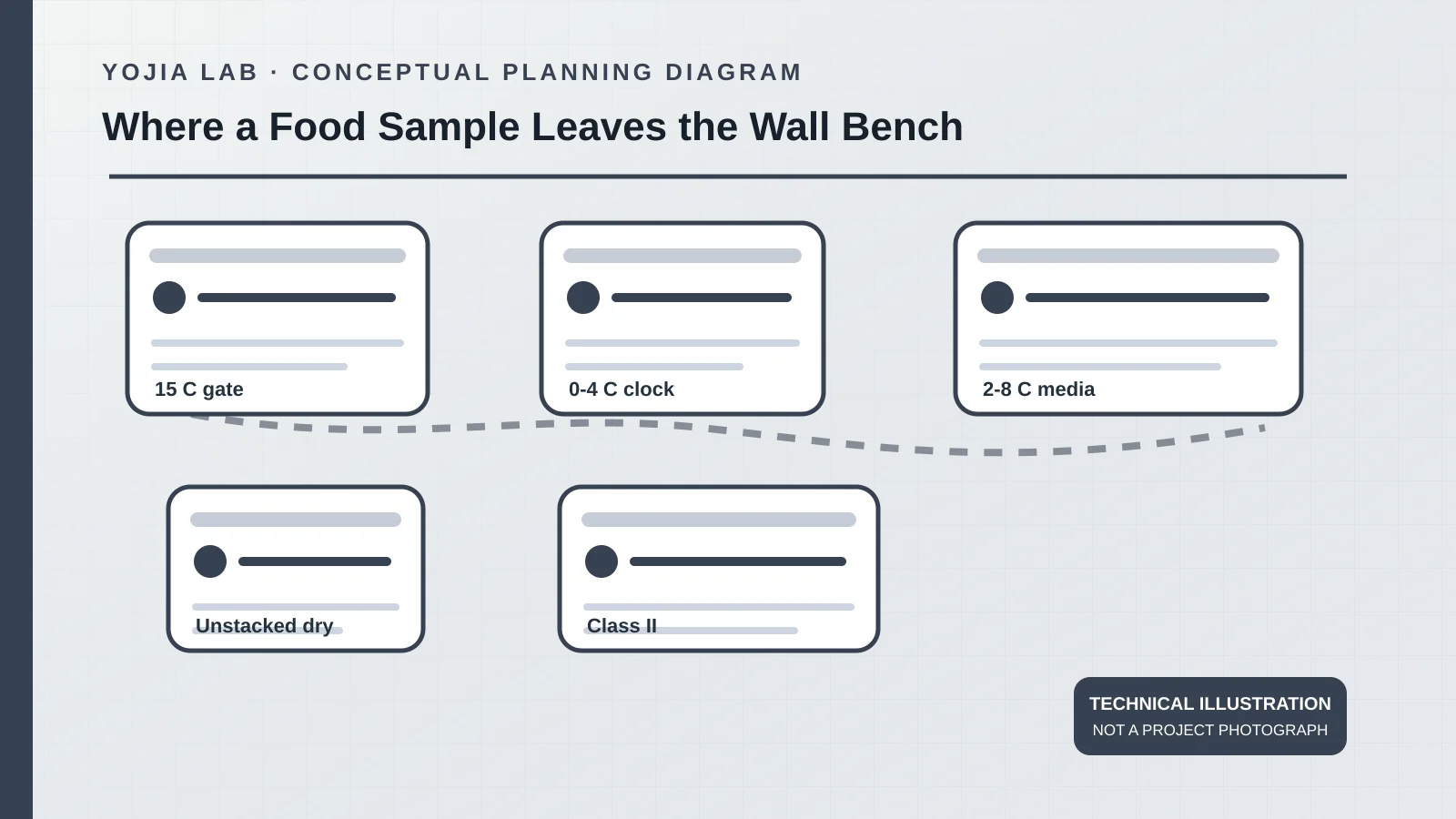
Chapter 1 of the April 2022 manual says to keep the original storage condition. Refrigerated foods other than shellfish travel in ice at 0–4 °C and should not be frozen. Unless a method says otherwise, they should not be analyzed more than 36 hours after collection. Section 5 stores frozen samples at −20 °C, unfrozen perishables at 0–4 °C for not longer than 36 hours, and nonperishable, canned, or low-moisture foods at room temperature. Shell stock stays above freezing but below 10C, as printed, and refrigerated shellfish and shell stock are examined within 6 hours, and never more than 24 hours, after collection.
MLG 1.03 is written for the three FSIS field service laboratories. A raw microbiology sample received warmer than 15 °C cannot be analyzed, because competing bacteria can outgrow the targets. Campylobacter work cannot proceed below 0 °C, because cold may damage the target. Unless a method says otherwise, the chapter’s default tolerance is ± 1.0 °C, ± 2 percent for weight and volume, and ± 0.2 pH units. That default does not rewrite the FDA 0–4 °C band, and the FDA chapter does not accept an FSIS raw sample that arrived above 15 °C. The wall laboratory bench can be where the seal is inspected. Accept or discard is a temperature, not a bench length.
02
The Salmonella chapter names a refrigerator on purpose
MLG 4.15 is the Salmonella PDF linked from the guidebook index read on 11 November 2026. That index cell prints no effective date. The key fact requires ≤ 15 °C on receipt for raw poultry, raw pork, and raw beef. The flow chart in the same PDF requires ≤ 15 °C for raw poultry and raw beef and does not name pork. Merging the two lines would invent one of them. Intact retail packages are disinfected at the cut immediately before opening, for example with 3 percent hydrogen peroxide or about 70 percent ethanol or isopropanol. A dirty package is washed first. A ready-to-eat sausage casing is not disinfected, because some casings let liquid through.
The equipment table lists a 2–8 °C refrigerator for media and sample reserves. That appliance is not a continuation of the wall laboratory bench. MLG 1.03 holds the remainder in a sterile container, in a secure place, under the sampling protocol. Flow-chart temperatures such as 35 °C peptone water or 42 °C modified broth are incubators. Writing “cold” once, then lengthening the bench, has not chosen among 0–4 °C, 2–8 °C, and ≤ 15 °C.
03
Drying a plate is a short counter step
MLG 41.09, Revision 09, effective 14 October 2024, is the FSIS Campylobacter method for poultry rinsate, sponge, and raw product. Receipt is 0–15 °C. Unless the method says otherwise, measurements carry ± 2 percent. Campylobacter is biosafety level 2. Live cultures follow CDC guidelines for that level, and a Class II laminar-flow biosafety cabinet is recommended when infectious aerosols or splashes may form. That recommendation does not forbid every open-bench action. It assigns aerosol and splash work to the cabinet.
Campy-Cefex plates are spread unstacked on the counter to dry quickly, because dry plates inhibit swarming, and incubation should limit light. If the jar cannot control moisture, 4 to 5 drops of glycerol go on filter paper in an open dish. The tank mixture is 85 percent nitrogen, 10 percent carbon dioxide, and 5 percent oxygen. A static incubator at 42 ± 1 °C holds enrichment and plates. The table again lists 2–8 °C for media and reserves, and a freezer at or below −70 °C. Only the unstacked drying fits the wall laboratory bench.
04
Thawing and room temperature are their own addresses
Chapter 1 prefers not to thaw frozen food before analysis. If a portion must be tempered, thaw it in the arrival container at 2–5 °C, normally within 18 hours. Rapid thawing is below 45 °C for not more than 15 minutes, with continuous agitation in a controlled bath. A wall laboratory bench near ordinary room temperature is neither address. The 36-hour clock for a perishable refrigerated sample starts at collection, not when the package reaches the bench.
Room temperature in Chapter 1 is for nonperishable, canned, or low-moisture foods, and for dry or canned foods collected at ambient temperature. It is not permission to park raw poultry on the wall laboratory bench. MLG 41.09 takes Wang’s transport medium from the 2–8 °C refrigerator and lets that one cryovial warm on the shipping day. The warming does not make the bench the store. FSIS says these methods are what its own laboratories use and are not a brand endorsement. The drawing can mark opening, unstacked drying, and the recommended cabinet as three items. The cold address stays the number in the document the laboratory adopted.
Before pricing, place the usable wall length, modules, and service points for the wall laboratory bench run with the room notes above. Final materials and supplied scope remain the approved quotation.