01
The two balance lines are not one specification
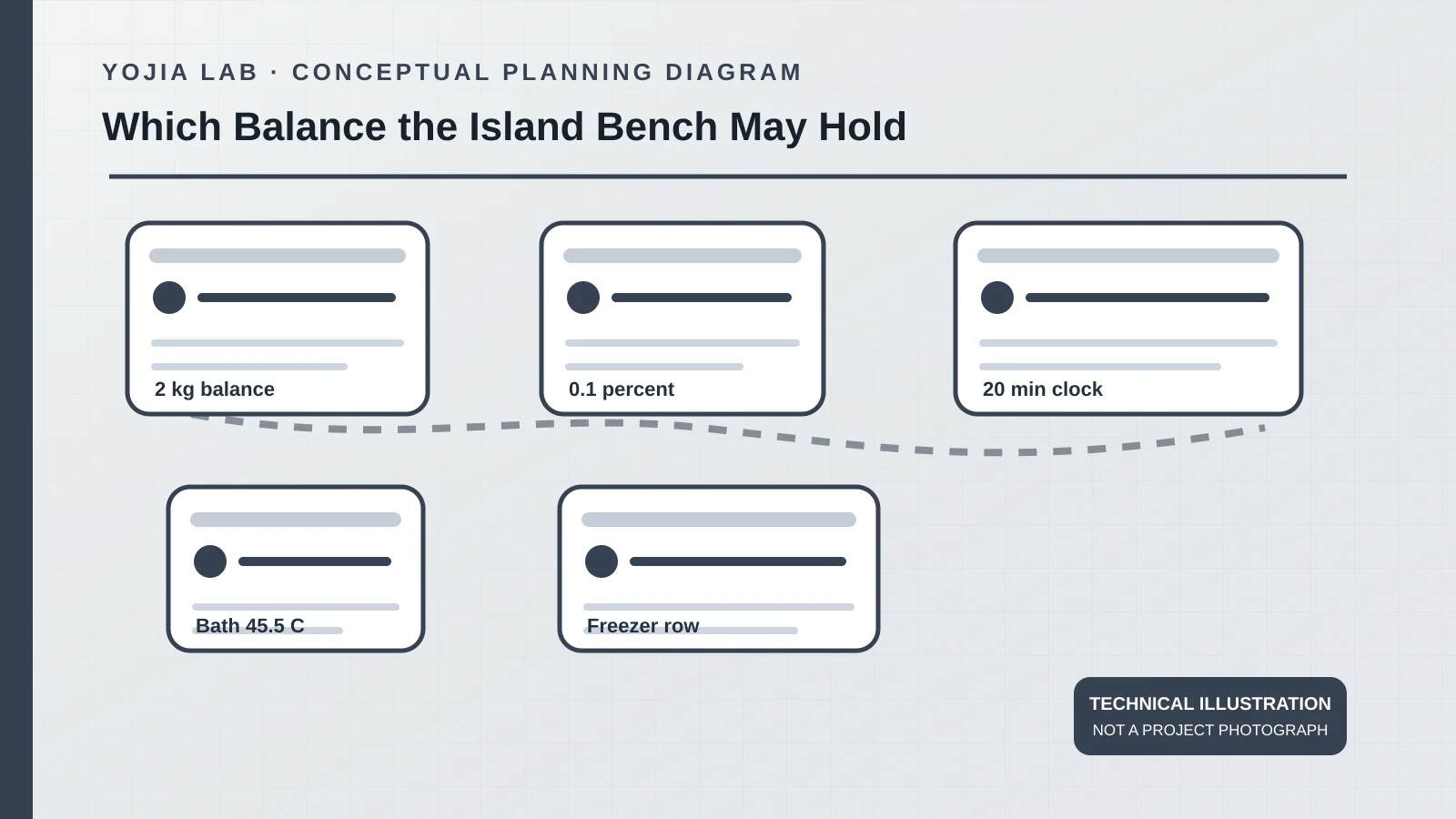
MLG 3.02 opens its equipment list with a balance of capacity at least 2 kg and sensitivity ± 0.1 g, then a blender, a stomacher, incubators, water baths, a freezer at or below −10 °C, and a refrigerator at 2–8 °C. FDA Chapter 1, April 2022, item B.3 is a balance with weights and sensitivity to 0.1 percent. A later step says to tare the jar and weigh to ± 0.1 g. The percent and the gram step are two sentences in that chapter. Neither sentence is the FSIS capacity.
The island bench carries the named balance and the dilution bottles of that same method. MLG 3.02 puts at least 2 kg and ± 0.1 g on the drawing and leaves 0.1 percent in the FDA chapter. Chapter 1 puts 0.1 percent and the ± 0.1 g weighing step on the drawing and does not borrow the 2 kg line. A room that runs both methods keeps two rows. One averaged “0.1” is not a row.
02
Portion and diluent change before the bench does
MLG 3.02 changes the portion with the product. Homogenate is 50 ± 0.1 g plus 450 ml of Butterfield's phosphate diluent or buffered peptone water, stomached or blended for 2 minutes, liquid covering the blades. Bird rinse is 400 ml for chickens and 600 ml for turkeys, rocked 1 minute at about 35 swings through about one foot; turkey bags are noted as 24 by 30–36 inches. Egg product is 100 g into 900 ml. Catfish is 25 ± 2.5 g plus 225 ± 22.5 ml. Under 50 g, weigh about half and add nine times that weight as diluent.
Chapter 1 uses a 50 g analytical unit for the aerobic plate count and the coliform most probable number, and it gives 25 g as the Salmonella example. Nut halves and larger pieces are 50 g plus 50 ml, shaken 50 times through a 30 cm arc, not 450 ml. Its high-speed blender is 10,000–12,000 rpm, or equivalent shear, in a 1,000 ml jar that can be autoclaved for 60 minutes at 121 °C. Those lines size a jar and a motor. The island bench length stays untyped until the room names which of these preparations it runs.
03
Clocks and air plates stay in their own paragraph
MLG 3.02 caps the interval from stomaching or blending until plating at 20 minutes, including the bird, egg, and catfish lines. Shaking is about 25 times through about one foot, or a vortex, and a pipette must not deliver less than 10 percent of its capacity. Chapter 1 caps its blend at 15 minutes. Chapter 3, January 2026, adds 12–15 ml of agar at 45 ± 1 °C within 15 minutes of the original dilution. Those ceilings are not interchangeable.
Air checks differ too. MLG puts 1 ml of Butterfield's diluent on a film or pour plate, open 15 minutes, incubated with the samples, ceiling 15 CFU per plate for a 15 ± 2 minute exposure. Closed systems such as TEMPO are excused. Chapter 3 says fallout plates during plating should not exceed 15 colonies in 15 minutes, on a level, clean, ample bench in a room free of dust and drafts. The island bench can be that surface. The colony ceiling is a plate result, not a length of the top.
04
Incubators and cold holds are not drawers
MLG lists incubators at 35 ± 1.0 °C and 20 ± 1.0 °C, baths at 45.5 ± 0.5 °C and 37 ± 1.0 °C, a refrigerator at 2–8 °C, and reserves at or below −10 °C unless another protocol applies. A needed thaw is about 18 hours at 2–8 °C or 1–2 hours in cold water. Chapter 3 uses a 45 ± 1 °C bath, 35 ± 1 °C incubation (milk 32 ± 1 °C), 0–5 °C refrigeration (milk 0–4.4 °C), and a freezer from −15 to −20 °C. Chapter 1 stores frozen samples at −20 °C and unfrozen perishables at 0–4 °C for not longer than 36 hours.
Nearness of the agar does not turn the island bench into the bath, and a reserve does not turn it into the freezer. MLG recommends a Class II laminar-flow biosafety cabinet where a step may create infectious aerosols or splashes. That recommendation is not a cabinet count and not a chemical enclosure. Put the named balance, portion, and clock on the island bench. Give every appliance the setpoint of the document that asked for it. If the document is still unnamed, the balance line and the bench length stay blank.
Before pricing, place the room dimensions, user sides, and service interfaces for the island laboratory bench layout with the workflow notes above. The final configuration remains the approved quotation and drawings.