01
Three documents bind three different readers
NASA-HDBK-8739.21 gives guidance for implementing ANSI/ESD S20.20. Its foreword limits “supplier” to civil servants and contractors who build ESD-sensitive hardware for NASA projects, and it does not prescribe one procedure for every case. The recommended work-surface default is greater than 10^5 and less than 10^9 ohms of surface resistance. The same book’s definition of static dissipative is wider: surface resistivity at least 10^5 and below 10^12 ohms per square. A drawing that prints only “dissipative” has not chosen a band.
MSFC-RQMT-2918 Revision E is for internal use at Marshall, says it also applies at Michoud, and shall not be invoked on contracts. Contracts are pointed to ANSI/ESD S20.20 or another approved procedure. Where Revision E is mandatory, paragraph 6.2.2 requires worksurface resistance or resistivity from 1 × 10^5 to 1 × 10^9 ohms, or ohms per square. Pasting that range onto a commercial inquiry that is not under Revision E copies a limit the document itself withholds from contracts.
02
The measurement is part of the limit
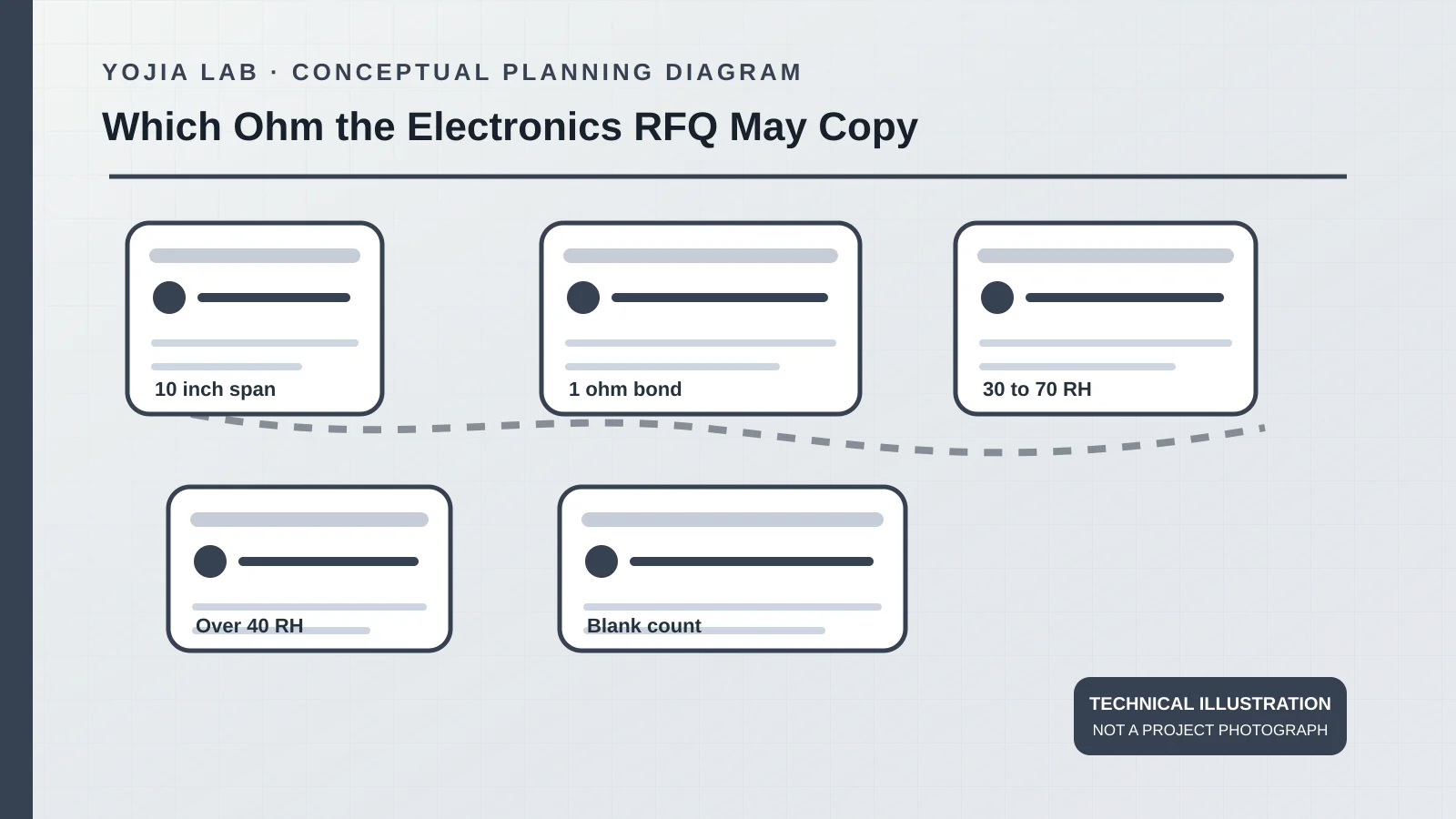
When the NASA handbook is the method, Appendix A places two 5-pound, 2.5-inch electrodes 10 inches (25 cm) apart and at least 2 inches (5 cm) from the edge, reads a 100-volt megohmmeter after 15 seconds, and uses a clean, dry surface, the worn area if the top is old. Dissipative grounding is measured from the center to equipment ground the same way. The common point is continuous to no more than 1 ohm point to point. The run to equipment ground should be under 1 ohm, and the impedance to the neutral bond at the main service under 2 ohms. Daisy-chaining is not permitted.
A surface below 10^5 ohms is a different case; optical benches are the handbook’s example. A hard ground uses a series resistor above 800 kilohms or a ground-fault interrupter, described as opening at an unsafe current, usually about 5 milliamperes, and checked by a lamp that goes out when TEST is pressed. Soft grounding of a dissipative surface shall be under 10^9 ohms. Marshall’s table is not this procedure. If the buyer has not adopted the appendix, the electrode, the span, the voltage, and the wait stay off the inquiry. A worksurface quantity does not replace them.
03
Humidity is three sentences, not an average
Section 7.11.4 sets 30 to 70 percent relative humidity near the sensitive item, and 40 to 70 percent for Class 0. Below 30 percent it calls for a humidifier or an ionizer, or a stop until the target returns, and it notes that surface resistivity changes exponentially with humidity. Revision E instead says keep humidity over 40 percent, record it just before work, and add precautions below 40 percent. The Association’s humidity FAQ says humidity control is not an ANSI/ESD S20.20 requirement. The qualification condition it describes is 12 percent ± 3 percent relative humidity at 23 °C ± 3 °C. A company plan that names a band must monitor it. A silent plan leaves monitoring optional.
Thirty, forty, and twelve percent are not averaged. A NASA supplier who adopted the handbook copies 30 to 70 percent, or 40 to 70 percent for Class 0, including the stop below 30 percent. A Marshall organization under Revision E copies “over 40 percent” and the pre-work record. A plan that never mentions humidity does not inherit either NASA sentence; the FAQ’s point is that S20.20, as the Association explains it, imposes no humidity control. The inquiry prints one position and names the document. “Control humidity” has not chosen.
04
What the inquiry can price
Named rows can be priced without treating the surface as a finished program. The handbook can include the 10-inch, 100-volt, 15-second check, a common point at no more than 1 ohm, and a humidity instrument when 30 to 70 percent applies. Revision E uses 1 × 10^5 to 1 × 10^9 ohms, humidity over 40 percent, and bans pink polyethylene bags, film, bubble wrap, and foam near sensitive items. That ban is a Marshall shall, not a finding about every other polymer, and it does not move onto a contract sent back to ANSI/ESD S20.20.
The quantity is the last number. It waits for the limit, the measurement, the humidity position, and a choice between the narrow work-surface band and the wider dissipative definition. Seating, flooring, garments, and wrist straps sit in other tables and are not included by a count. If none of the three documents is adopted, every ohm, every percent, and the quantity stay blank. The inquiry then asks for the buyer’s plan rather than a midpoint between those limits.
Before pricing, check the distributor and contractor project support against the room and workflow conditions already recorded above.